A field guide that starts with the water
An independent field guide to the goldfish — breeds, symptoms, care guides and seven tools that show their working — built so the reader knows what to do first, and why.
Introduction
gold.fish is an independent field guide to one species, Carassius auratus. Its line is “Better lives for goldfish.”, and its footer describes it as care, breeds, health and tools, “written from the biology up”. It is in English, and every page is credited “Made by Gabriele Masetti”.
The About page counts what the site holds: 21 breeds, each with its own profile; 27 symptoms, starting from what you can see; 96 guides to care, the tank and food; seven tools; nine buying guides, clearly labelled; and 1,078 questions answered. On 18 November 2026 its sitemap index listed 174 pages.
This case study is about how those pages are designed to do one job. A reader who arrives with a fish in a bowl, or a fish that looks unwell, should leave knowing what to do first, and why.
The challenge
The About page states the problem plainly. Goldfish are among the most kept fish in the world and among the most misunderstood. They are sold as starter pets and treated as disposable, when, in the site’s words, they are large, long-lived animals that can share a home for fifteen or twenty years “if a few things are done right”. Most of those things are not expensive or difficult. They are just rarely explained well.
Three things make that hard to design for.
- The reader is often in a hurry. The About page names who arrives: people whose child won a fish at a fair, whose friend left one behind, whose shop gave bad advice, or whose fish looks unwell “and the internet is shouting”.
- The advice disagrees with itself. Tank sizes, feeding amounts and lifespans differ between experienced keepers and published sources. A single confident number is easy to print and often wrong.
- Health content can do harm. A dosage given for the wrong volume, or a diagnosis given from a photograph, hurts fish.
The brief, reduced to one line: give the reader the order of things, the reasons behind them and the ranges around them, and never false certainty.
The concept
The site’s answer begins with a sentence on its front page.
A goldfish is a carp.
The page continues: everything here follows from taking that seriously — “the tank it will outgrow, the water it lives in, the decades it can last.” From there, the About page sets out five positions that shape every section:
- Reasons beat orders. A keeper who understands why ammonia matters will do better than one who has memorised a list.
- Ranges beat rules. Where experienced keepers disagree, the page says so and explains the assumptions.
- Water comes first. Poor water is a frequent cause of illness, so it is tested before anything else.
- Commercial content stays separate. Buying guides are labelled and never mixed into care or health advice.
- Nobody gets shamed. The goal is better outcomes for fish, not winning arguments with their owners.
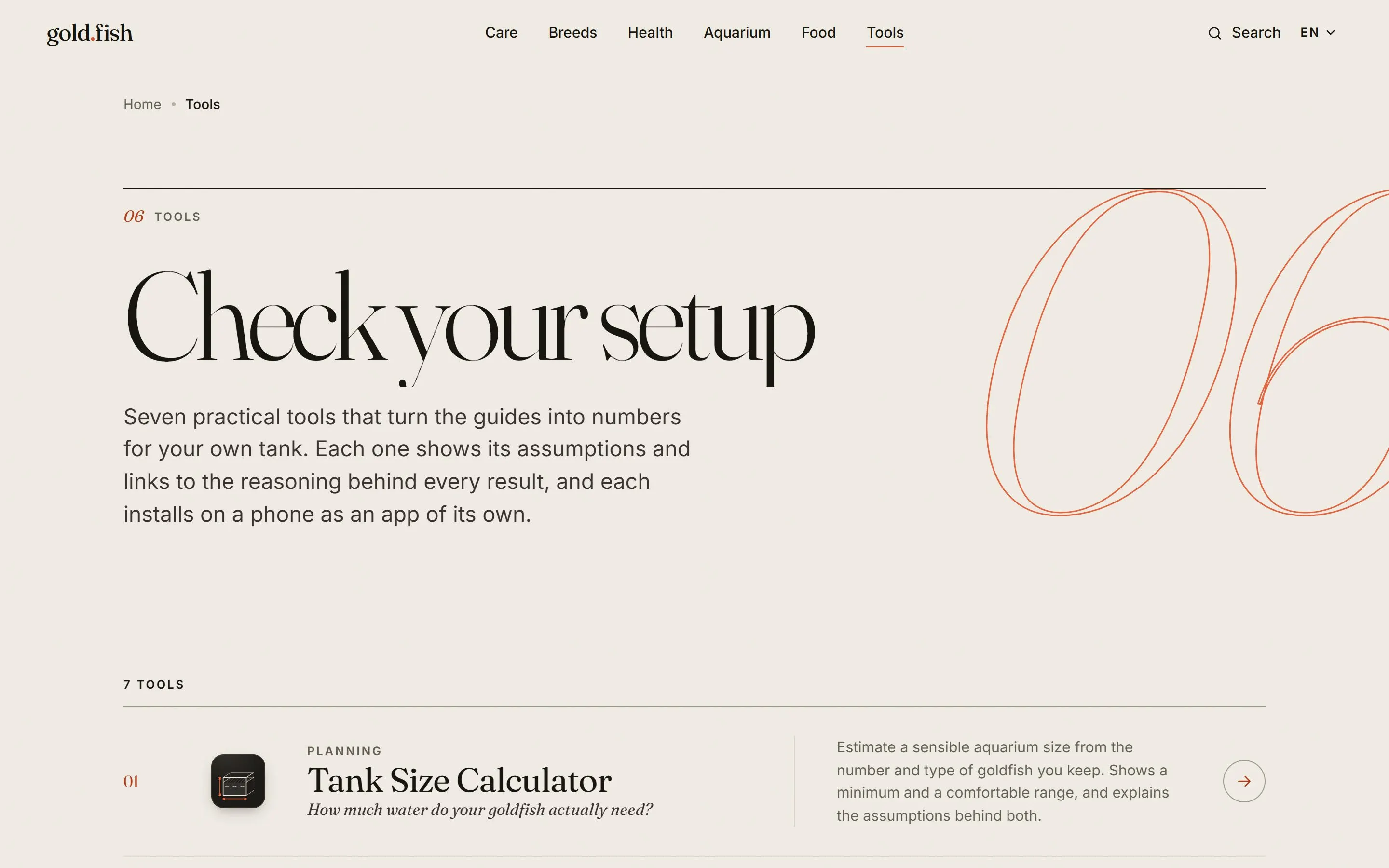
The architecture follows the same order. The front page presents six numbered sections as “everything a goldfish needs, in the order it needs it”: 01 Care, 02 Breeds, 03 Health, 04 Aquarium, 05 Food, 06 Tools. Each carries its count — 51 guides, 21 breeds, 27 symptoms, 29 guides, 16 guides, 7 tools — and each section’s opening page carries its number again — on Health and Tools as a large outlined numeral.
The design
Black water, cream paper, one orange. The palette is small: a near-black “night” for water, a warm cream “paper” for reading, and a single orange accent the stylesheet calls koi, with a darker variant for text. Pages that show fish — the front page, every breed profile — open on night. Pages that are read open on paper.
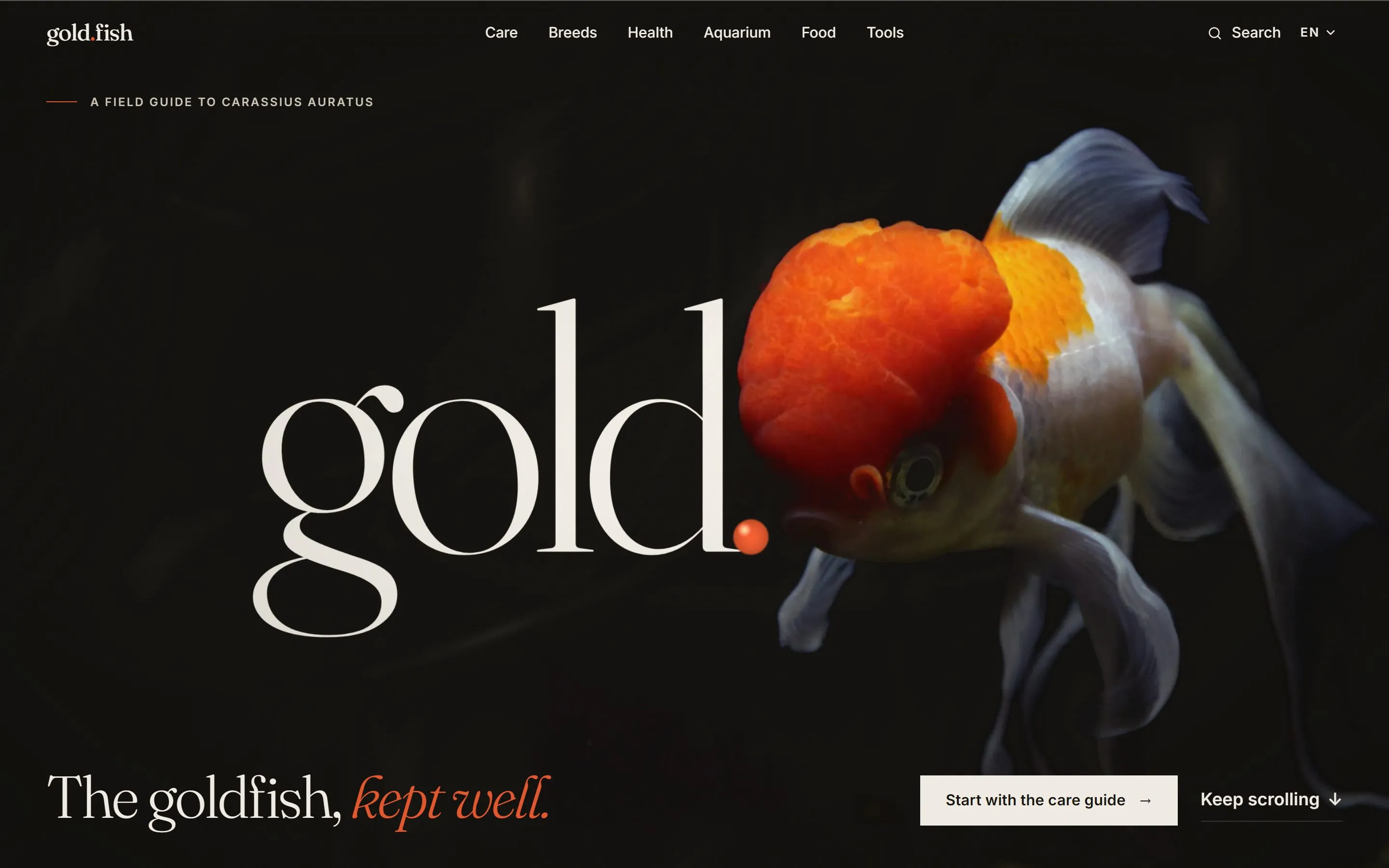
A pellet for a full stop. The front page sets the word gold at display size, and its full stop is an orange pellet, drifting next to a red-cap oranda photographed swimming out of black water. The water is live: a small line reads “Move through the water” (“Touch the water” on a phone), and the surface ripples where the pointer passes.
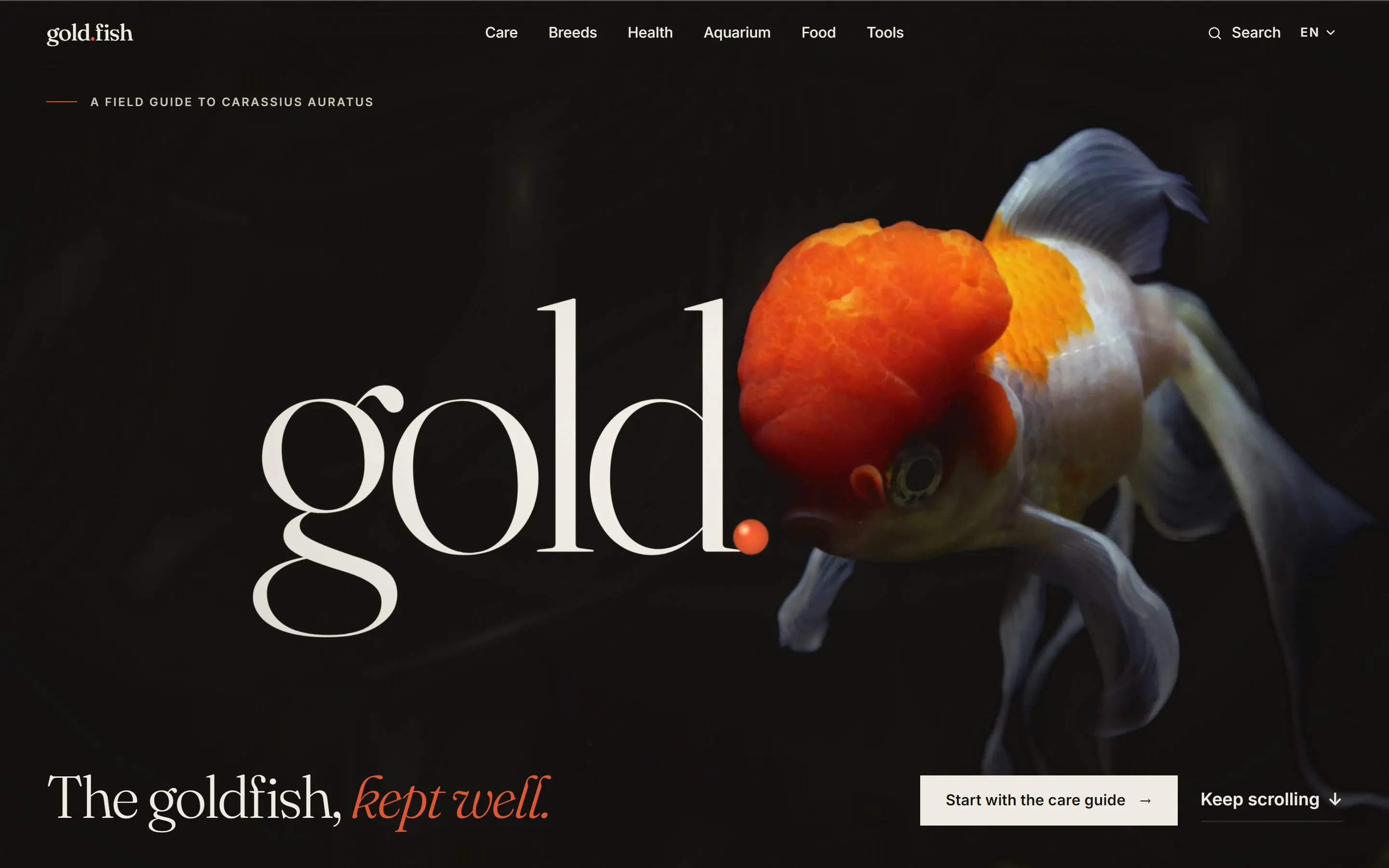
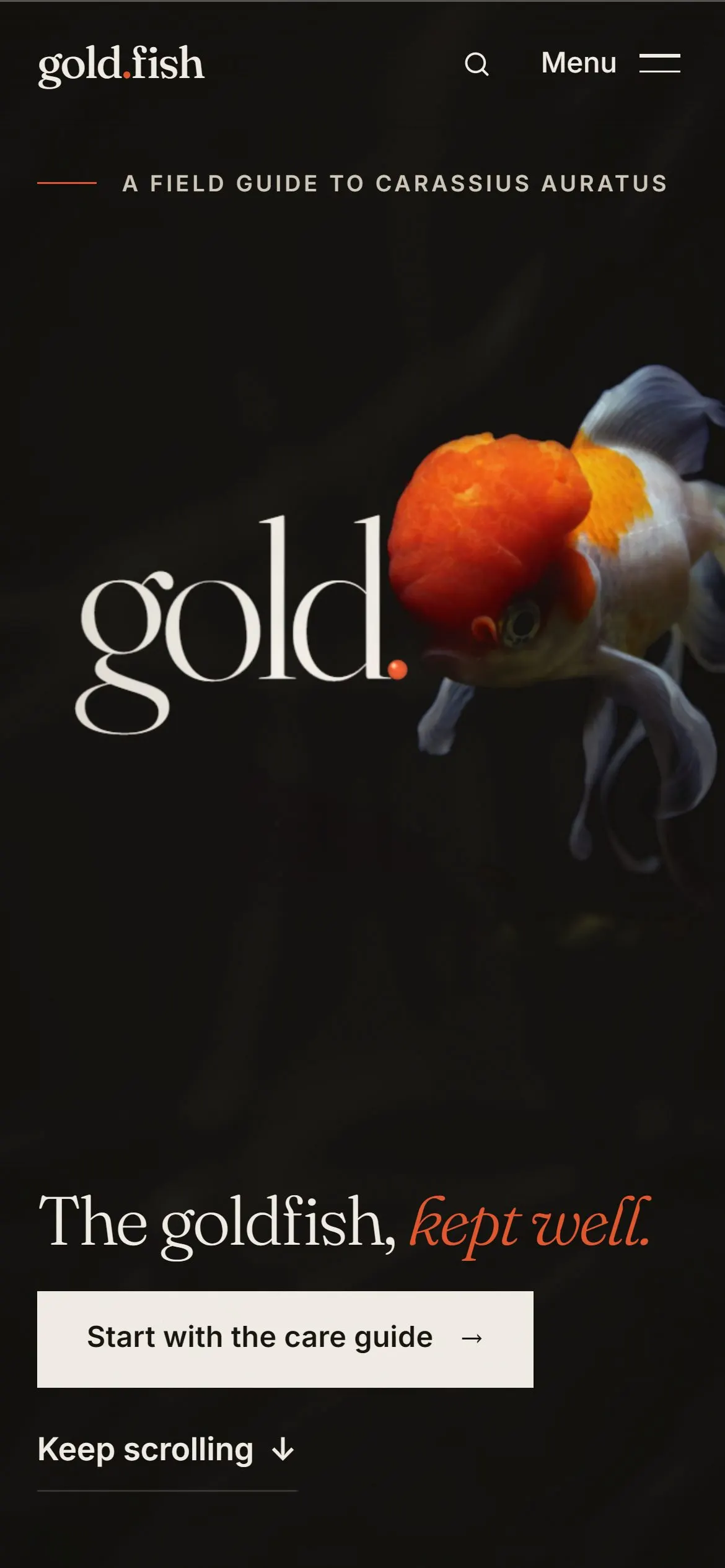
Two typefaces, strict roles. Fraunces, a variable serif with a true italic, carries headlines, numbers and figures; Inter runs the interface and the long reading. The italic is used for one kind of emphasis — the turn of a headline, in orange: “The goldfish, kept well.”, “A thousand years, twenty-one fish.”, “Everything a goldfish needs, in the order it needs it.” Numbering is set in the same italic, so a reader learns to recognise a sequence before reading it.
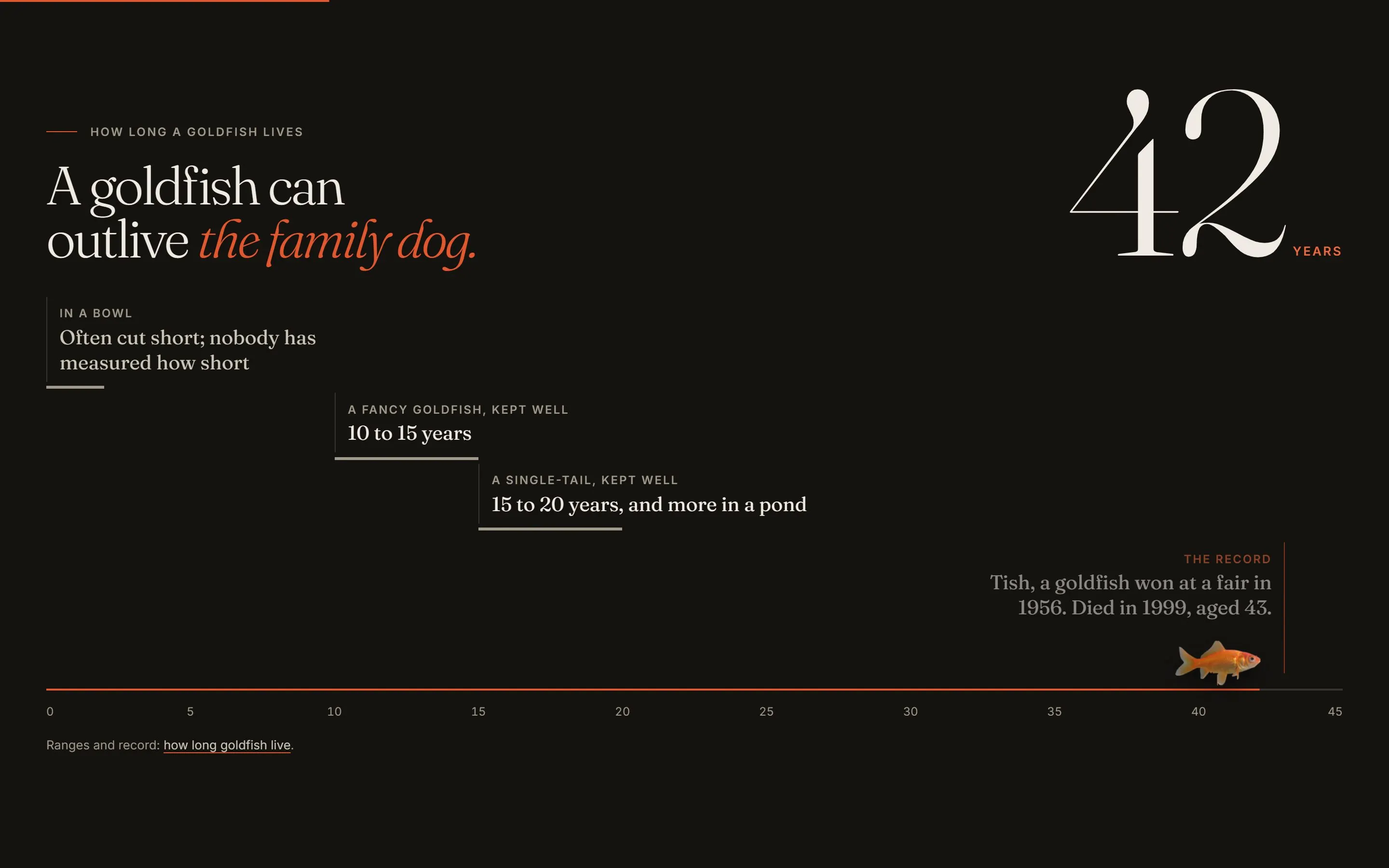
A scale instead of a statistic. The second scene of the front page is the site’s argument in one image. A goldfish swims along a scale from 0 to 45 years as the reader scrolls, a counter climbs, and the ranges appear in turn: in a bowl, “often cut short; nobody has measured how short”; a fancy goldfish kept well, 10 to 15 years; a single-tail kept well, 15 to 20 years, and more in a pond. At the end of the scale is the record: Tish, won at a fair in 1956, who died in 1999, aged 43.
Real fish, cut out. The site uses no illustrated goldfish. The About page says every fish in a diagram is cut from a breed photograph, not drawn, and the image credits page lists each source photograph — almost all from Wikimedia Commons, the pompom from Unsplash — with its author and licence. The front page’s procession of the 21 breeds, in the order they first appear in the record, is made of those cut-outs. The one exception is honest about itself: the meteor, a tailless fancy described in 1917, survives only as a drawing, and the site shows the drawing.
The experience
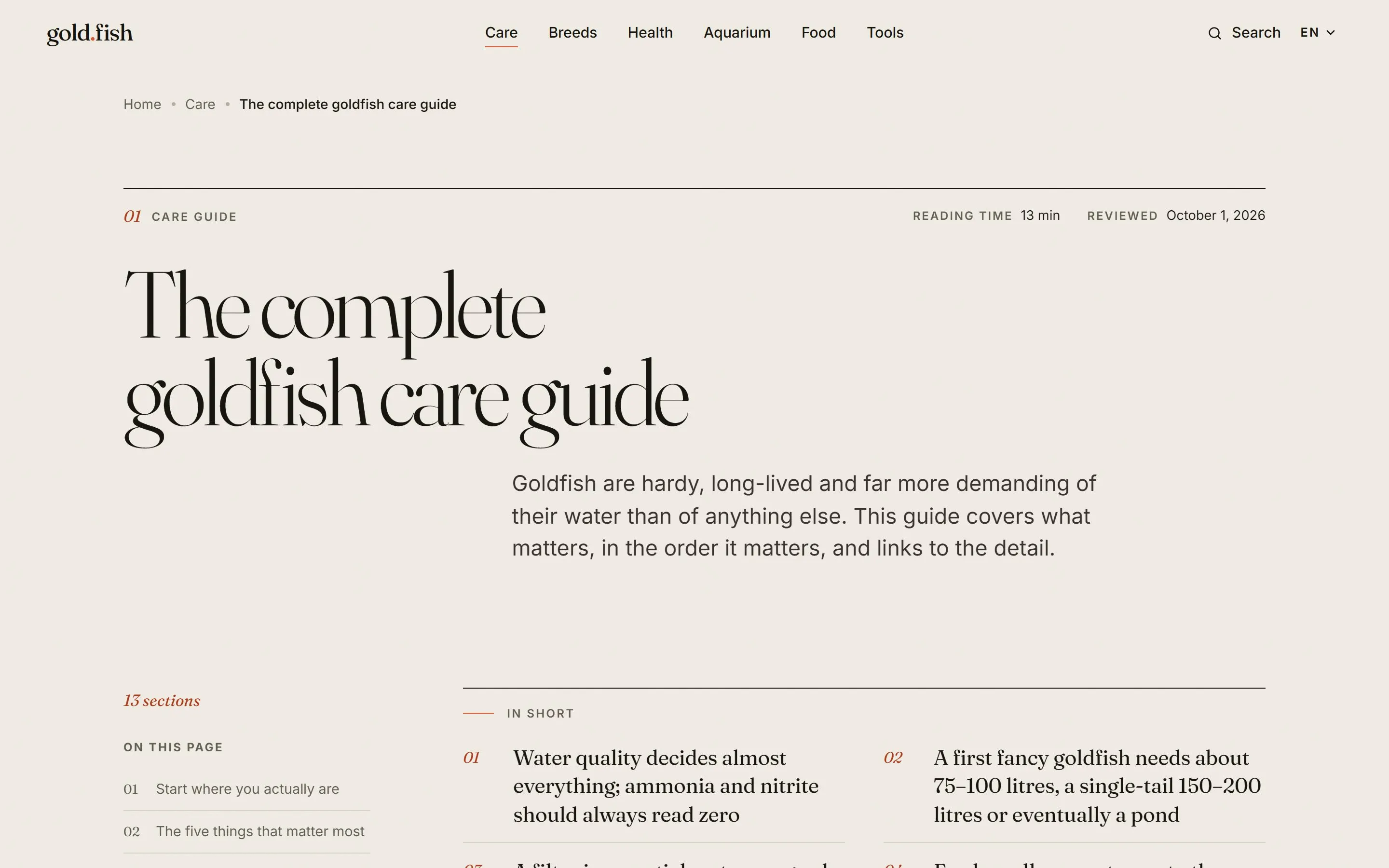
A guide reads in one direction. Every guide opens with its section number, its reading time and the date it was last reviewed, then a block called In short: the page’s conclusions, numbered, before the argument for them. A sticky table of contents follows the reader down. Inside, the same devices recur on every page — Myth / Reality pairs, Why this matters asides, tables that route a situation to a page (“Your situation — Start here”) and frequently asked questions at the end. The complete care guide calls itself “the hub for everything else on the site”.
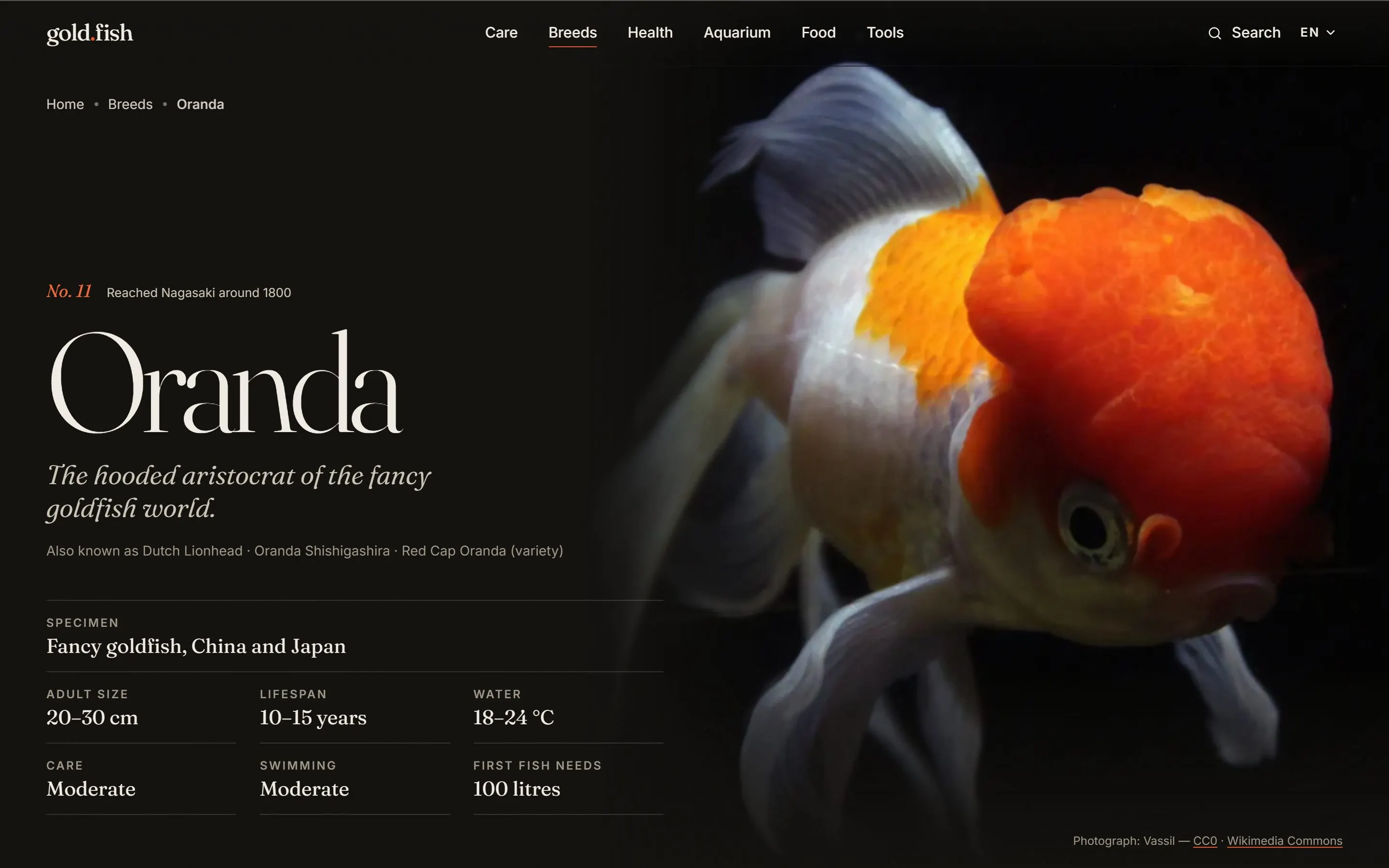
A breed is a specimen. Each of the 21 profiles opens on night, with the breed’s number in the atlas, the earliest date the record allows (“Reached Nagasaki around 1800”) and a specimen card: adult size, lifespan, water, care, swimming, and how much water a first fish needs. Beneath it, a note headed About these figures says what the numbers are: ranges that keepers’ guides give for a fish in good care, not measurements of the breed, while the care and swimming ratings are the site’s own. The meteor’s card reads “Not recorded” in five places, because, as its page says, where the record is silent the page says so rather than filling the gap.
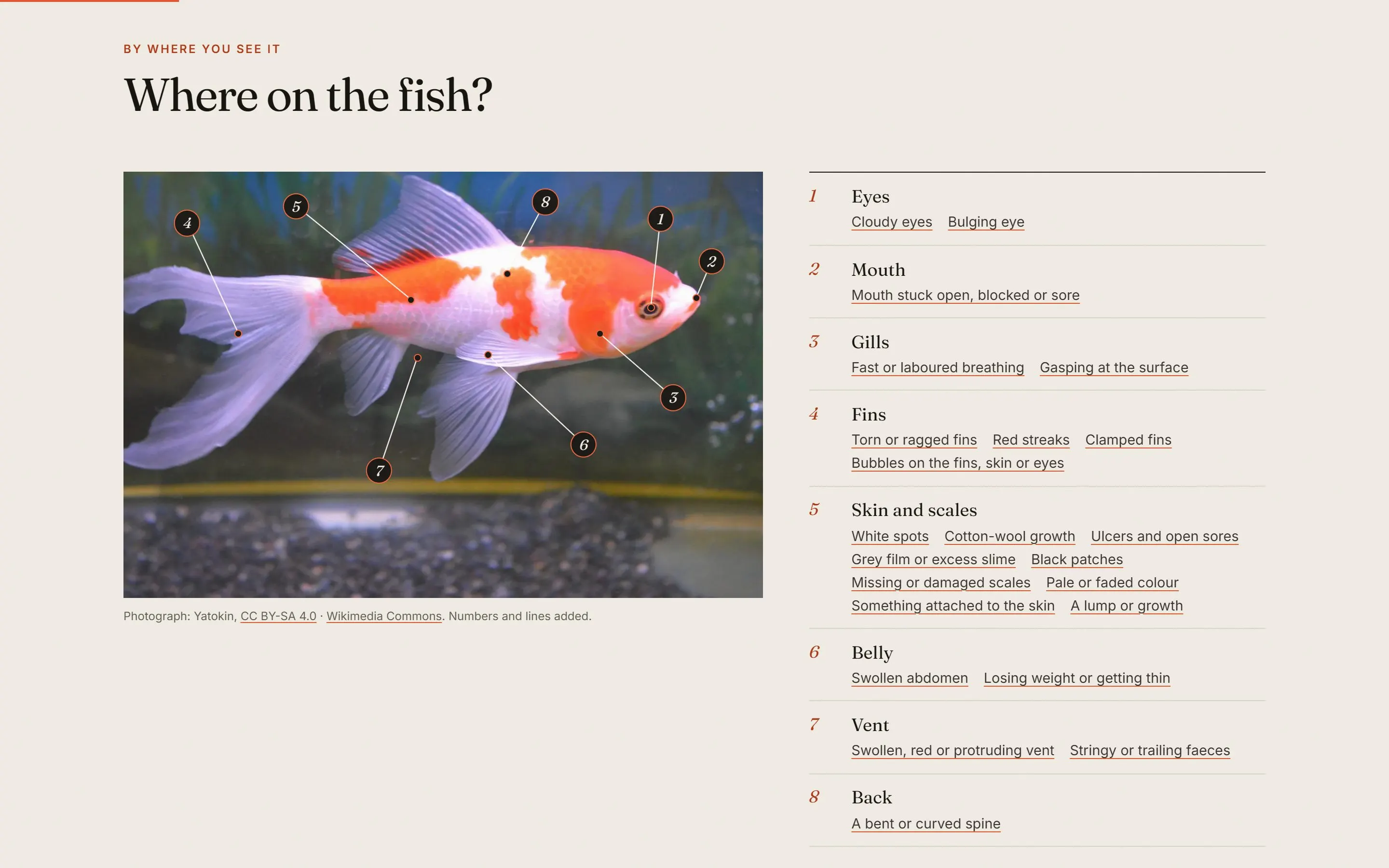
Health starts from what you can see. The health section is organised by symptom, not by disease — “the right way round”, as the care guide puts it, “because you can see the symptom and cannot see the cause.” It opens with one instruction, Test the water, then a photograph of a goldfish with eight numbered regions — eyes, mouth, gills, fins, skin and scales, belly, vent, back — each linked to the symptoms found there. Every symptom page carries a three-step scale of urgency, Watch closely, Act within a day or two, Act today, with the step for that symptom marked.
The editorial policy sets the limits of these pages: they describe what a symptom may indicate, which water checks to make first, when veterinary help is appropriate and what not to do, and they deliberately give no medication dosages, specific salt concentrations or confident diagnoses. The white spots page says it in place: “We do not publish dosages here, because the right amount depends on the product, the volume and the fish.”
The tools
The seven tools are where the guides become numbers: tank size, aquarium volume, water parameters, stocking, feeding, age and tankmate compatibility. The tools index promises that each one shows its assumptions and links to the reasoning behind every result — and that each “installs on a phone as an app of its own”. Each has its own name and icon as an app: Tank Size, Water Check, Stocking, Feeding, Fish Age, Tankmates, Volume.
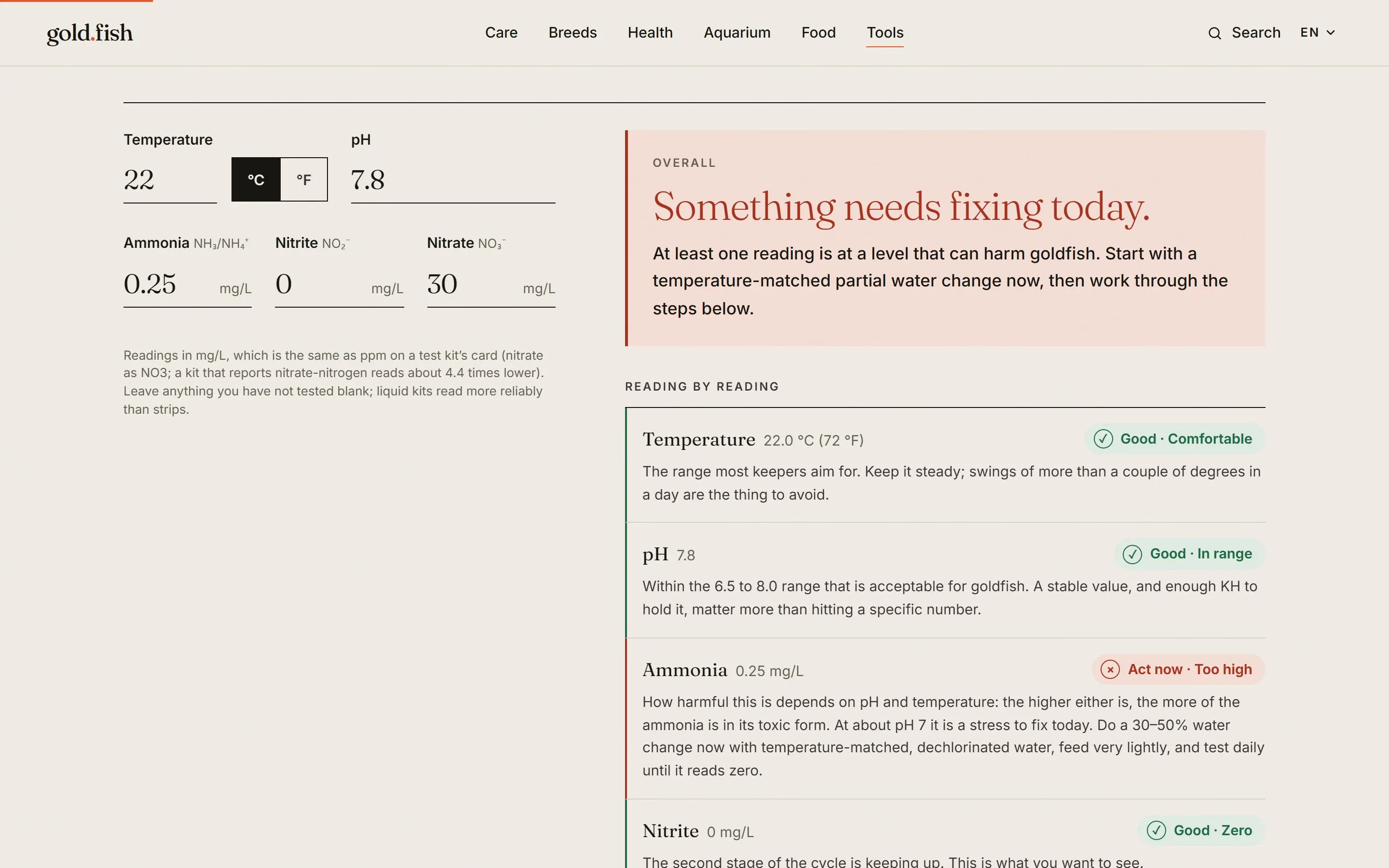
Every tool page has the same anatomy: What it needs and What you get before the form, the result, and then a section headed Behind the numbers — “How the tool reaches its answer, and what the answer does not tell you.” The Water Parameter Checker takes temperature, pH, ammonia, nitrite and nitrate. With sample readings — 22 °C, pH 7.8, ammonia 0.25 mg/L, nitrite 0, nitrate 30 — it returns an overall verdict, “Something needs fixing today.”, and a status for each value, using the same symbols as the health pages: a tick for good, a tilde for acceptable, a cross for act now.
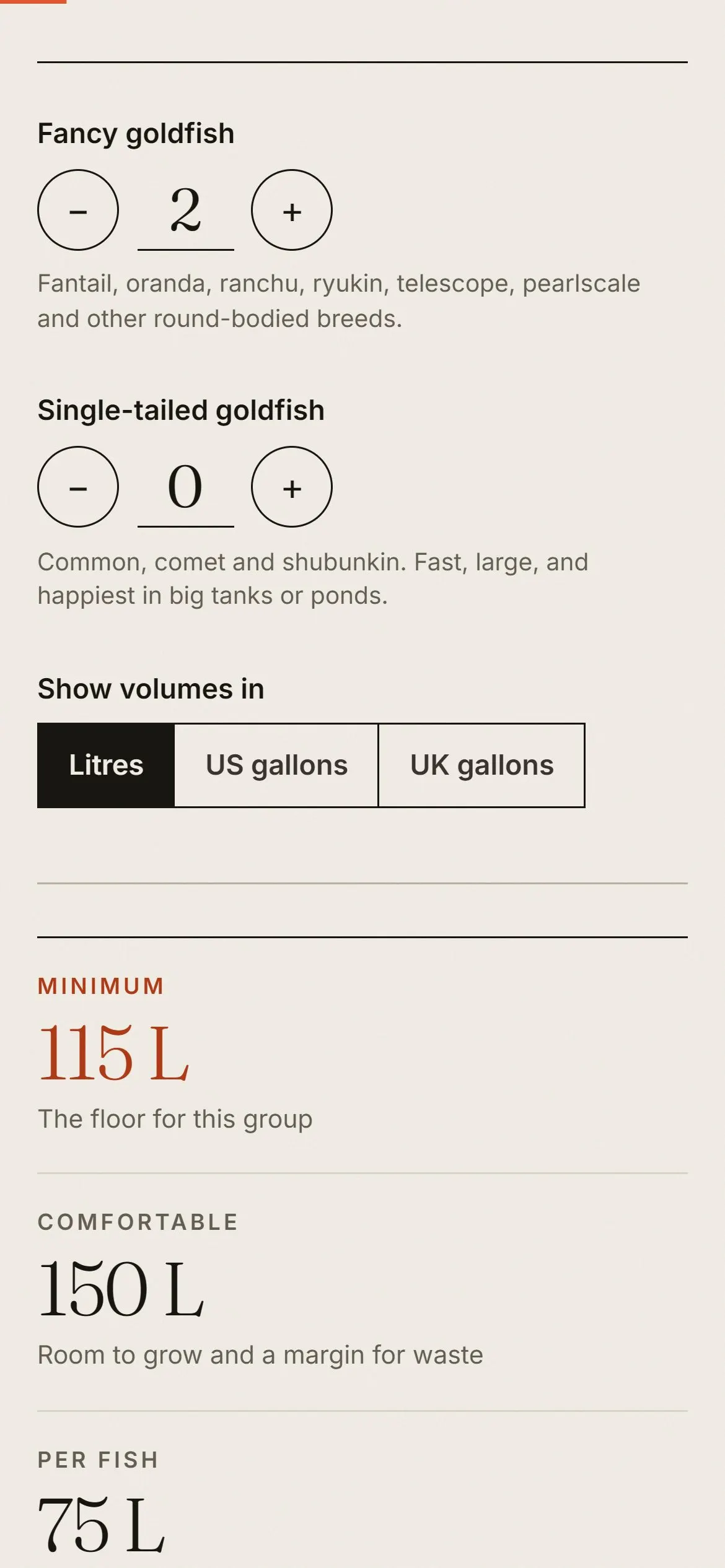
The method under each tool is written as prose a keeper can check. The Tank Size Calculator adds a working range per fish — 75 to 100 litres for the first fancy goldfish and 40 to 50 for each additional one; 150 to 200 for the first single-tail and 75 to 100 for each additional one — and shows the lower figure as the minimum and the higher as comfortable. It then works through examples, including the one the phone shows below: two fancy goldfish, 115 to 150 litres. It also says what the answer cannot do, and what to do if the figure cannot be met.
The privacy page states that the tools run entirely in the browser and that the numbers entered are never transmitted. In the browser, entering readings into the Water Parameter Checker made no network request.
The system
What holds the site together is an order of operations. The care guide publishes it under the heading “If something is wrong, in this order”, and the health section, the Water Parameter Checker and the symptom pages all point back to it.
First
- 01Test the waterWater checkerAmmonia, nitrite, nitrate, temperature. Invisible without a kit, and it accounts for a very large share of what looks like disease.
Then
- 02Change water if anything reads wrongAquarium guidesAnd keep changing it. The guide notes this is safe whatever the cause.
Then
- 03Look at the fish properlyWhere on the fish?In good light, naming what you can actually see.
Then
- 04Go to that symptomSymptom pagesNot to a treatment.
Only then
- 05Consider medicatingUsing medications safelyWhich the site argues should be the last step rather than the first.
Two editorial rules keep the content consistent across 174 pages.
One page owns each figure. The editorial policy says that figures which recur across the site have one page that owns them, and the others defer to it, “because a common way a reference site becomes wrong is not a bad figure but two good ones drifting apart.” Where a figure genuinely differs by context, the page stating the second one explains why.
Every guide is dated twice. Each guide carries a published date and a reviewed date. The earliest published date on the site is 1 September 2026; reviews look for factual errors, outdated positions and inconsistency with the rest of the site, and corrections are made in place.
We would rather fix a page than defend it.
Commercial content is built to be checked too. The nine buying guides label each pick by its basis: researched recommendation, editorial opinion or tested by us — and the buying guides index says that nothing carries the last label yet. The affiliate disclosure states that commercial links appear only in the buying guides, that care guides, breed profiles, health pages and tools contain none, and that, at the time of writing, the retailer links are plain search links that earn nothing. On the live site, every retailer link in the buying guides is an Amazon search link with no affiliate tag. The disclosure adds that if affiliate links are introduced, they will carry a rel="sponsored" attribute and the page will be updated. The site shows no advertising and, according to its privacy page, sets no tracking cookies and loads no analytics or advertising scripts; its fonts are self-hosted.
Underneath, gold.fish is a static site, as its privacy page says, with the content of each page in its HTML. The structured data describes articles, frequently asked questions, breadcrumbs and, for each tool, a web application. Search runs in a dialog against an index loaded by the page, with results labelled by kind — symptom, breed, food, aquarium. An RSS feed carries every guide, profile, symptom page and buying guide, and a missing page answers: “This page has swum off.”
Details
- Units, both ways. Litres and US gallons side by side in the guides; the tools switch between litres, US gallons and UK gallons, and Celsius and Fahrenheit.
- A note on nitrate. The Water Parameter Checker warns that a kit reporting nitrate-nitrogen reads about 4.4 times lower for the same water, and says to multiply before entering.
- Sources named where they disagree. The Feeding Calculator sets out published feeding rates from the University of Florida IFAS and the Merck Veterinary Manual, and the differing times given by the RSPCA and the Bristol Aquarists’ Society, before settling on a rule of thumb.
- Labels with the picture. Breed photographs are explained, not only credited: About this picture says what in the photograph identifies the breed.
- A key for the unsure. The atlas sends a reader who cannot name their fish to an identification key built on two questions: how many tail fins, and is there a dorsal.
Outcomes
- 174pages in the sitemap index, 18 November 2026
- 21breeds, each with its own profile
- 27symptoms, starting from what you can see
- 96guides to care, the tank and food
- 7tools, each installable as an app
- 1,078questions answered, as the About page counts them
Read on the live site on 18 November 2026: the sitemap index, the About page and the section pages.
What this case study does not claim: visitors, rankings, revenue or a veterinary review of the content. The site publishes none of these, and it describes its health pages as educational, not a substitute for a vet.
What gold.fish demonstrates is a way of designing reference content for a reader under pressure: put the order of operations in the architecture, show the working beside every number, keep the commercial pages behind a clear wall — and let one real fish, swimming out of black water, carry the argument that it deserves better than a bowl.
Explore the project
gold.fish
An independent field guide to the goldfish — breeds, symptoms, care guides and seven tools that show their working — built so the reader knows what to do first, and why.
Sources for this case study
- gold.fish — Home
- gold.fish — About
- gold.fish — Editorial policy
- gold.fish — The complete goldfish care guide
- gold.fish — The atlas of the goldfish
- gold.fish — Oranda
- gold.fish — Meteor
- gold.fish — Health: symptoms explained
- gold.fish — White spots on a goldfish
- gold.fish — Tools
- gold.fish — Water Parameter Checker
- gold.fish — Tank Size Calculator
- gold.fish — Buying guides
- gold.fish — Affiliate disclosure
- gold.fish — Privacy
- gold.fish — Image credits
- gold.fish — Sitemap index
Everything described here can be checked on the live project. Figures were read on 21 Nov 2026; screenshots are captures of the public site.