A newsroom that can’t publish what it can’t source
An automated newsroom on artificial intelligence: no story ships until code finds every quote and figure on the pages it cites.
Introduction
AI.info is an independent publication about artificial intelligence: the news, the research, the tools, the companies, the roles and the events of the field, in one place, in English and in Italian. Its news is found, written and checked by AI systems, inside a newsroom designed by FIG’s founder — and built around one rule, stated on its About page: no model grades its own work.
On 17 November 2026 its public sitemap listed more than thirteen thousand pages. Behind them sit a daily paper, a weekly letter, a research desk that reads arXiv every half hour, catalogues of tools and models whose values are read from the makers’ own pages, and a literacy course of 795 lessons in 21 paths.
This case study is about the design of that system: how a newsroom run by machines can earn the trust a reader would give a careful editor — and show its working while it does.
The challenge
AI.info’s own statement of the problem is blunt: artificial intelligence is the most documented field of its time, and one of the hardest to follow. Research lives on preprint servers, announcements on company blogs, roles on hundreds of career sites, events on ticketing platforms — and the news is repeated faster than it is checked.
For an automated newsroom the problem is sharper still. Language models write fluently, and fluency is not accuracy. A system that drafts with AI has to be designed so that a plausible sentence with no source behind it cannot reach a reader — not because someone remembered to check, but because the product cannot work any other way.
The brief, reduced to one line: make verification the structure of the product, not a disclaimer at the bottom of it.
The concept
Three decisions shape everything else.
- Original sources only. Every story is built on the press release, the paper, the filing or the official post — never on an outlet that repeated it. If the original cannot be found, the story is not published.
- Separation of powers. The model that writes is never the model that checks. Two checkers from different families of models read each draft against its pages, each on its own; a third reading can lift a hold only by quoting a line that code then finds on the page.
- Evidence over opinion. In the house rule, an error is called an error only with the line of the page that shows it.
No model grades its own work.
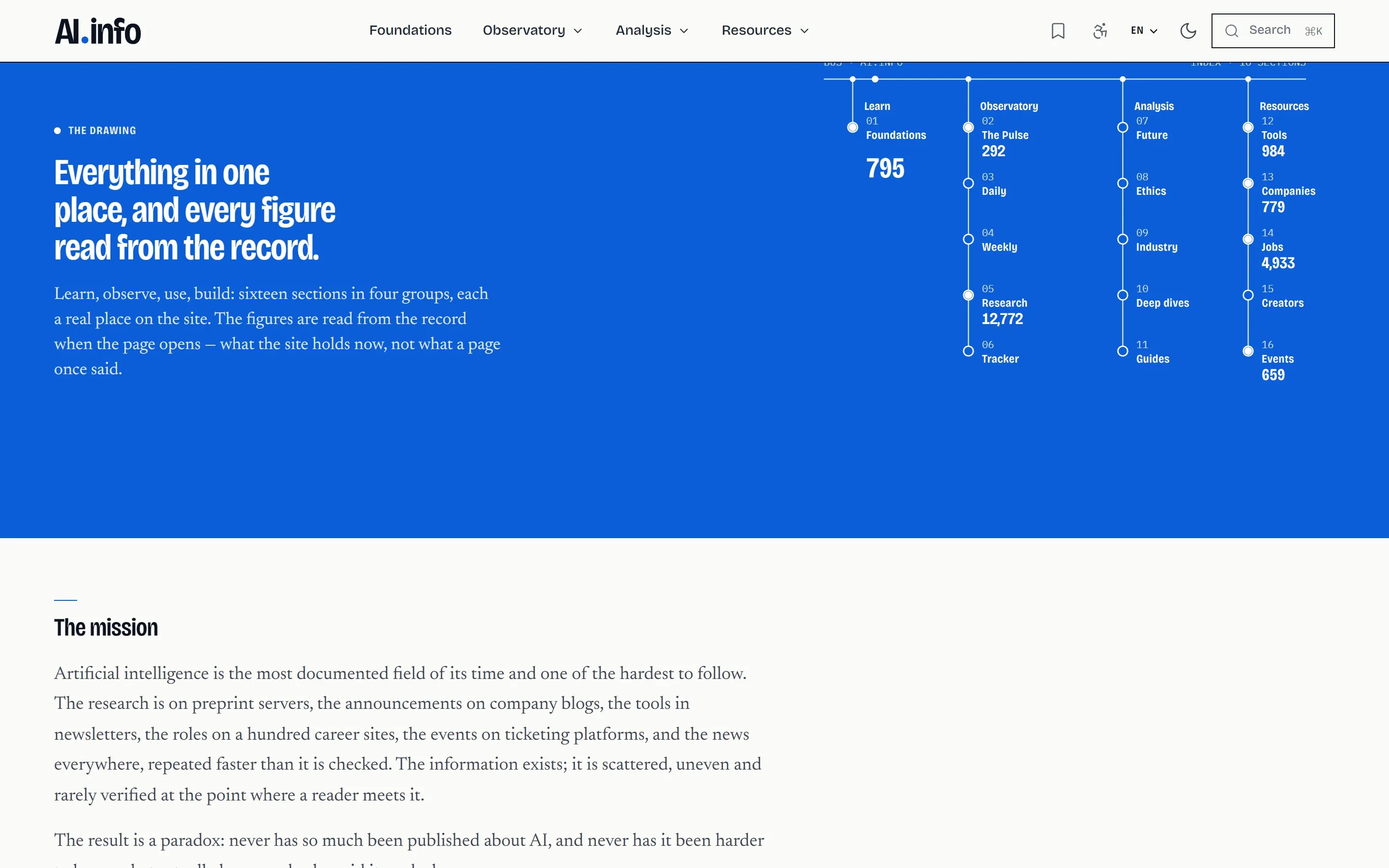
The same idea organises the site. AI.info presents itself not as a feed but as a working record of the field, arranged as sixteen sections in four groups — Learn, Observatory, Analysis, Resources — each a real place, each counted from what the site holds when the page opens.
The design
A typographic voice per job. A condensed display face carries mastheads and headlines; a grotesk runs the interface; a serif is kept for long reading; a monospace sets the record — dates, identifiers, counters. The four voices never swap roles, so a reader learns within a few pages what kind of text they are looking at before reading a word of it.
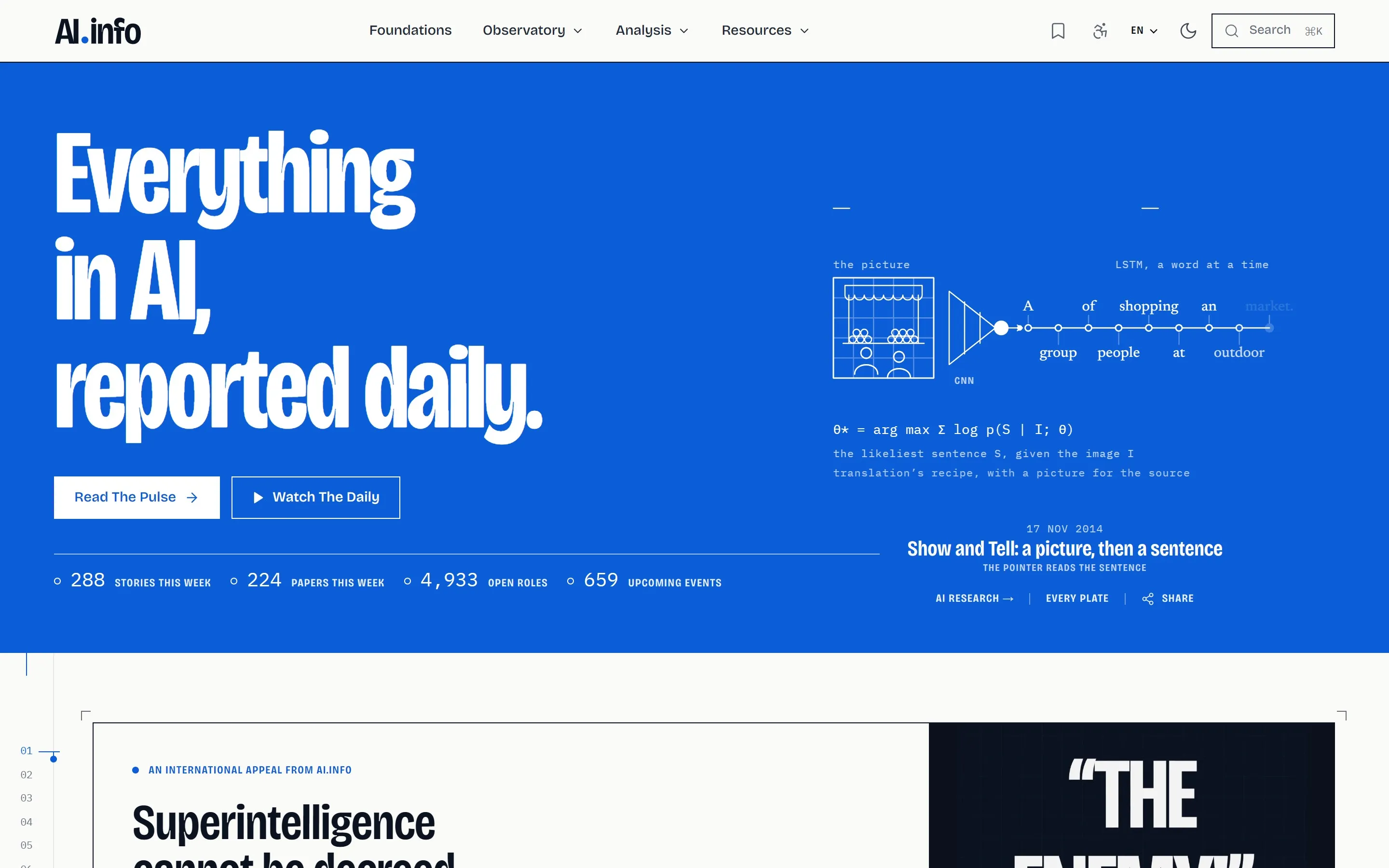
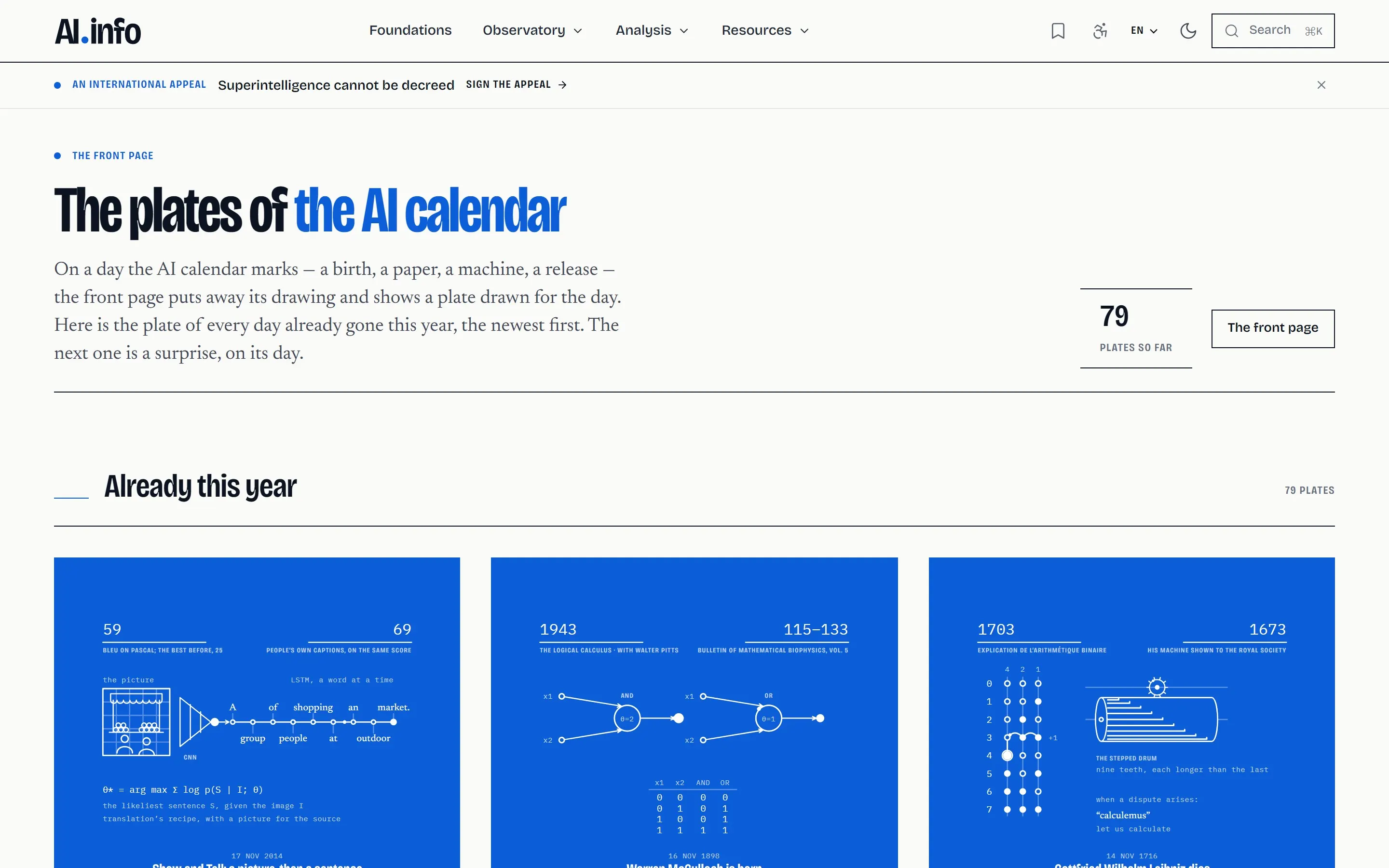
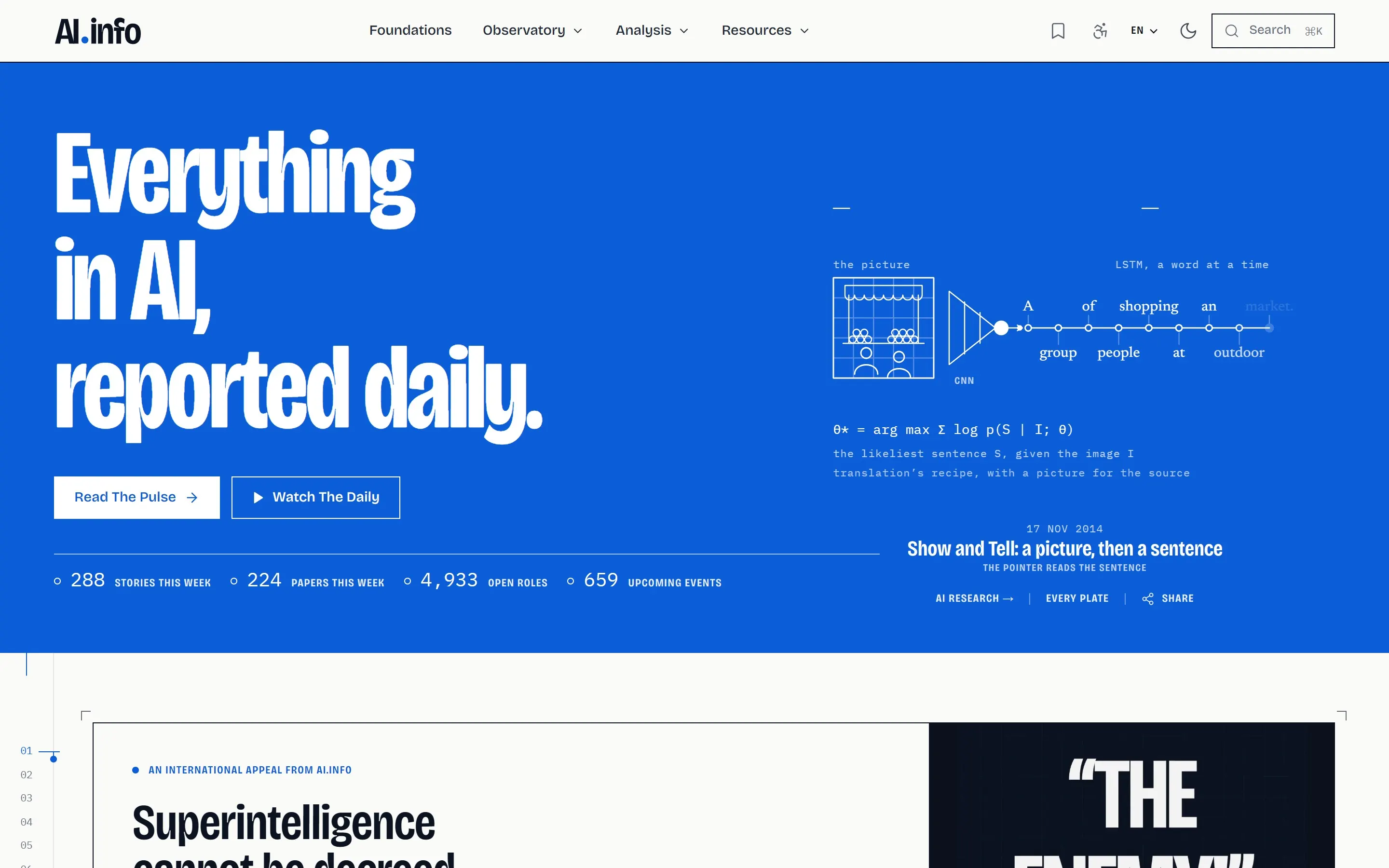
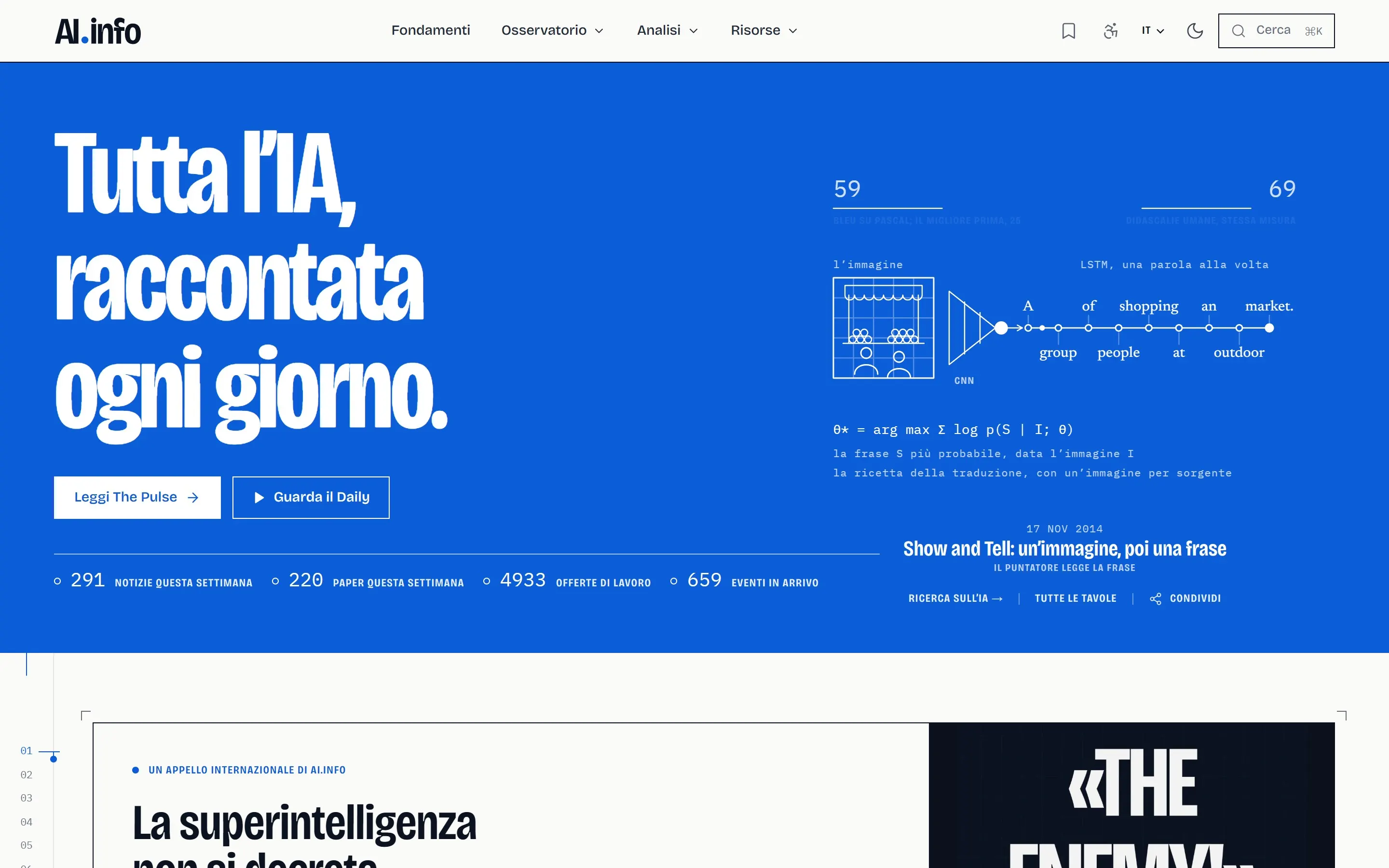
A plate instead of a stock photograph. The front page opens with a drawing of a day in the history of artificial intelligence — a birth, a paper, a machine, a release. On the day of these captures it was Show and Tell (2014), the model that turned a picture into a sentence. The drawings are collected as “the plates of the AI calendar”: by mid-November 2026 the front page had drawn 79 of them.
The byline as a contract. Before the first sentence of a story, the reader sees who wrote it, that it was checked, and against how many sources: AI.info Team · fact-checked · against 1 source. The European Union’s icon for content made with AI sits beside it. Nothing about the automation is hidden; it is the first thing the page declares.
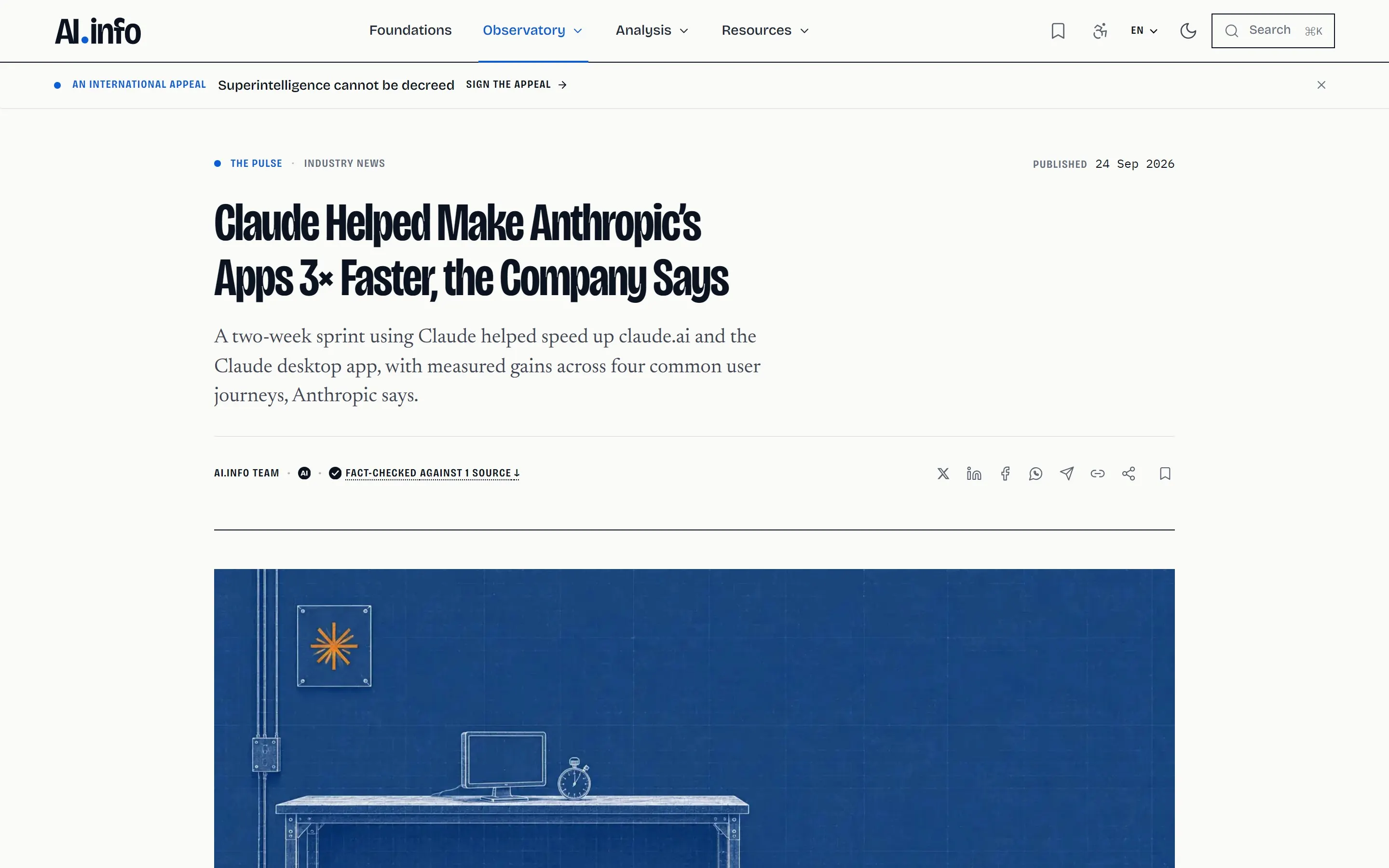
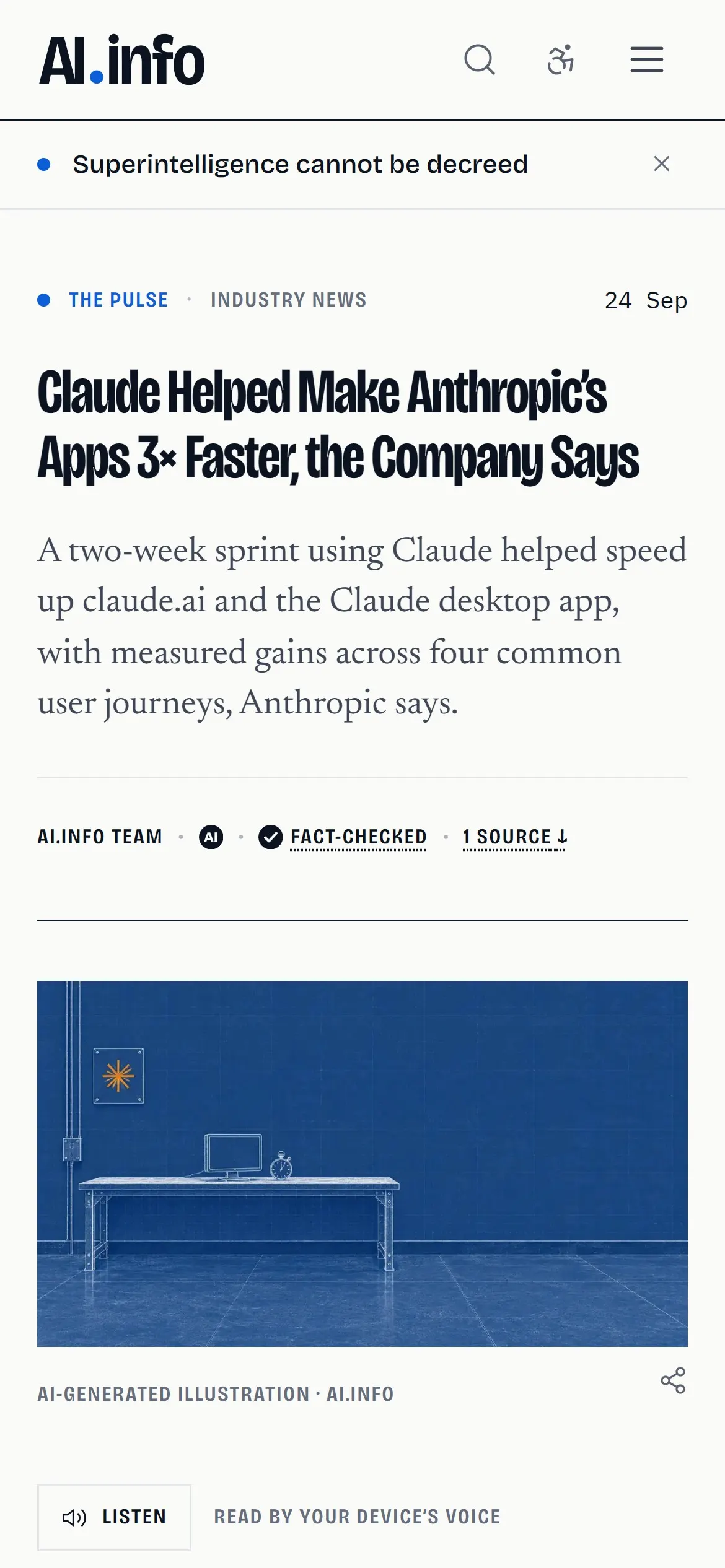
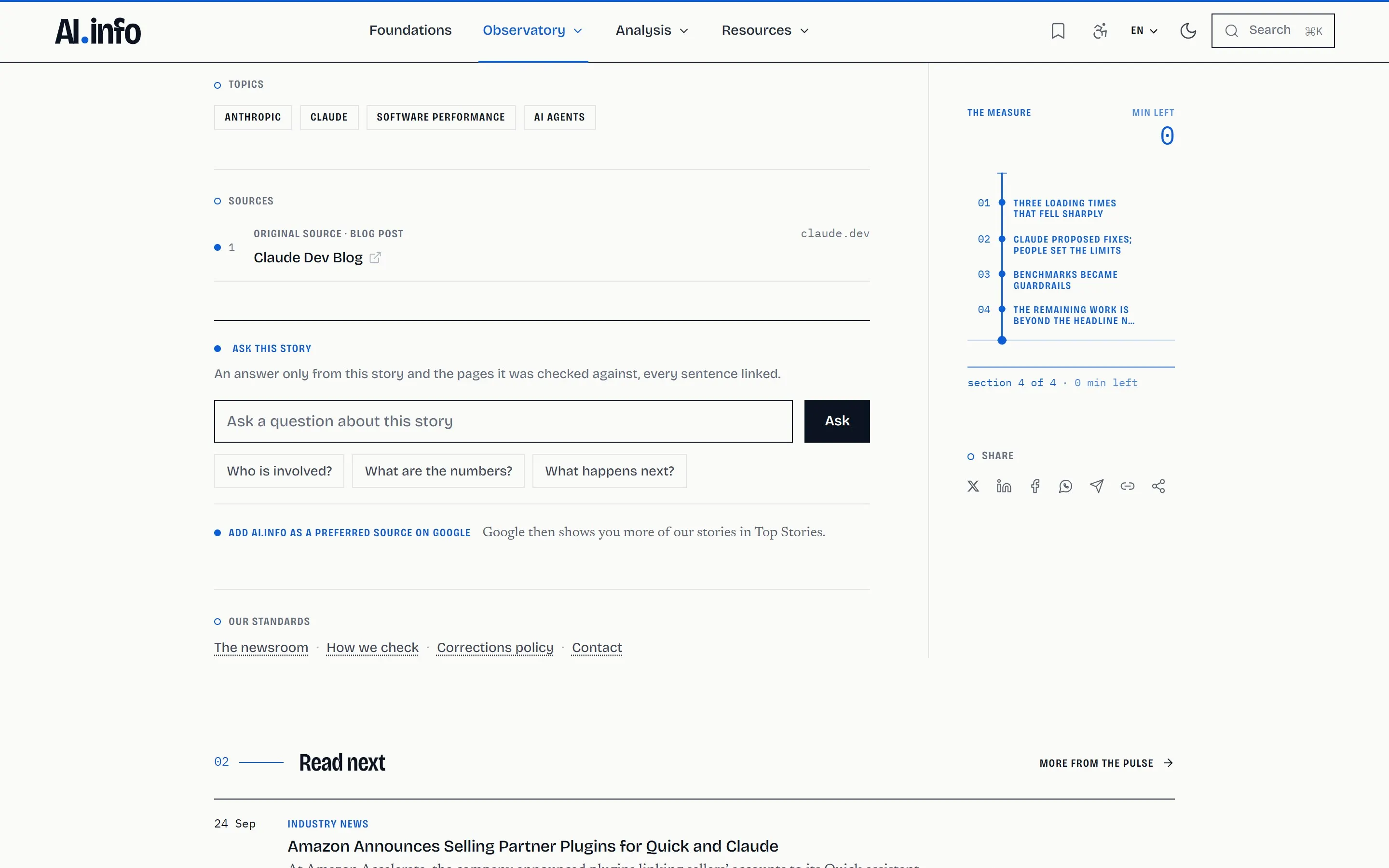
The end of a story is a dossier. Topics, the original source, the measure of the story, and Ask this story: questions answered only from the story and the pages it was checked against, every sentence linked.
The experience
The archive sits behind four doors — Foundations, Observatory, Analysis, Resources — and moves at three speeds.
- The Pulse, as it happens: stories filed through the day, each with its source.
- The Daily: the day in brief, the five stories that matter, the paper of the day, the event of the day.
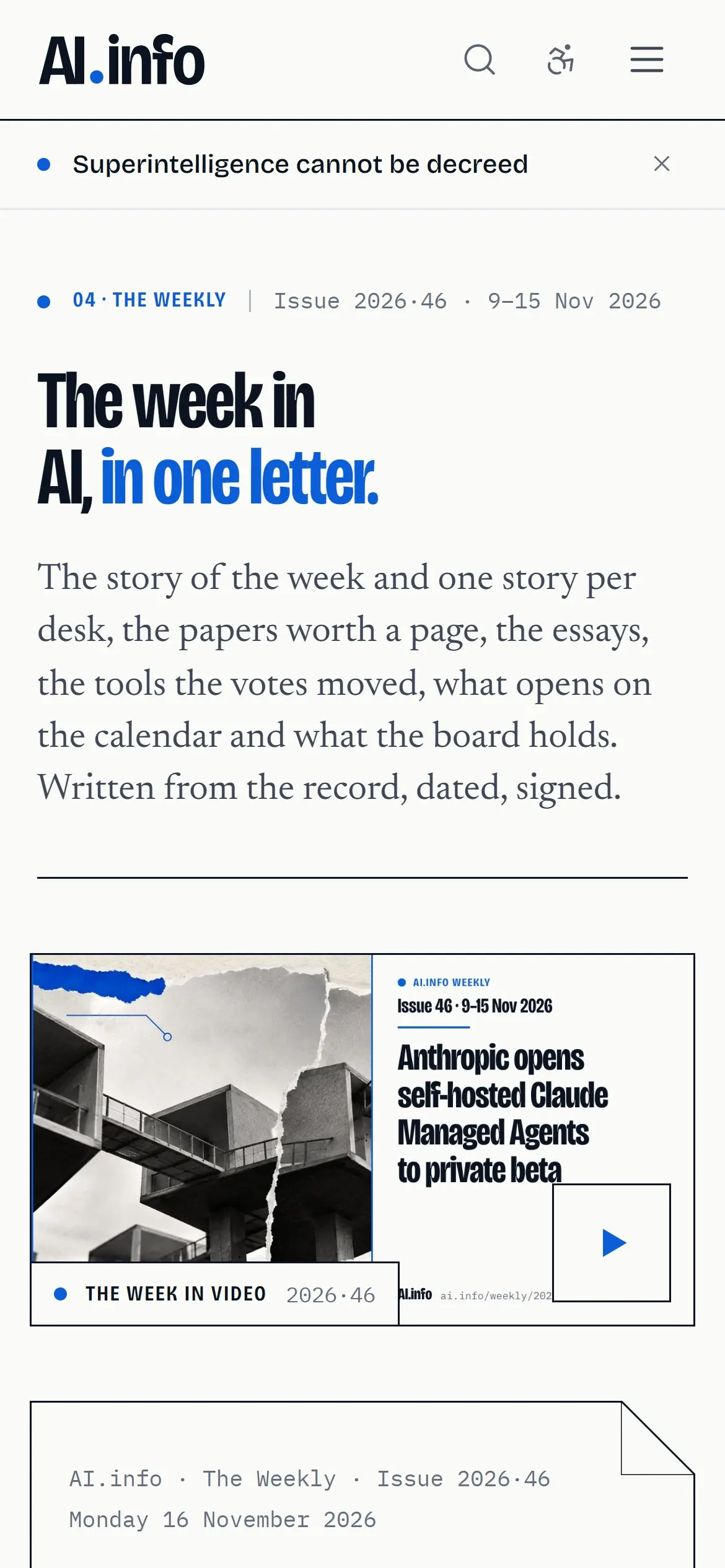
- The Weekly, “the week in AI, in one letter”, in six parts: the stories, the papers worth a page, the essays, the tools on the ladder, the calendar and the board.
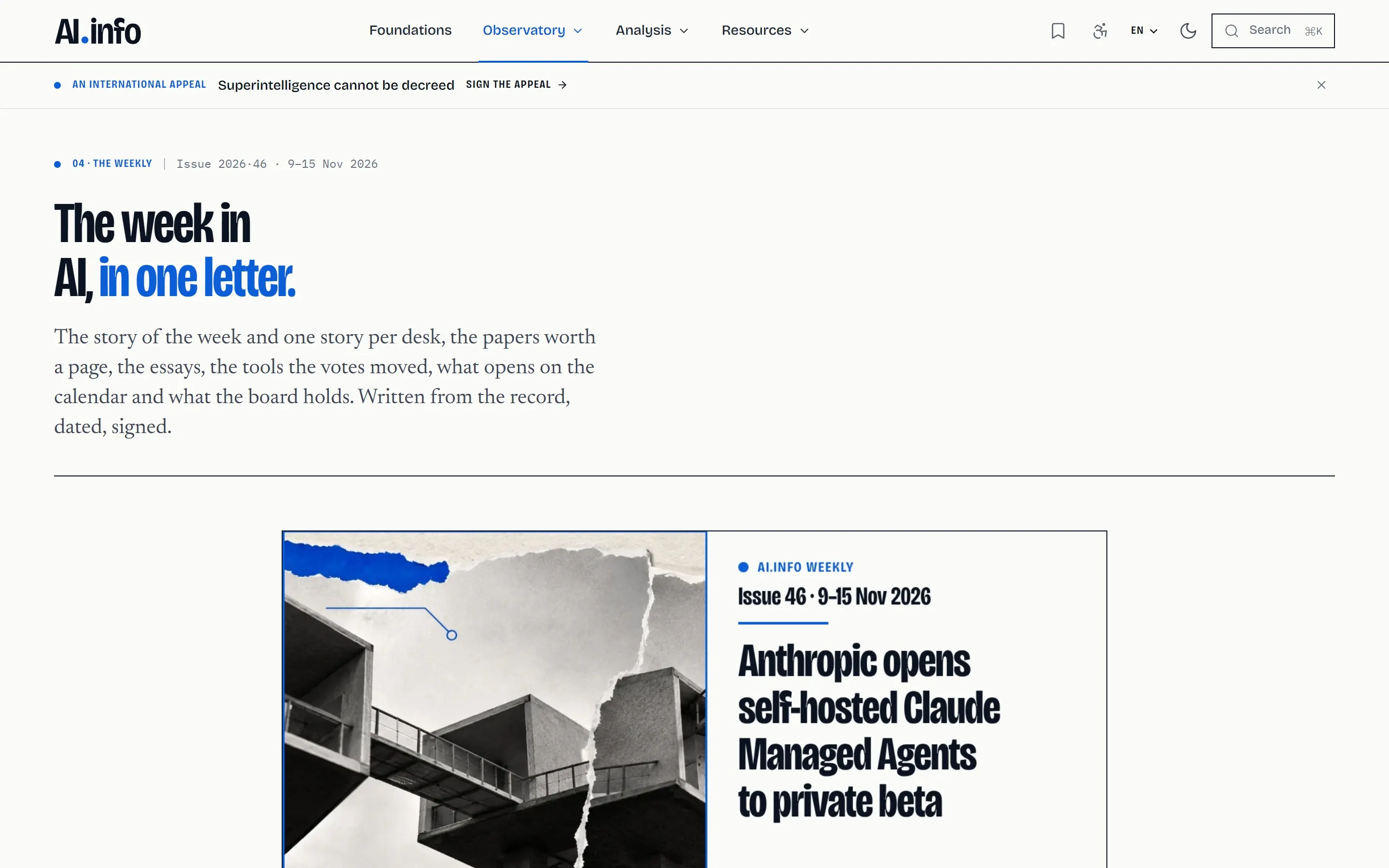
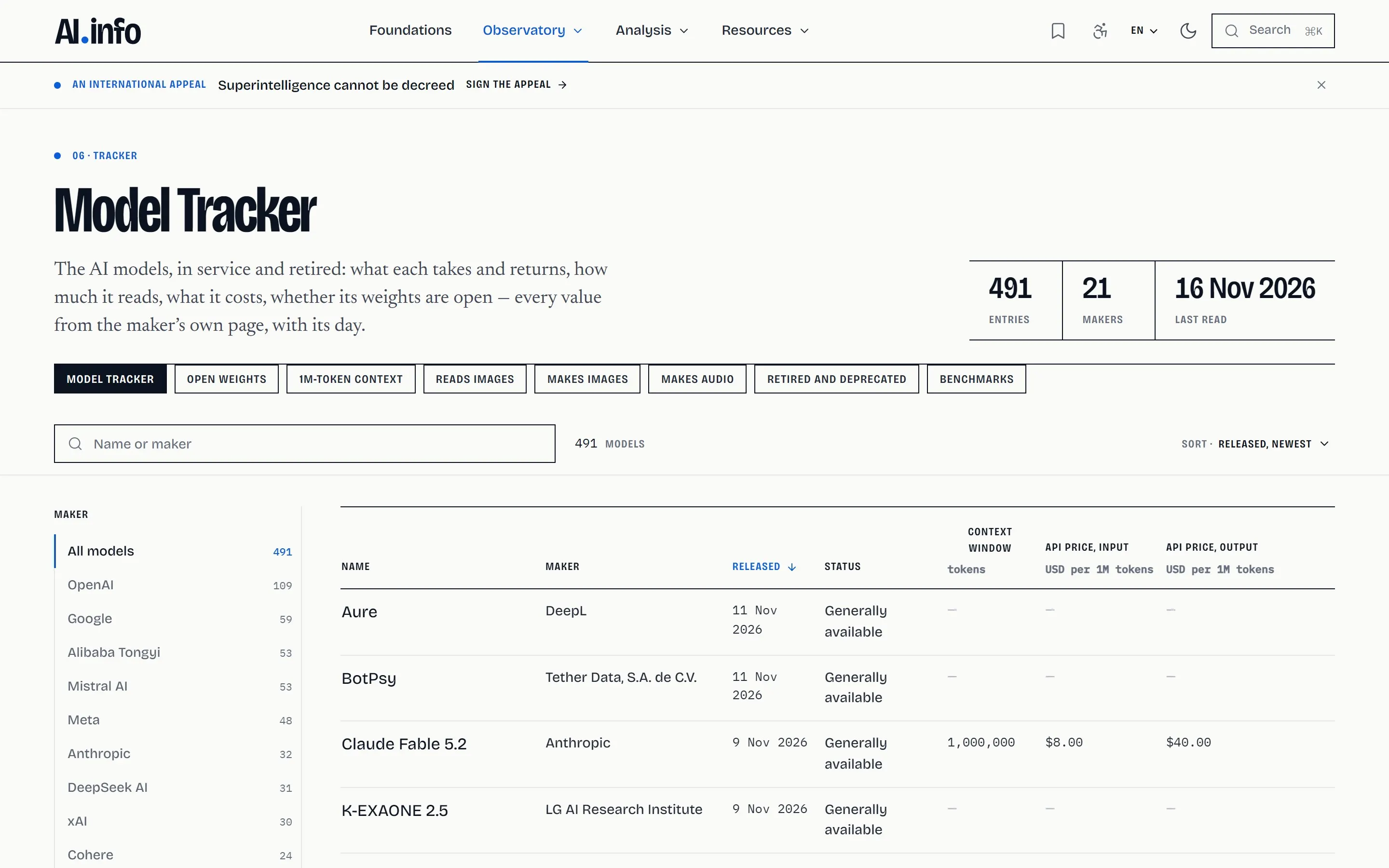
Beside the news stand the registers: places where a value is shown only as its source prints it.
- The Model Tracker lists the models in service and retired — what each takes and returns, how much it reads, what it costs, whether its weights are open — every value from the maker’s own page. When captured it held 491 entries from 21 makers.
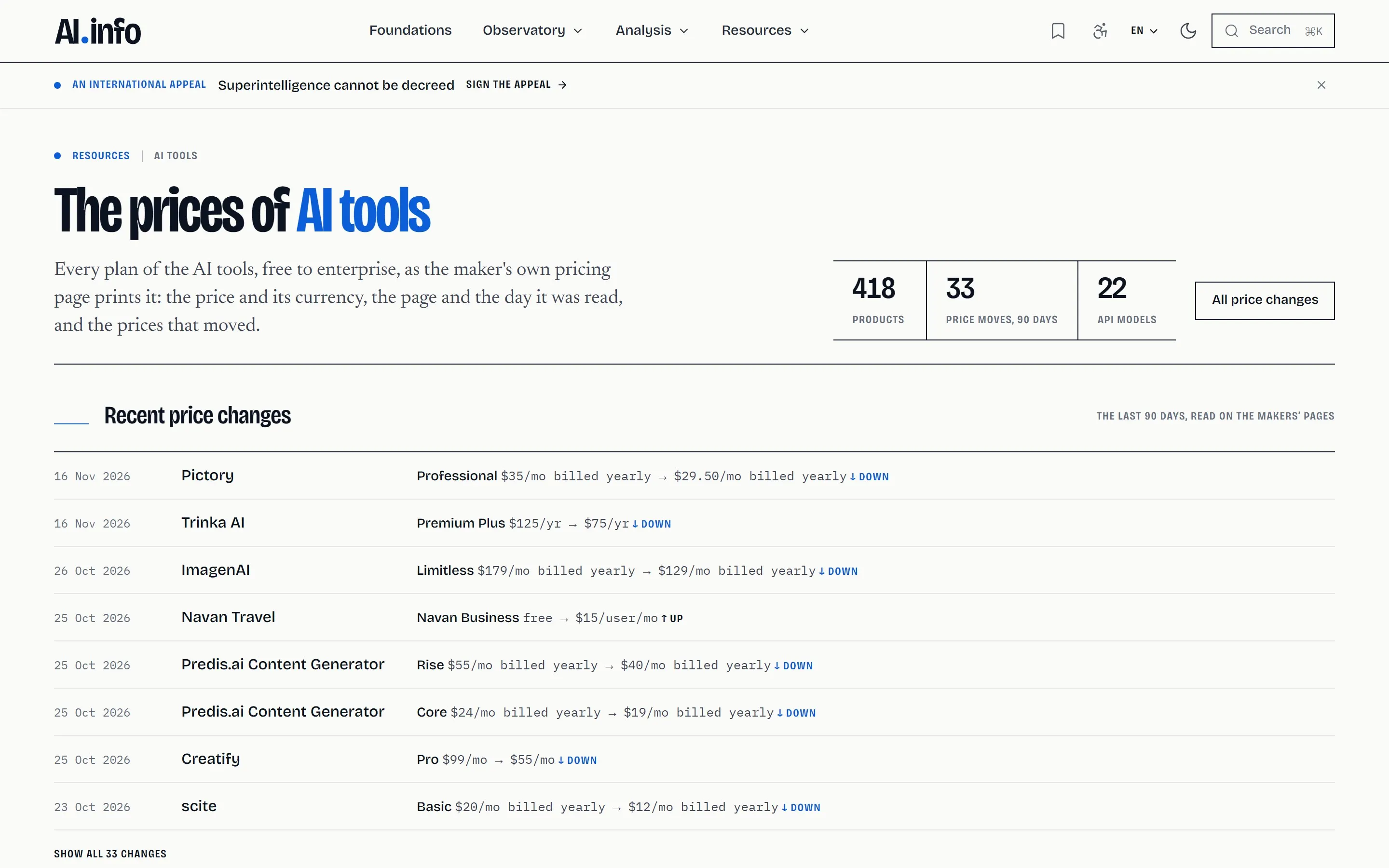
- The prices of AI tools reads each product’s pricing page every two weeks. A price is shown only when its amount and its currency are printed on that page; nothing is converted, and a price that returns to an earlier figure is not counted as a change.
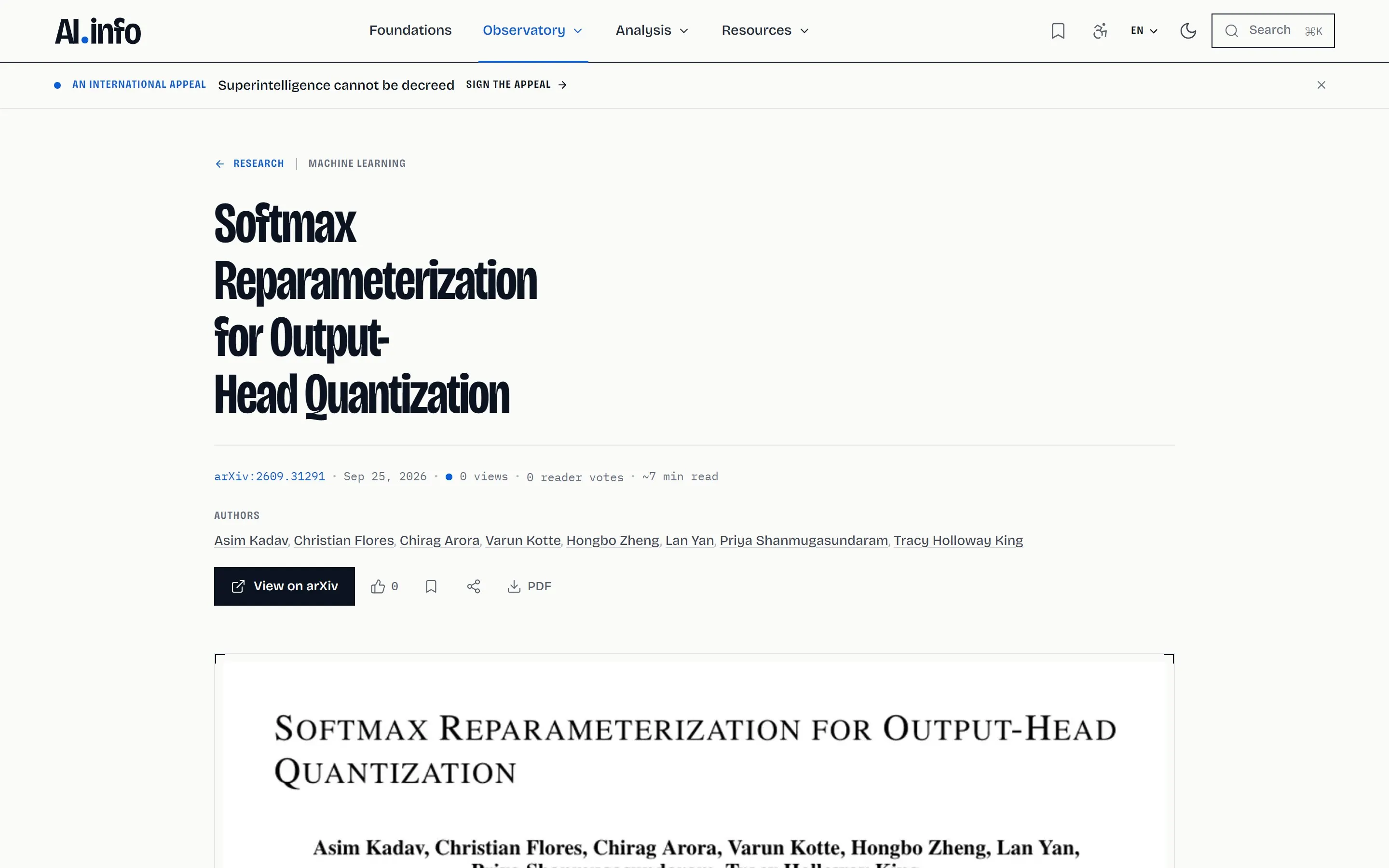
The research desk reads arXiv every half hour and turns the day’s chosen papers into pages a non-specialist can follow: a summary, what the paper is about, its contributions, its findings and its method in plain English, with the original one click away.
Everything can be followed without an account: seven RSS feeds, and job and event feeds that accept the same filters as their pages. The whole site exists in English and in Italian.
The system
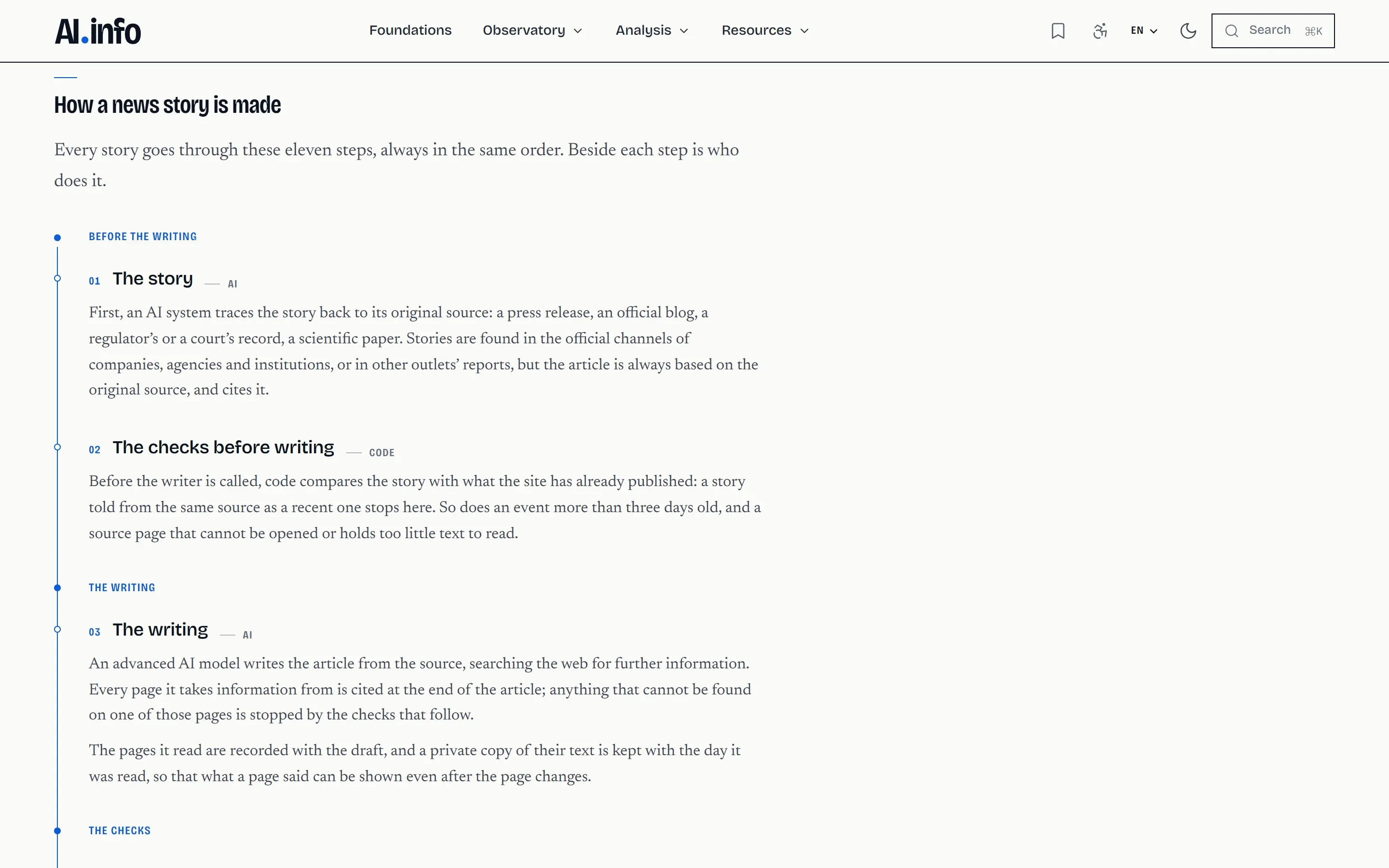
The heart of AI.info is not a page but a procedure. Every story passes eleven steps, always in the same order, and the site publishes who performs each one: an AI model, code, or both.
Before the writing
- 01The storyAIThe story is traced back to its original source: a release, an official post, a filing, a paper.
- 02The checks before writingCodeA story from the same source as a recent one stops here; so does an event older than three days, or a source that cannot be read.
The writing
- 03The writingAIA model writes from the source and cites every page it used. A private copy of each page is kept with the date it was read.
The checks
- 04The machine checksCode and AICode looks for every quotation and figure on the cited pages. One that is on none of them holds the story, whatever any model says.
- 05The first checkerAIA checker whose only task is to find what is wrong reads the draft against its pages.
- 06The second checkerAIA checker from a different family of models reads the same draft on its own, and can only add findings.
- 07The arbiterCode and AIA hold is lifted only when every finding is answered with a line of the page that code then finds there.
- 08The correctionCode and AIA held story goes back to be fixed, finding by finding, and through the checks again — up to three times.
Before publication
- 09The reading before publicationReading agentAbout every two hours an agent re-reads each waiting story against every page it cites, and decides.
- 10PublicationBylineSigned AI.info Team, with the EU icon for AI-made content, the fact-checked mark and the number of sources.
After publication
- 11After publicationCode and AIStories can be read again at any time; errors are corrected in the text and recorded. Translations are checked before they are shown.
Three design choices in that sequence matter beyond AI.info.
Code before models. The cheapest check is also the hardest to fool: a quotation either is on the page or it is not. Putting string matching ahead of any model turns the most dangerous failure — an invented quote — into a mechanical stop.
Disagreement by design. Two checkers drawn from different families of models, reading separately, catch different mistakes. Their findings are added together, and the second can never clear what the first found. More false alarms are the price; the arbiter, bound to lines of the page, is how the system pays it.
Honesty about limits. The method is published together with what it does not guarantee: that every article has been read by a person before publication, or that the checks catch every error. When one gets through, the article is corrected and says so.
Underneath, the publication is built to be read by people and by machines. Pages are rendered with their content in the HTML, in two languages linked by hreflang. The structured data describes a news organisation with its publishing principles, corrections, verification and ownership policies. A news sitemap, seven feeds and a robots.txt that welcomes search and answer engines complete a site designed to be cited correctly.
Details
- Scope sentences. Stories say what a figure does not claim — that a reported speed-up applies to selected journeys, for example, rather than to everything an app does.
- Corrections with evidence. A correction records the words before and after, and the page it rests on.
- What you will not find. No paywall, no sponsored placement, no story without its primary source, no tracking pixel in anything sent by email.
- Memory of sources. The text of every cited page is kept with the day it was read, so what a page said can be shown even after the page changes.
Outcomes
- 7,619public pages in the sitemap, 2026-11-21
- 3,368research papers with a plain-English page
- 795lessons in 21 learning paths
- 491models in the tracker, from 21 makers
- 418products whose prices are read from source
- 2languages; translations checked before they are shown
Read on the live site on 16–17 November 2026: sitemaps, the Model Tracker, the prices page and the About page.
What this case study does not claim: audience, rankings or revenue. Those numbers are not public, and a studio that designs newsrooms which refuse to print what they cannot source should not publish figures it cannot source either.
What it does show is a working answer to a question most of the industry is still asking — how to use language models in publishing without asking readers to trust them blindly. On AI.info the answer is structural: an order of operations, a separation of powers, and a page that tells the reader exactly what happened before the story reached them.
Explore the project
ai.info
An automated newsroom on artificial intelligence: no story ships until code finds every quote and figure on the pages it cites.
Sources for this case study
- AI.info — How we work (the eleven steps)
- AI.info — About
- AI.info — The Weekly
- AI.info — Model Tracker
- AI.info — The prices of AI tools
- AI.info — The plates of the AI calendar
- AI.info — Feeds
Everything described here can be checked on the live project. Figures were read on 21 Nov 2026; screenshots are captures of the public site.