Nothing between the reader and the text
A free, ad-free website for reading and comparing 36 public-domain Bible translations, typeset with care, where every chapter is also an open JSON file.
Introduction
Free.Bible is a website for reading and comparing the Bible. It holds 36 translations in 22 languages, every one of them in the public domain, from the Leningrad Codex of 1008 to the World English Bible of 2020. Its interface can be read in 20 languages. It has no advertising, no trackers, no cookies and no accounts, and there is nothing to pay for.
Every page carries the same credit at its foot: Typeset in Italy by Gabriele Masetti — in Italian, Composto in Italia da Gabriele Masetti. The word is chosen with care. The site treats the Bible first as a text to be set, and only then as software.
On 18 November 2026 its sitemap index listed 43,741 page URLs across 37 sitemaps. Behind those pages sits a second edition of the same texts, meant for machines: every chapter is also a plain JSON file at a stable address, open to anyone.
This case study is about the two halves of that design — a page made for slow reading, and a corpus made to be taken away.
The challenge
The texts themselves are not scarce. A public-domain translation may be read, quoted, printed and republished without asking anyone. What surrounds the text is the problem, and the home page names it in one sentence: most Bible sites are “a business with Scripture attached”.
The second problem is typographic. Scripture has a structure that ordinary web text ignores: chapters and verses, lines of poetry and their indents, the superscriptions of the Psalms, section headings, the divine name set in small capitals in many English Bibles, the words of Jesus printed in red in some editions, and the Hebrew of the Old Testament, written from right to left with vowel points and accents above and below the letters. A reading site has to carry all of it, in many scripts, without the apparatus getting in the way.
The third problem is permanence. A site can disappear; a text in the public domain should not disappear with it.
Read together, the pages answer one question: how to give each text the care of a printed edition and the freedom of a public file.
The concept
Three decisions shape the rest.
- Public domain only. Every translation can be reused without permission, and each one says where it came from. The sources are eBible.org and getbible.net, converted to structured JSON; each translation page links to its provenance and licence.
- Nothing to collect. The About page lists what the site does not do: no advertising, sponsorships or affiliate links; no accounts, cookie banners or analytics trackers; no paywalls. Reading preferences and the last position read are stored in the reader’s own browser. In the sessions recorded for this study, the site set no cookies and every request went to free.bible itself.
- Every chapter is a file. There is no API and no key. Everything the site renders comes from JSON files at predictable URLs, served to any origin. The home page invites developers to mirror the whole corpus: 93 MB.
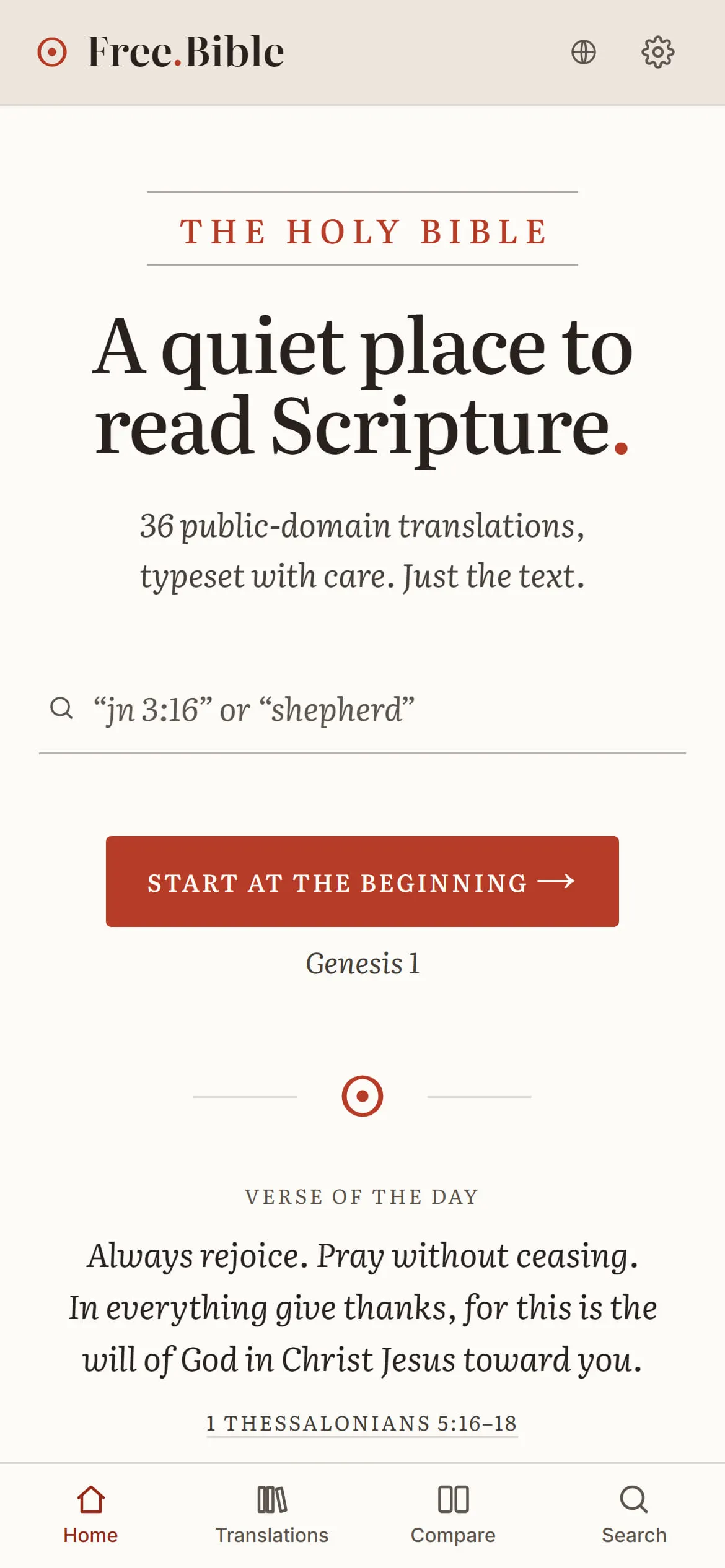
Scripture deserves careful typography and quiet pages — not banner ads, popups, or upsells.
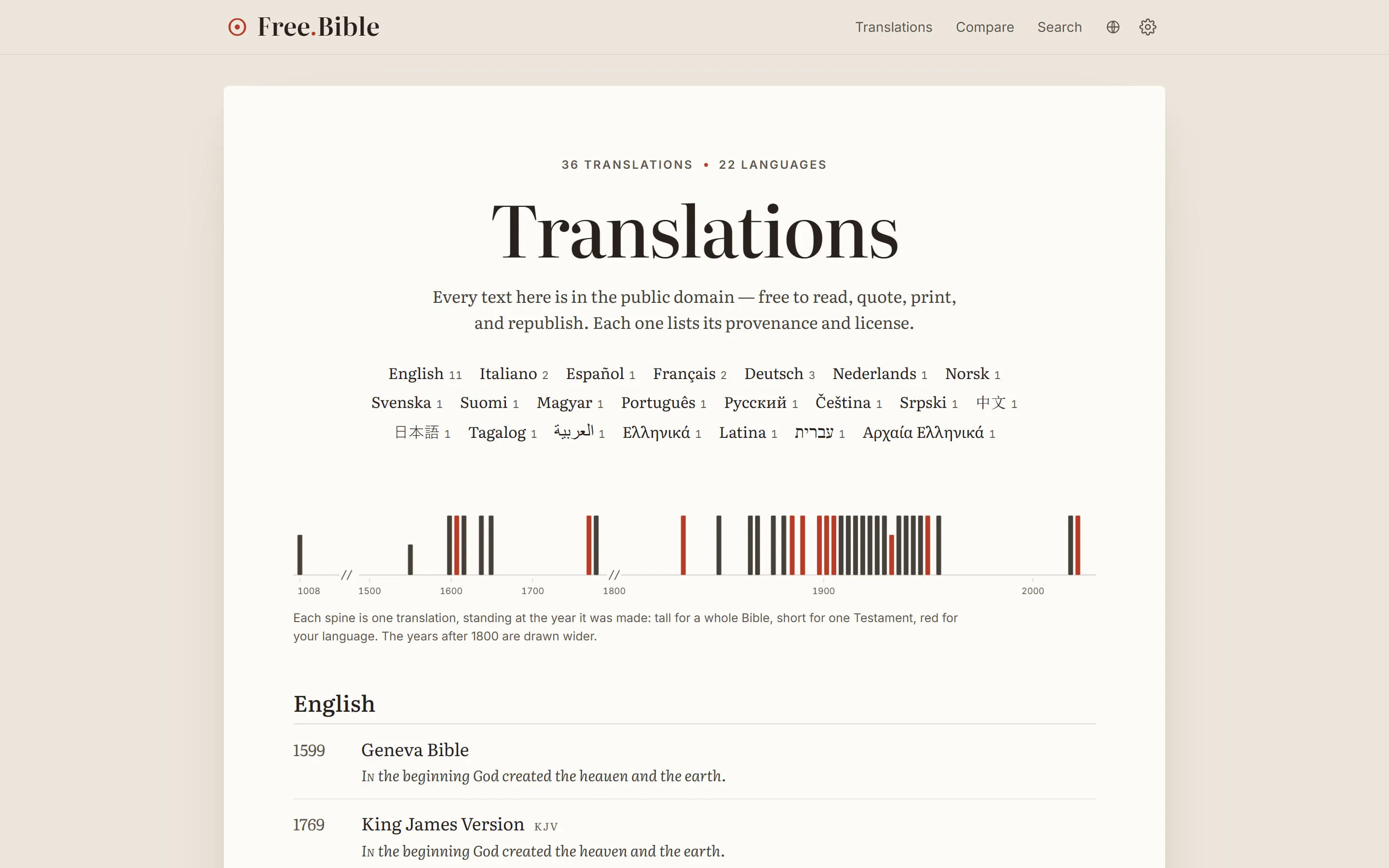
The translations page turns the collection into a drawing. Each translation is a spine standing at the year it was made: tall for a whole Bible, short for one Testament, red for the reader’s own language. The thousand years between the Leningrad Codex and the World English Bible fit on one line because the years after 1800 are drawn wider.
The design
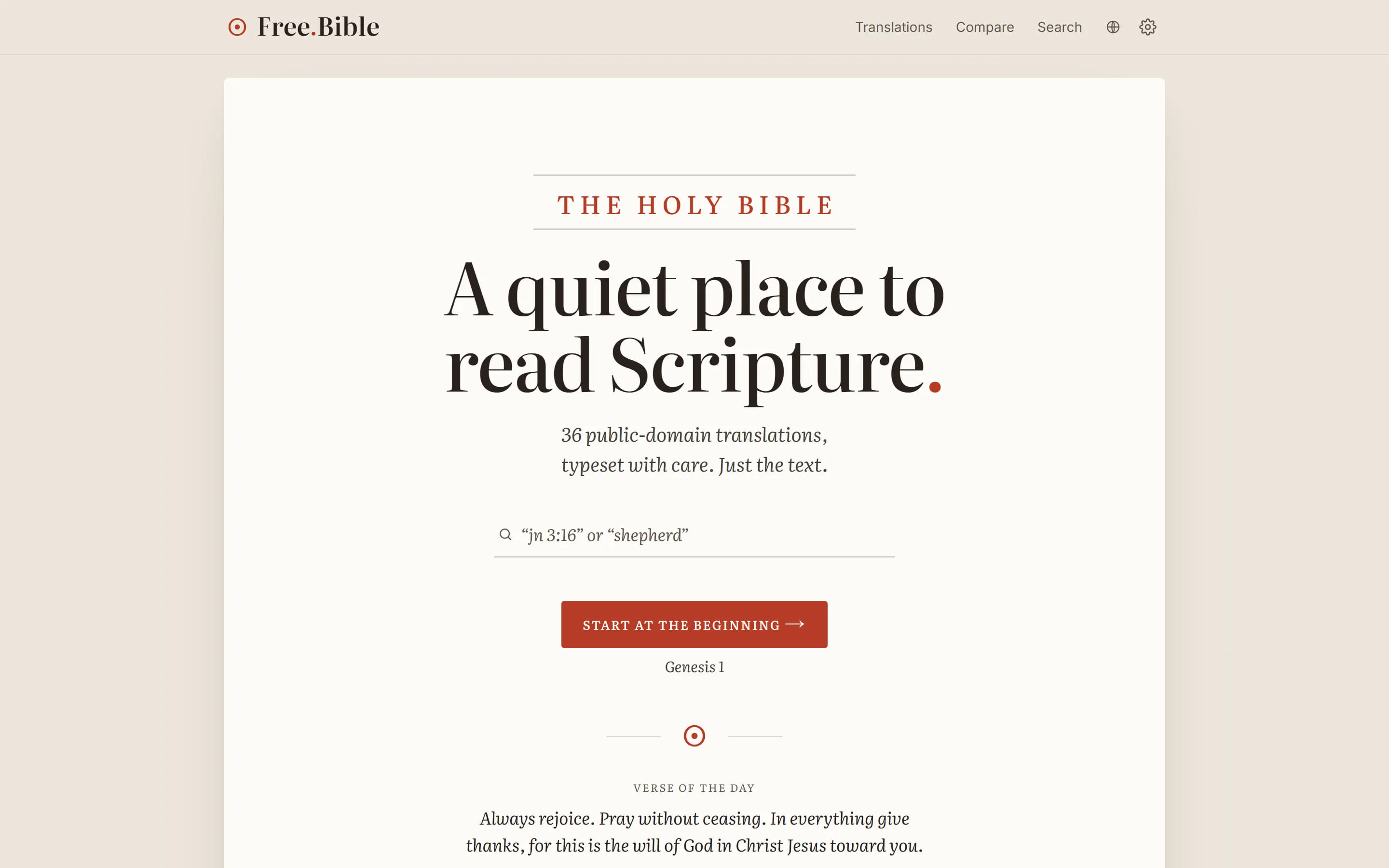
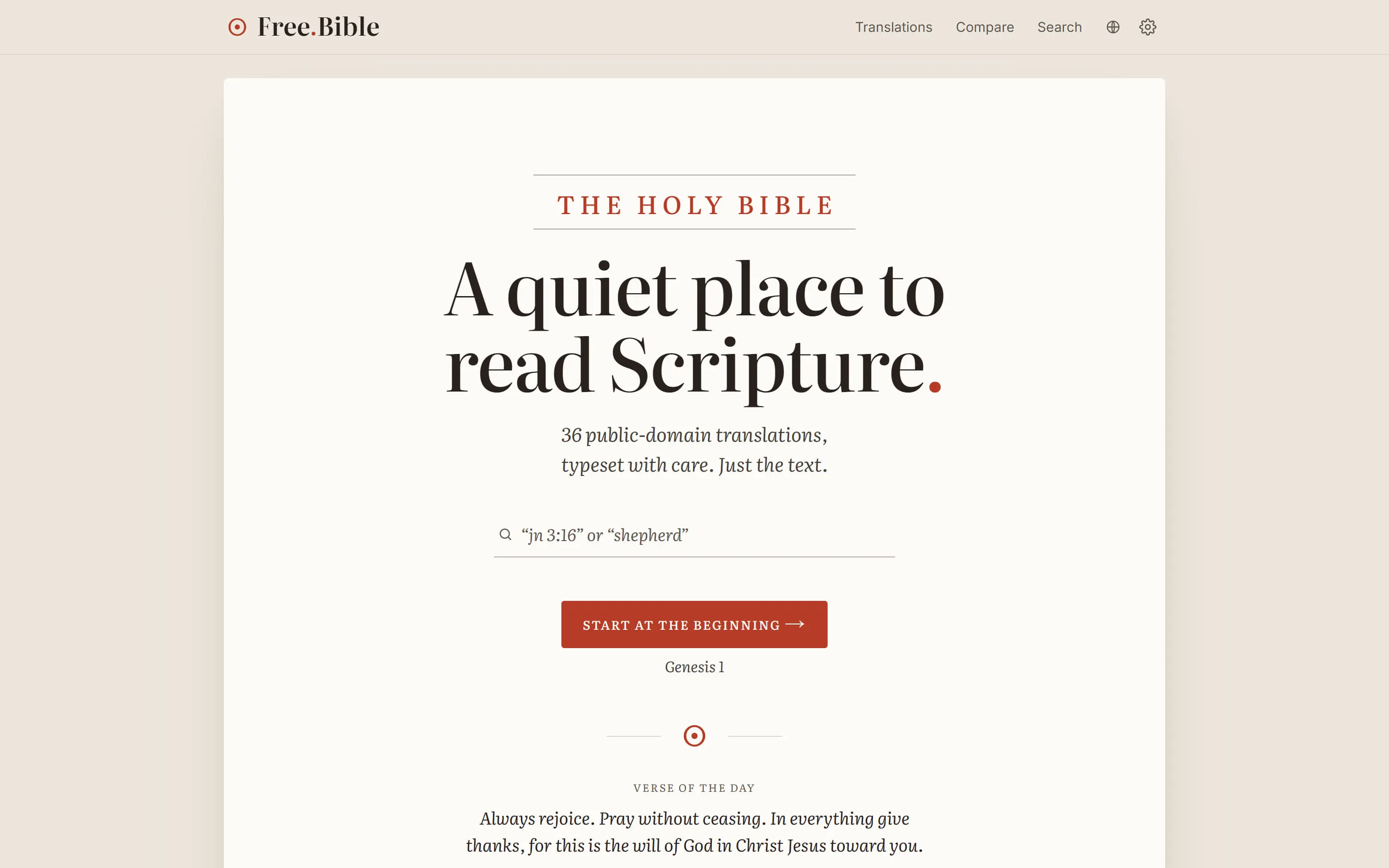
A sheet on a warm ground. Every page is set on a white sheet that lies on a warm paper-coloured ground, with a soft shadow under it. The stylesheet names its colours as a printer might: room, sheet, ink and minium — the red lead used for the rubrics of manuscripts. Red is kept for a few jobs only: the dot in the name Free.Bible, the kicker “The Holy Bible”, the one button on the front page, chapter numbers and verse numbers.
Three faces with fixed roles. The colophon states them: Scripture is set in Literata, the interface in Inter, Hebrew in Noto Serif Hebrew. The front page headline, A quiet place to read Scripture., is Literata at display size; the menus and labels are Inter. A reader can tell the text from the controls without reading either.
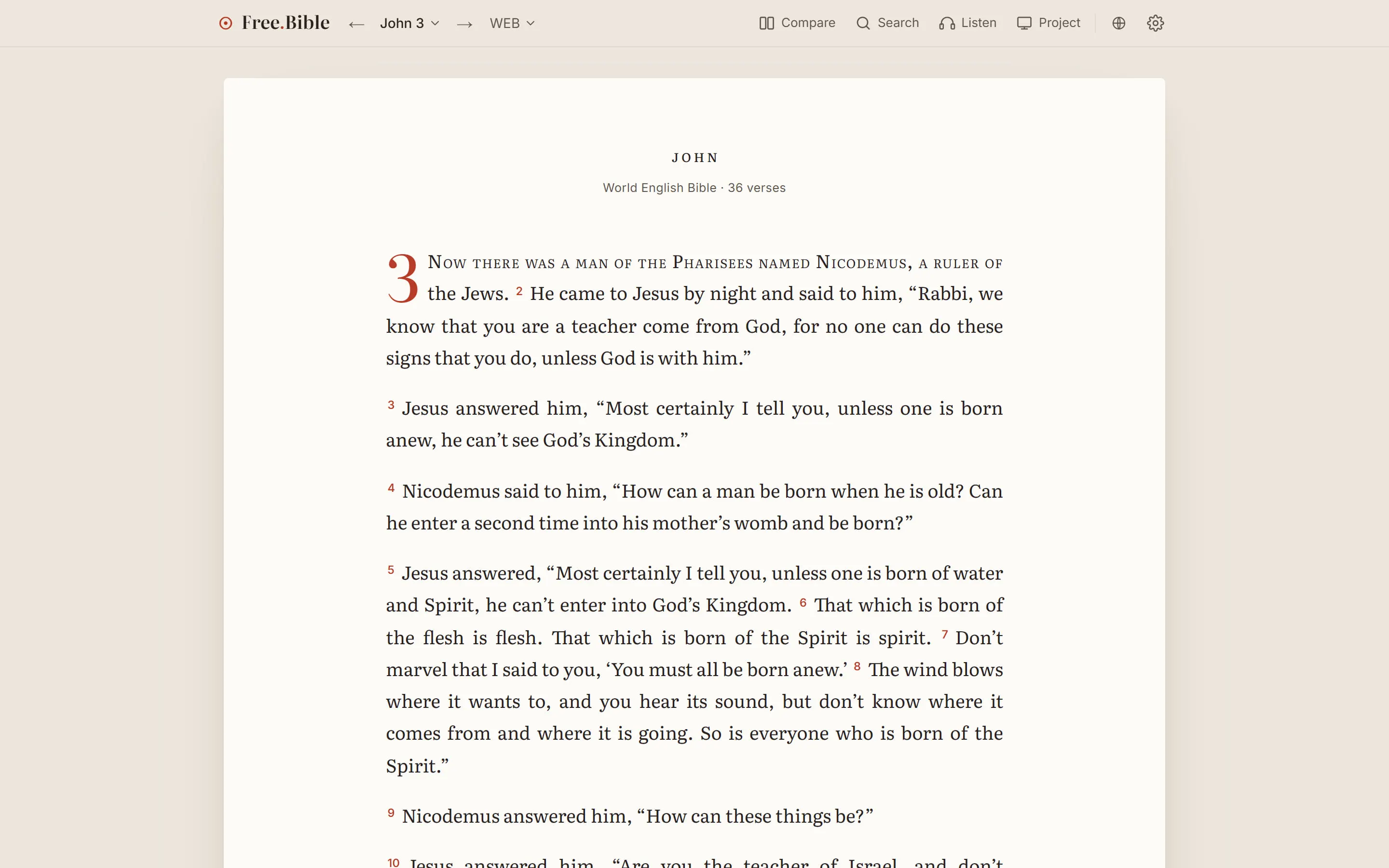
A chapter set like a book. The book name runs at the head in spaced capitals, with the translation and the number of verses beneath it. The chapter number is a large red numeral; the first line is in small capitals; verse numbers are small, red and raised, so the eye can find them and the reading can ignore them. In the Psalms, lines of poetry keep their indents, the superscription — A Psalm by David. — is set in italic, and the divine name, LORD, is set in small capitals, as in print. A thin red line under the toolbar shows how far into the chapter the reader is.
Settings that belong to the reader. The reading settings offer a theme (auto, light, sepia, dark), five text sizes from 16 to 24 pixels, three typefaces, three line widths, a reader’s edition in flowing prose without verse numbers, one verse per line, and the words of Jesus in red — “as in red-letter editions, where the translation marks them”. The choices are kept in the browser; nothing is sent anywhere.
Evening on the front page. Near the end of the front page, Genesis 1:5 — “There was evening and there was morning, the first day” — sits where the ground turns from paper to night. The last section, Nothing between you and the text, is set in light type on dark.
The experience
Going to a passage the way it is written. The field on the front page reads a reference as a person would write it. Type jn 3:16 and it answers “→ John 3:16 (press Enter)”; type shepherd and it offers to search. In the Italian interface, gv 3:16 opens Giovanni 3:16 in the Diodati. The book names and abbreviations behind this are published in the canonical book table, in 20 languages.
The keyboard. In the reader, the arrow keys turn chapters, g opens the reference picker, / opens search and p opens projection mode; Escape closes any dialog. The shortcuts page adds one line that matters: “Shortcuts stay out of the way while you type in any input field.”
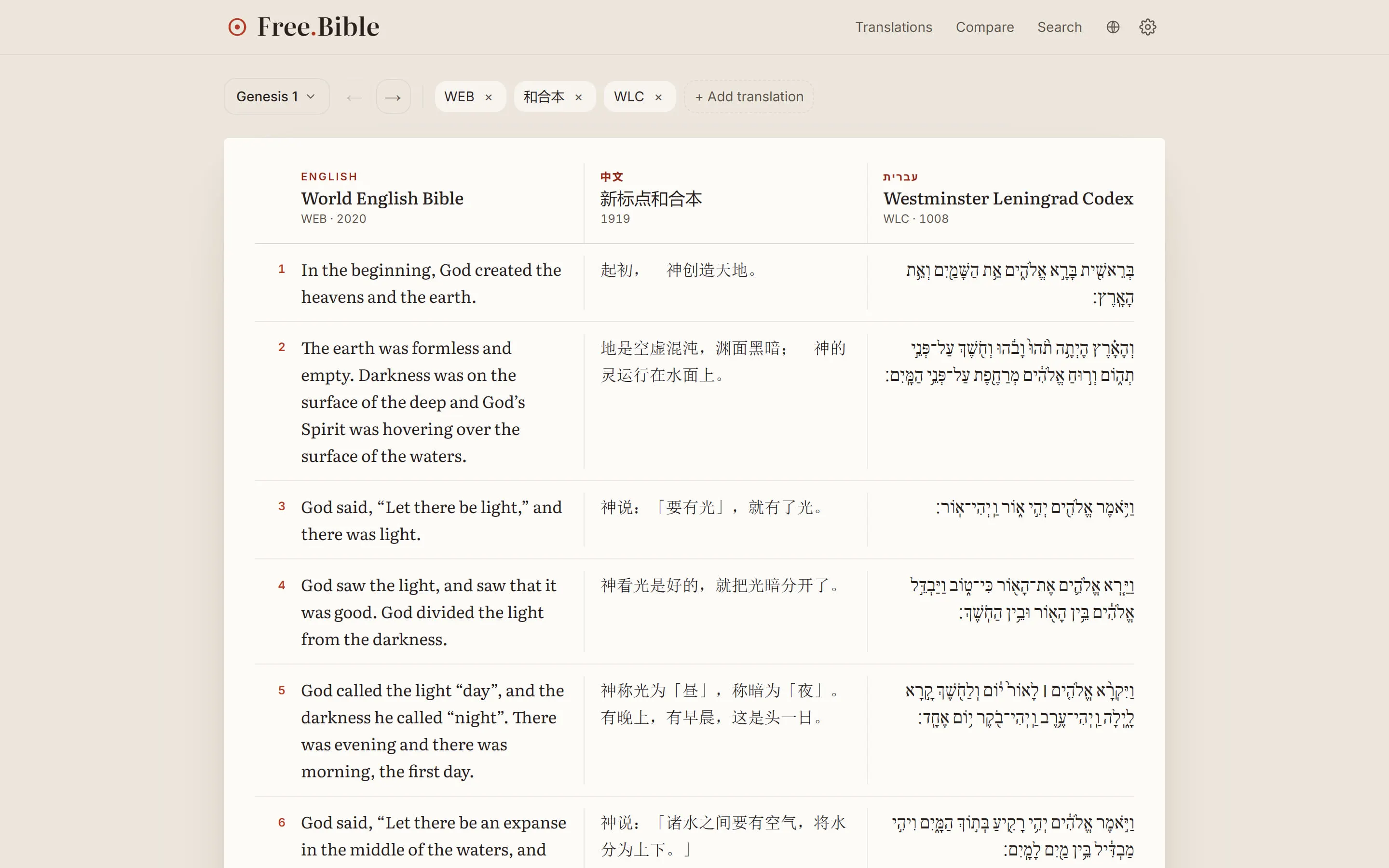
Compare. Up to six translations sit side by side, aligned verse by verse, in any mix of scripts and directions. Verses are matched by number; where a translation has no verse, the page says so rather than guessing.
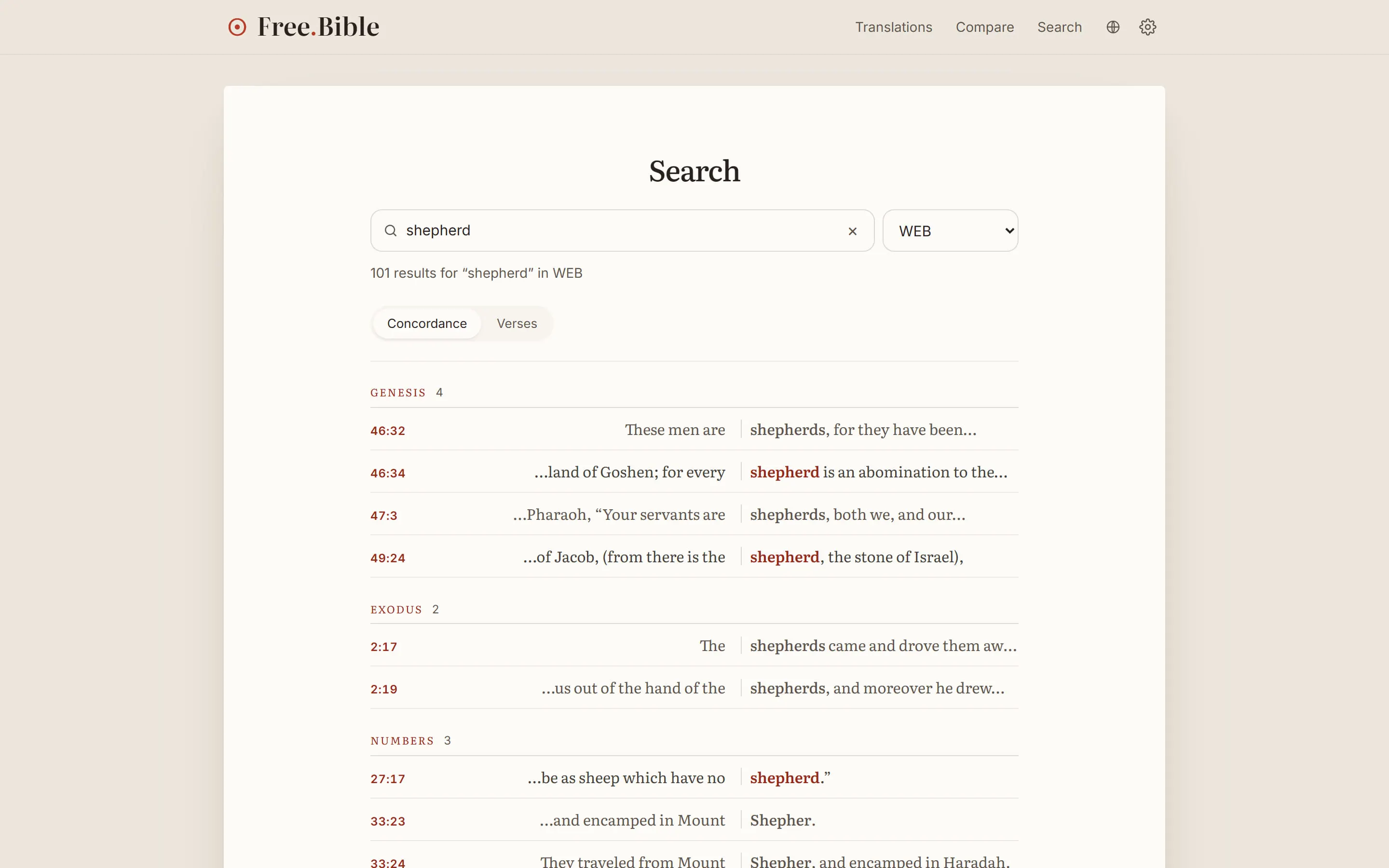
Search as a concordance. Results are grouped by book and shown with the words on either side of the match, aligned on the word itself, as in a printed concordance; a second view lists whole verses. The index is built in the browser the first time a translation is searched — “Only the first time: after that, search works offline too.”
One verse, many uses. Selecting a verse number opens a short menu: copy the verse with its citation, copy a link, share it as an image or a video in the site’s own typography, embed it on another site with one line of HTML, compare it across translations, or report an error. Projection mode puts a passage on a screen for a church, a classroom or a study group: one verse at a time, full screen, in large type, moved with the arrow keys. A chapter can also be read aloud, verse by verse, by voices that the About page says run entirely in the browser.
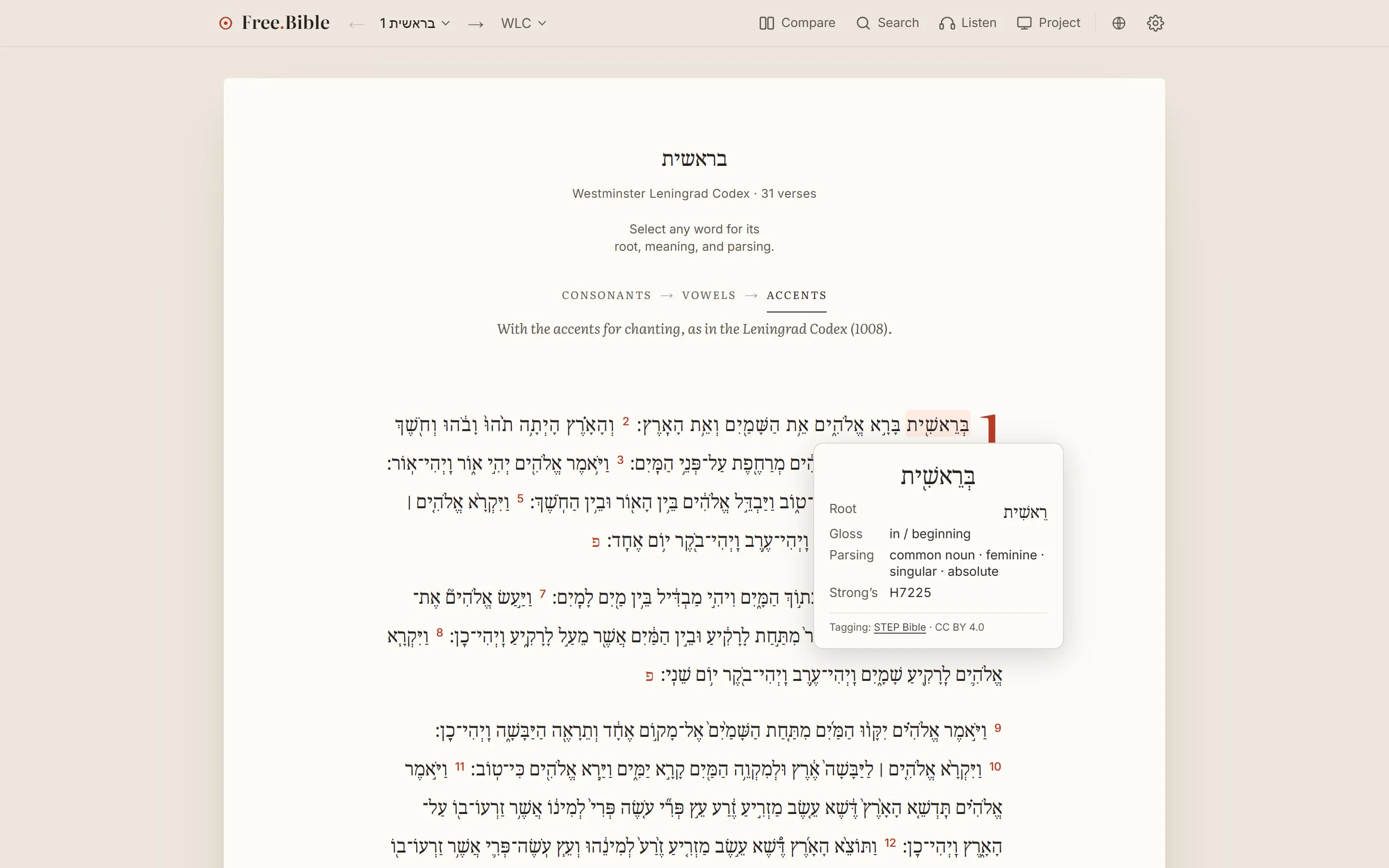
The text beneath the translation. In the Hebrew and Greek texts every word can be selected for its root, its meaning, its parsing and its Strong’s number, with the tagging credited to STEP Bible. Above each chapter, the text can be taken apart in layers. The Hebrew goes from the consonants alone, “the text as it was written before the Masoretes”, to the vowel points added in the 7th–10th centuries, to the accents for chanting of the Leningrad Codex. The Greek goes from uncials — “capitals without spaces or accents, as in the codices of the 4th century” — to the unaccented text, to the accented one.
An app without a store. The footer offers Install the app; the site’s manifest opens it full screen, like an app. A whole translation can be downloaded for reading with no connection, and what has already been read stays available offline.
The system
The site is fully static. In the words of its colophon, every chapter is pre-rendered HTML, “which is why it’s fast”. Under the HTML is the data, documented on the developers page as four kinds of address:
/bible/manifest.json— the list of translations, with language, direction, year, licence, source and scope;/bible/books.json— the canonical table of 66 books, with chapter counts, identifiers and names in 20 languages;/bible/web/index.json— the books of one translation, with their local names;/bible/{translation}/{book}/{chapter}.json— one chapter.
Book identifiers are English slugs in every translation, so addresses are predictable across languages: /bible/diodati/john/3.json is Giovanni 3. A verse carries only what the page needs to set it: its number, its text, poetry indents, paragraph and stanza breaks, section headings and Psalm superscriptions. Missing verses are kept missing — Acts 8:37 in the American Standard Version, for example — “exactly as in print editions”.
There is no API to sign up for, because there is no API — every chapter is a file.
The two halves meet at the foot of every chapter. Under the last verse, the chapter’s own address is printed: /bible/web/john/3.json. Selecting it turns the page over and shows the chapter as published — the same text as plain JSON, with a button to copy the address and a link to open the file.
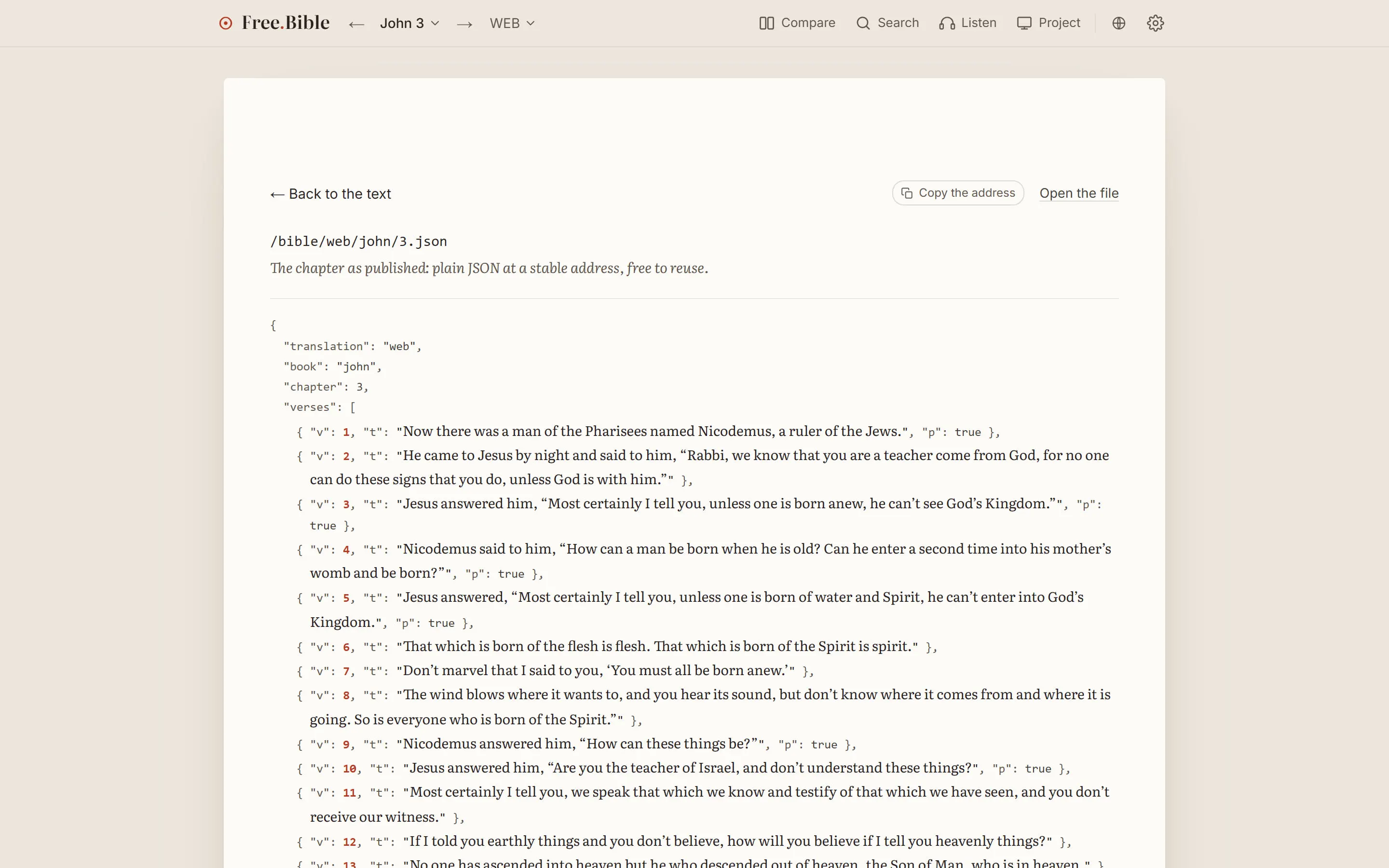
The developers page sets out the terms, and they are short. The files are served to any origin, with no key, no sign-up and no rate limits beyond fair use of the CDN. The addresses are stable: a breaking change to the schema would ship under a new path prefix, never in place, and the current schema version is declared in the manifest. Responses are cached for 24 hours, and anyone who wants the whole corpus regularly is asked to mirror it instead.
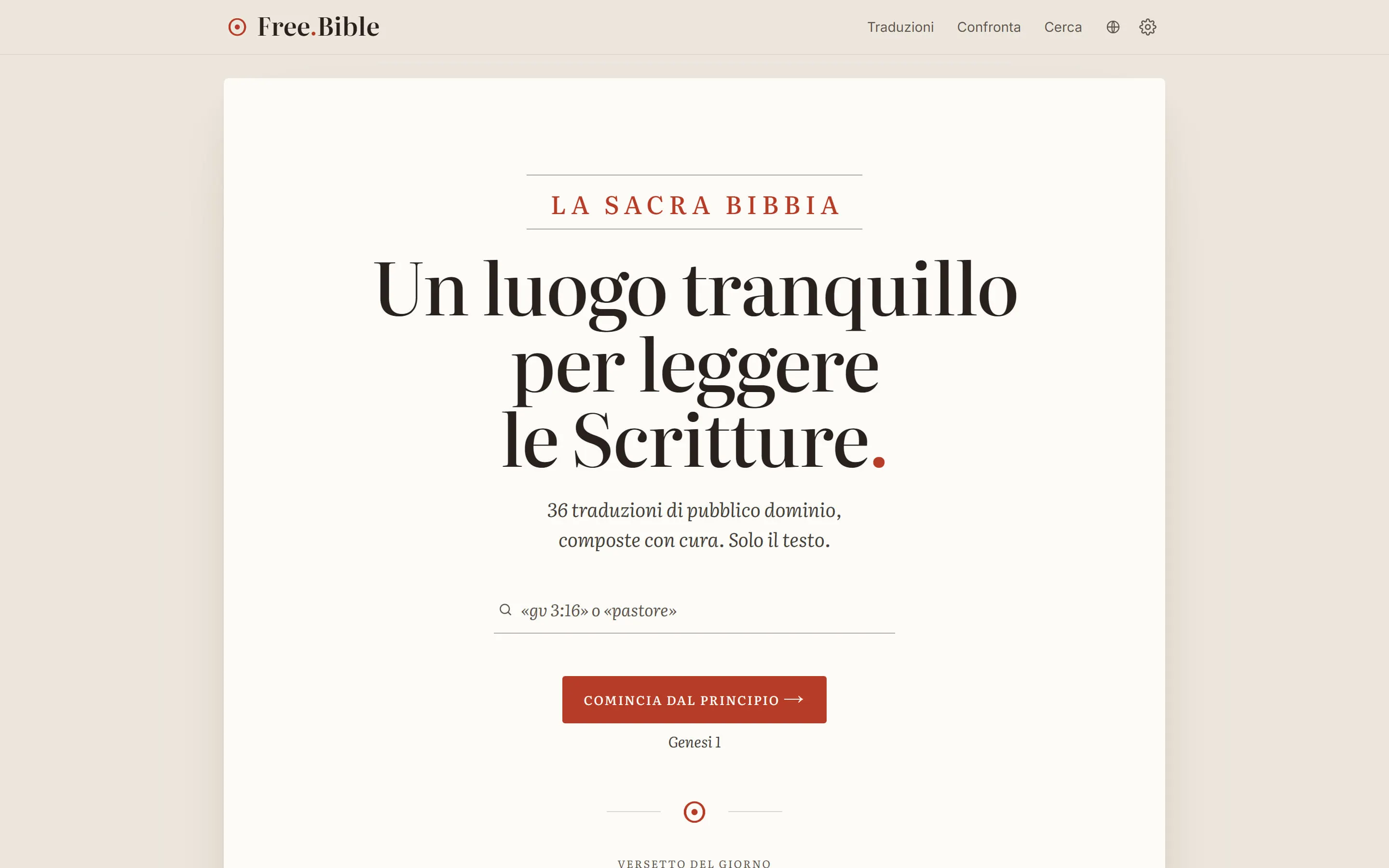
Twenty interface languages. Every page declares its siblings in 20 languages through hreflang, from English and Italian to Arabic, Chinese, Latin and Tagalog. The Arabic interface turns the whole layout right to left. The default translation follows the language: the Italian front page quotes the Riveduta and the Diodati, and references typed there open in the Diodati.
Offline by design. A service worker keeps three caches with three policies: the site’s versioned files and the Bible JSON are served from the cache first, because they do not change under a reader; pages are fetched from the network first and fall back to the copy already read, or to an offline page that renders the chapter from the cached JSON.
Details
- The year in the reader’s numerals. The footer sets the current year in Roman numerals — MMXXVI — except in the Arabic, Chinese and Japanese interfaces, where it is written 2026.
- A credit in every language. Typeset in Italy, Composto in Italia, Gesetzt in Italien, In Italia compositum: the same line, translated with the rest of the interface.
- Licences stated, not assumed. The manifest lists a licence for every translation. The King James Version carries a note: public domain worldwide, with printing rights within the United Kingdom governed by Crown letters patent.
- Nothing to consent to. There is no cookie banner because there are no cookies to ask about. The site’s own code is MIT-licensed.
- Honest scope. Translations that cover one Testament say so — the Leningrad Codex and the JPS Tanakh of 1917 are the Old Testament, the Textus Receptus the New — and the spines on the translations page are drawn short to match.
Outcomes
- 43,741page URLs in the sitemap, 18 Nov 2026
- 36public-domain translations, 1008 to 2020
- 22languages of the texts, Hebrew and Greek included
- 20interface languages, declared with hreflang
- 1,189chapters in a whole Bible, each one a JSON file
- 93 MBthe whole corpus, free to mirror
Read on the live site on 18 November 2026: the sitemap index and its 37 sitemaps, the data manifest and book table, the front page, the translations page and the About page.
Free.Bible publishes no figures for readers or visits, and this case study does not claim any. It sets no cookies and runs no analytics, so it would have none to give.
What it shows is a way of treating a shared text: set it as carefully as a printed edition, put nothing between it and the reader, and publish it so plainly that anyone can take it — and keep it, if the site itself is ever gone.
Explore the project
free.bible
A free, ad-free website for reading and comparing 36 public-domain Bible translations, typeset with care, where every chapter is also an open JSON file.
Sources for this case study
- Free.Bible — Home (English)
- Free.Bible — Home (Italian)
- Free.Bible — About (what you can do, what we don’t do, colophon)
- Free.Bible — Sources and licences
- Free.Bible — Developers: open Bible data
- Free.Bible — Translations
- Free.Bible — John 3, World English Bible
- Free.Bible — Genesis 1, Westminster Leningrad Codex
- Free.Bible — Compare translations
- Free.Bible — Search
- Free.Bible — Keyboard shortcuts
- Free.Bible — Data manifest
- Free.Bible — Sitemap index
Everything described here can be checked on the live project. Figures were read on 21 Nov 2026; screenshots are captures of the public site.