A fare against its own history
A daily split-flap board of cached airfares from 46 cities, each measured against its own route’s usual price, with no invented “was” prices.
Introduction
flight.deals is a daily board of airfares. It collects cached round-trip fares from real flight searches, keeps the cheapest one on each route, and says how that fare compares with the route’s own history. Its metadata puts the idea in one sentence: “No invented ‘was’ prices.”
On 18 November 2026, after the refresh of 17 November at 14:50 UTC, the board held 3,776 fares from 46 departure cities to 88 destinations. The site is in English, shows prices in US dollars, euros or pounds, and keeps saved fares in the visitor’s own browser. The About page states who is behind it: “flight.deals is built and run in Italy by Gabriele Masetti.”
This case study is about the design of a single comparison, the one between today’s fare and a route’s usual price, and about everything the site builds to keep that comparison honest: a split-flap board, a method shown with its working, calendars that admit their gaps, and a business model written out in full.
The challenge
A flight-deal page usually makes its argument with a discount. A fare is shown beside a higher figure, struck through, and the gap is the reason to click. The higher figure is rarely explained. It may be a list price nobody paid, an average of unknown dates, or simply a number chosen to make the gap look large.
That leaves the reader with the one question the page does not answer. The About page names it in its opening line: “Is this fare actually cheap?”
Three conditions made the question hard to answer well.
- Fares are cached, not live. The board works from searches other people have already made. A fare that was real eighteen hours ago may have moved, so the site cannot promise a price, only report one with its time.
- History is uneven. Some routes have months of prices on record; others have one. A comparison that needs history cannot be given to every route.
- The site is paid when people leave. Money comes from clicks out to booking sites, so every design decision that pushes a click is also a commercial one.
The brief, reduced to one line: say how cheap a fare is only when the evidence allows it, and show the evidence.
The concept
The concept is a measuring rule, stated on the home page and repeated on every page that explains the board.
- Every route has its own usual price. For each route, the site keeps the lowest fare seen for every month ahead. The median of those monthly lows becomes the route’s usual price. The About page calls it “a deliberately low line, built from real fares”.
- No history, no comparison. A route needs at least four months of observed fares before any percentage appears. Until then its card shows the fare alone. On 18 November 2026, 1,789 of the 3,776 routes had a usual price; the other 1,987 showed a bare price.
- Words are earned at fixed depths. A fare 20% below its usual price is Good, 30% Great, 40% Rare, 55% Exceptional. Most fares earn no word at all.
A label that fits everything means nothing.
The rest of the site follows from that rule. The board is organised by departure city, because a usual price belongs to a route, and a route starts somewhere. The vocabulary is kept small and literal: fares are “seen”, prices are “cached”, a percentage is “below its usual”, and the deepest drops are called Exceptional rather than error fares, because, as the Exceptional page says, they are “a seasonal low, not a confirmed mistake”.
The design
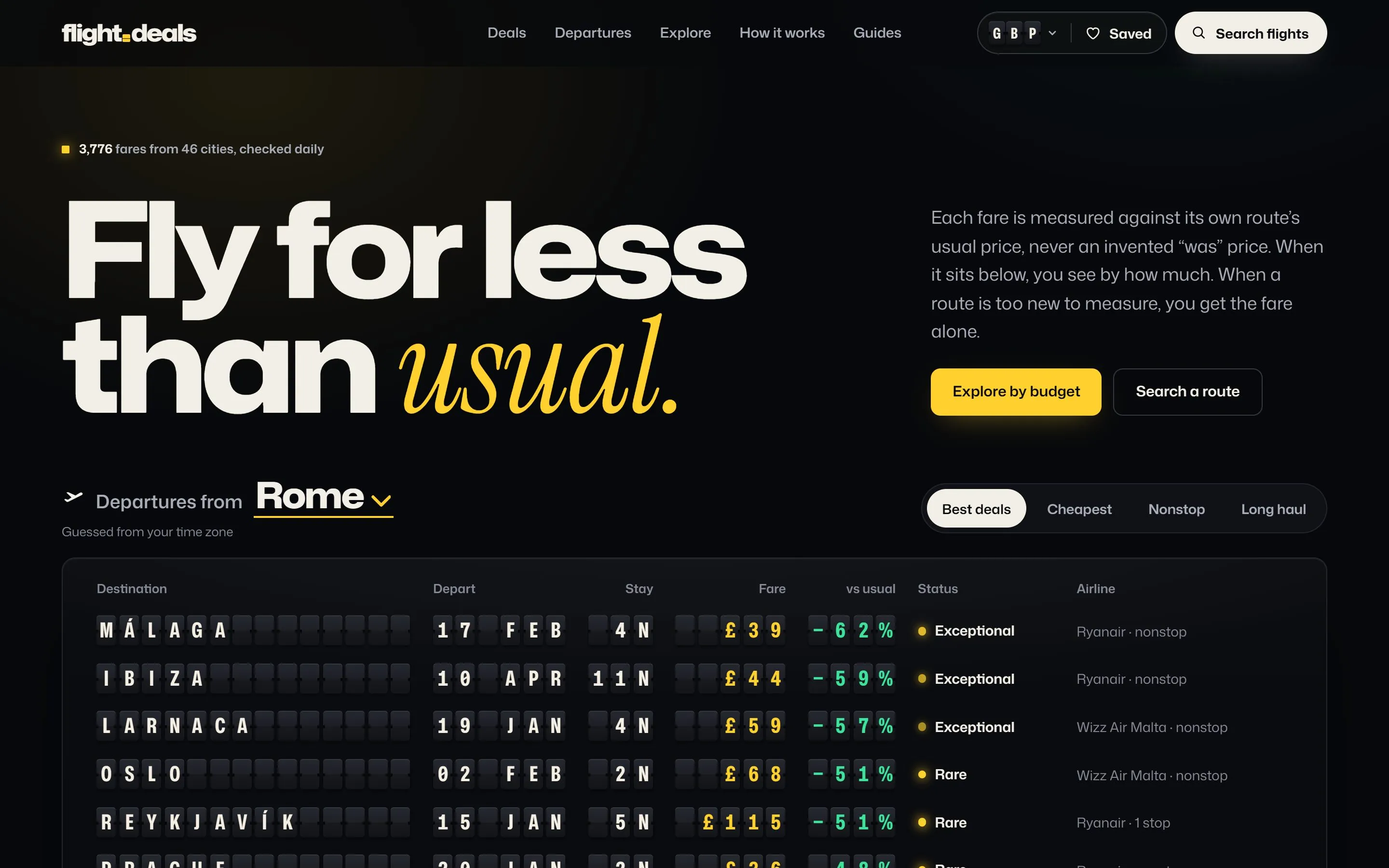
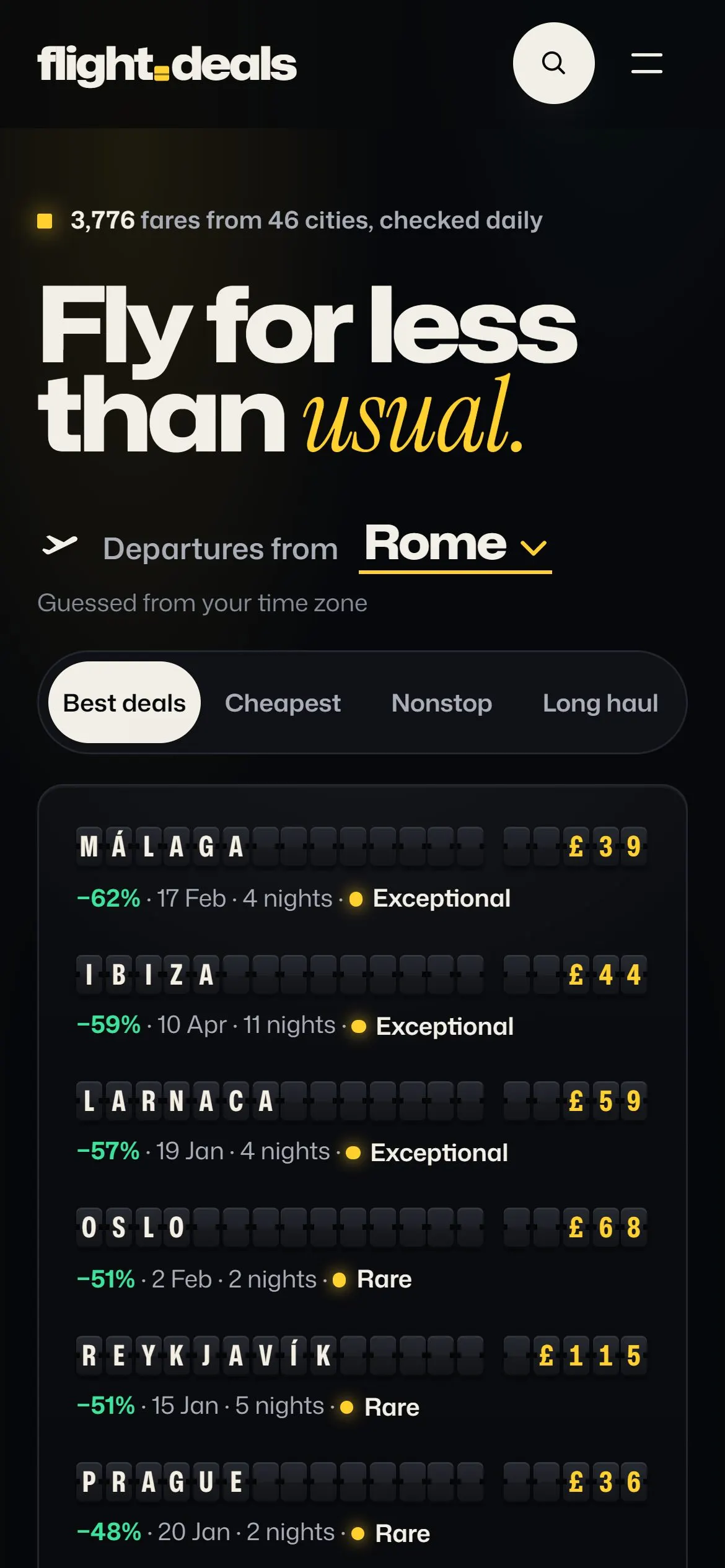
A departure board. The home page opens on a near-black ground with “Fly for less than usual.” in Mona Sans at weight 800, about 138 pixels tall on a desktop screen, with the last word set in Instrument Serif italic and coloured yellow. Below it sits the board itself. Destination, date, length of stay, fare and drop are spelled out on split-flap cells, letter by letter, like the departure boards in an airport hall. The footer names the reference: “Split-flap homage to the boards that taught the world to read departures.” The currency picker in the header uses the same cells, so the display currency reads “G B P”.
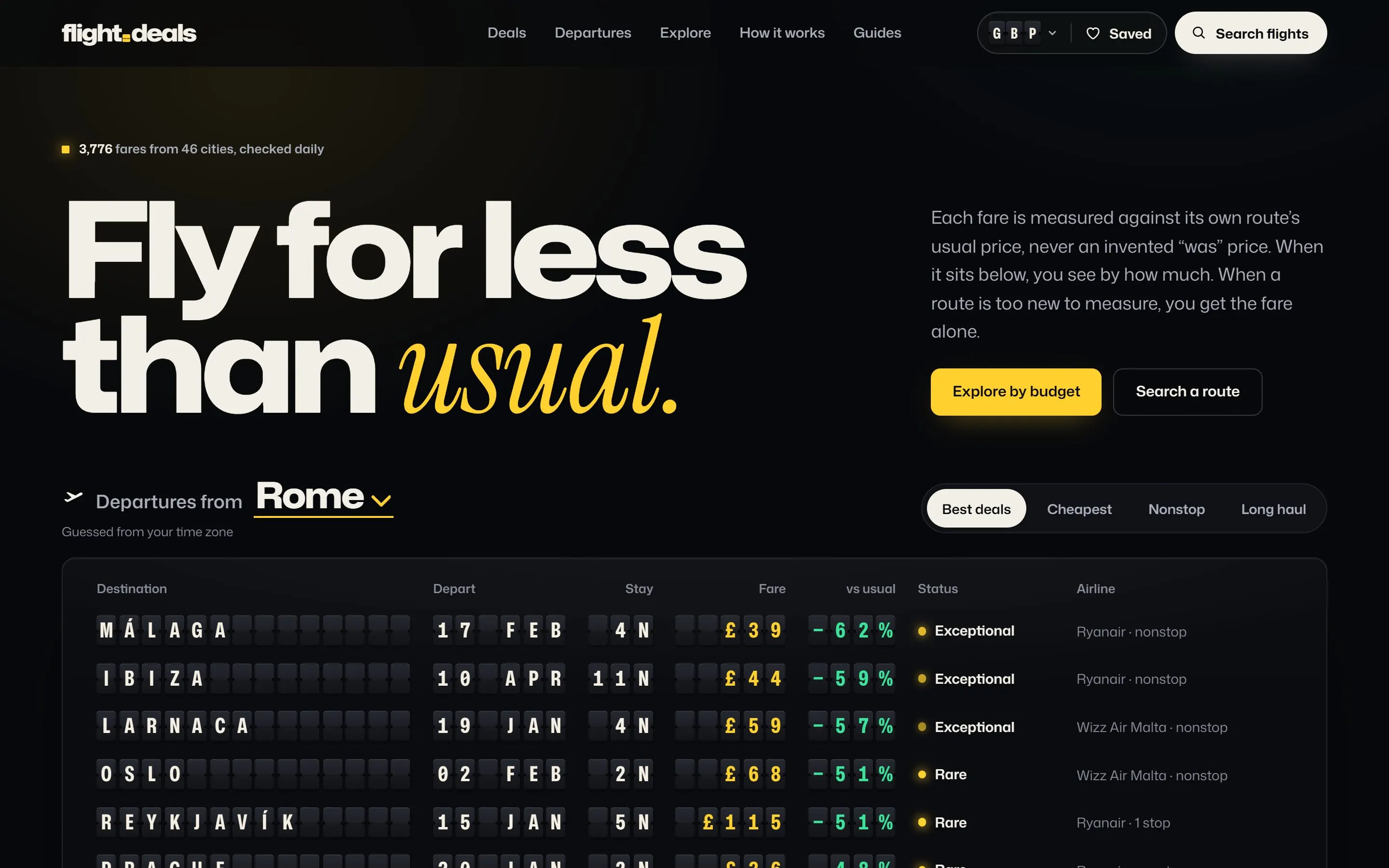
Two surfaces. The site runs on two themes declared in its markup. Fares live on the dark “terminal” surface: the board, the route pages, the city and destination pages. The pages a visitor reads rather than scans use a warm “paper” surface: How it works, Partners, the guide articles, the affiliate disclosure, the privacy policy. One accent links them, a yellow (#ffd02e) the stylesheet calls ember, used for prices, the active city and the main button. On paper it gives way to a dark gold, ember-deep (#7a5200), for the italic words in headlines. A green marks every drop.
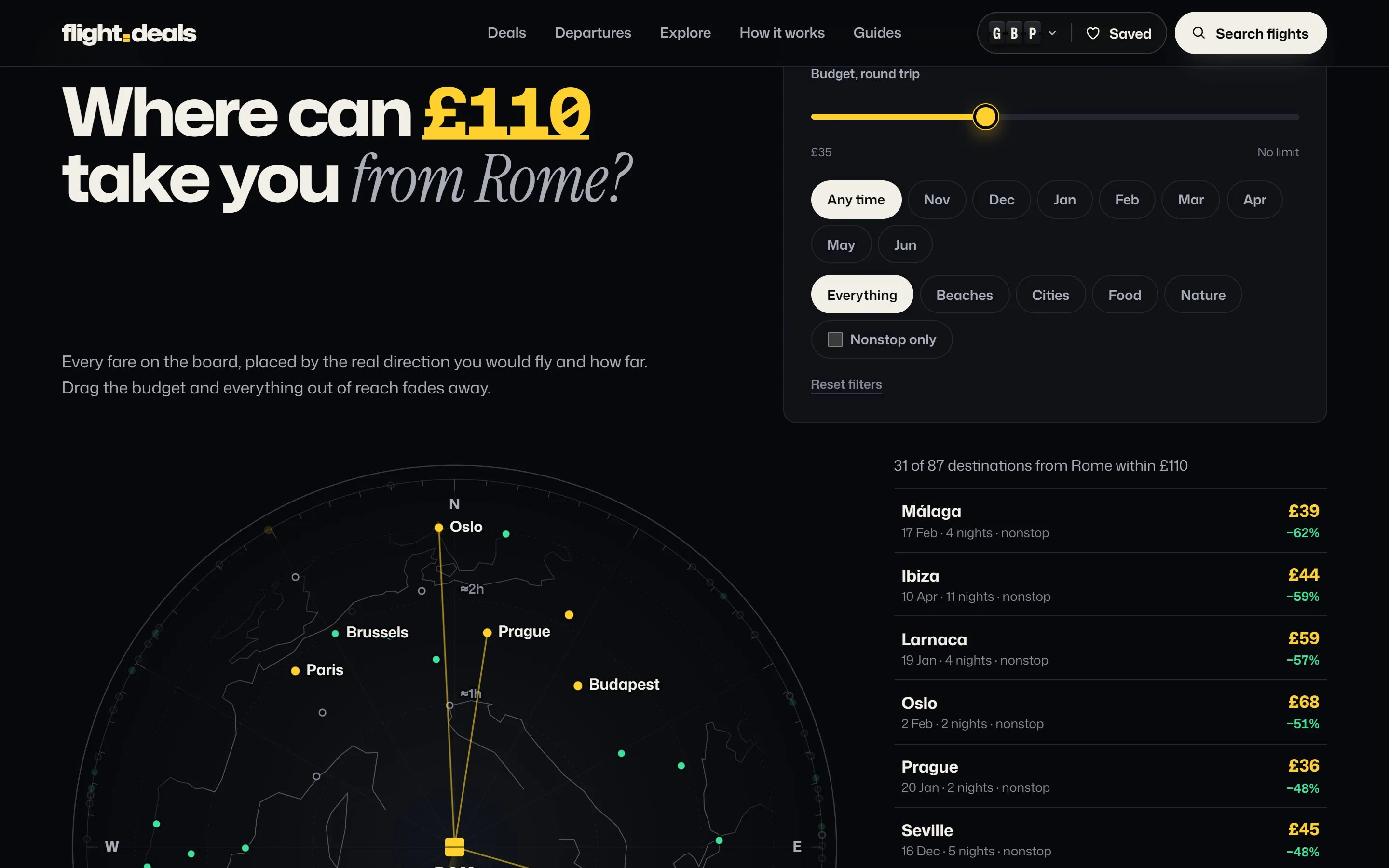
The scope. The second section of the home page is a map of reach rather than a list. “Where can £110 take you from Rome?” places every fare on the Rome board by the real direction of flight and its distance, inside rings of approximate nonstop flying time. A budget slider, a month row, five kinds of trip (from Everything to Nature) and a nonstop switch filter it; the page says “Drag the budget and everything out of reach fades away.” At £110 on 18 November 2026, 31 of 87 destinations from Rome were within reach.
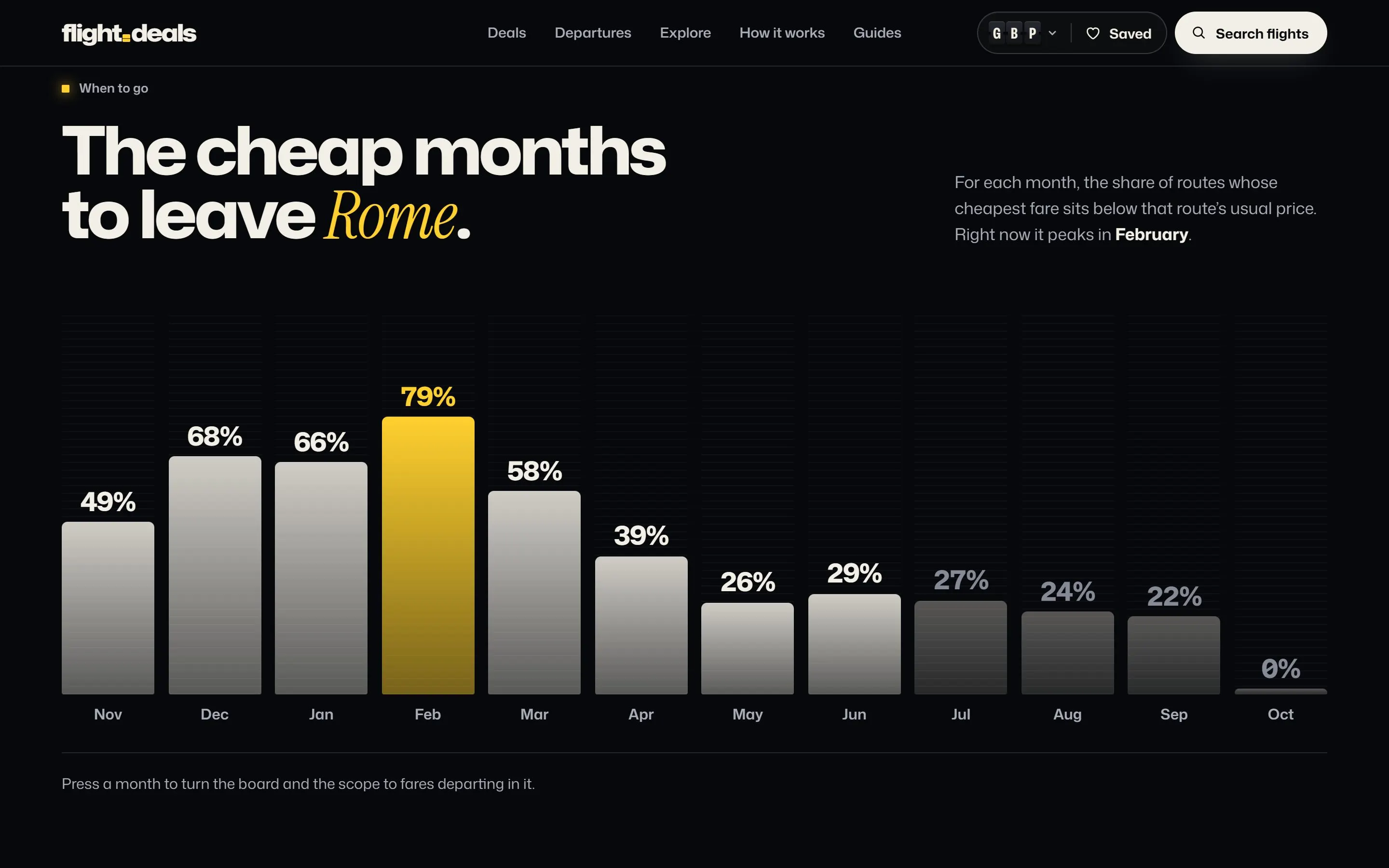
The months. Below the scope, a bar chart answers “The cheap months to leave Rome.” Each bar is the share of routes whose cheapest fare in that month sits below the route’s usual price, and each carries its own sentence, such as “Feb 2027: 34 of 43 routes below their usual price.” Months where no fare yet departs are drawn in grey and say so. Pressing a month turns the board and the scope to fares departing in it.
The experience
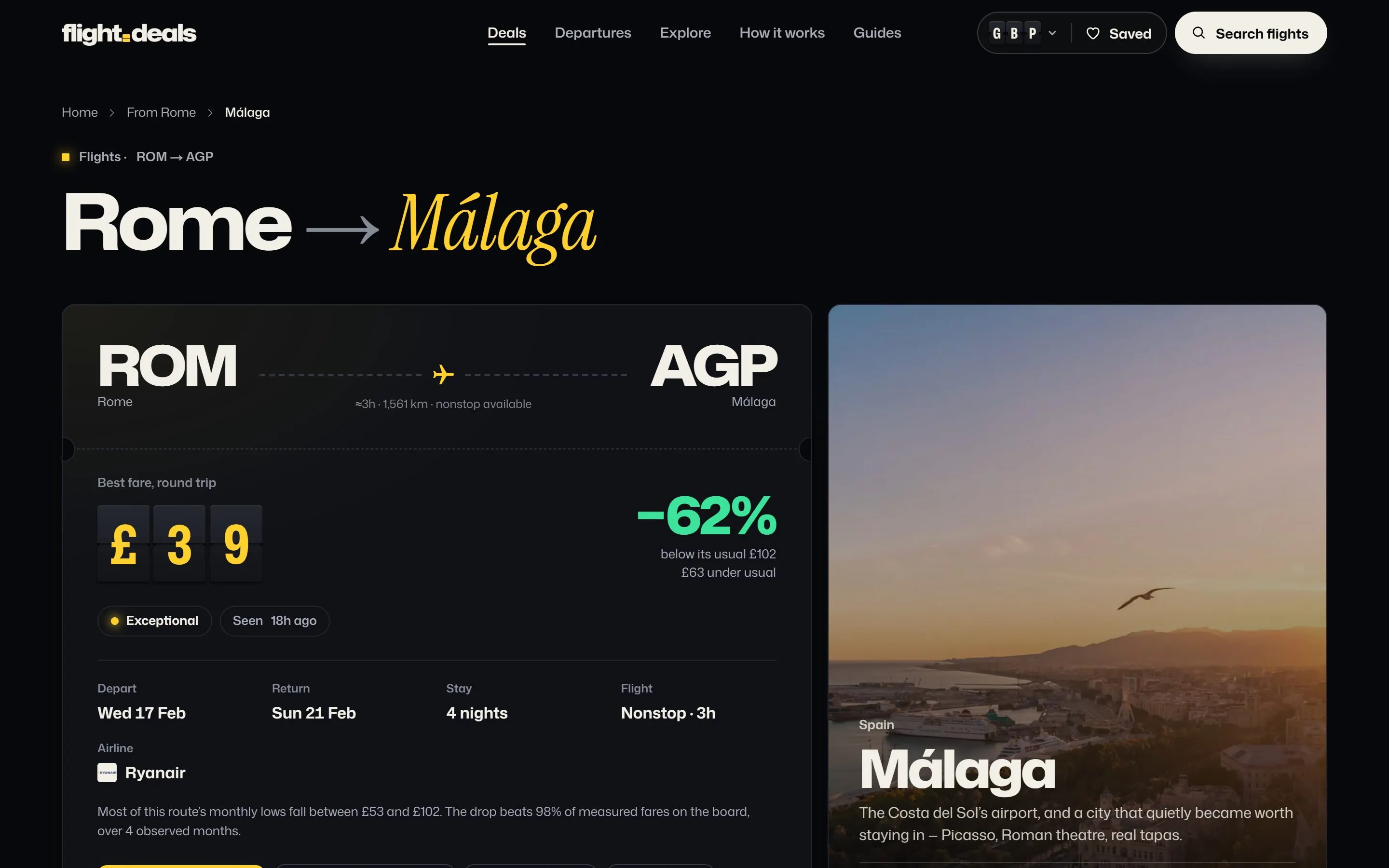
A route page is a boarding pass and a dossier. Every route has its own address, such as /flights/rome-to-malaga/. The page opens with the two airport codes, the distance and flight time, and the best round-trip fare on split-flap cells. On 18 November 2026, Rome to Málaga showed £39 for 17 to 21 February, 62% below its usual £102, labelled Exceptional and “Seen 18h ago”. Under the fare, one sentence places it: most of the route’s monthly lows fall between £53 and £102, and the drop beats 98% of measured fares on the board, over four observed months. The main button reads “Check this fare” and says that it opens the booking site in a new tab.
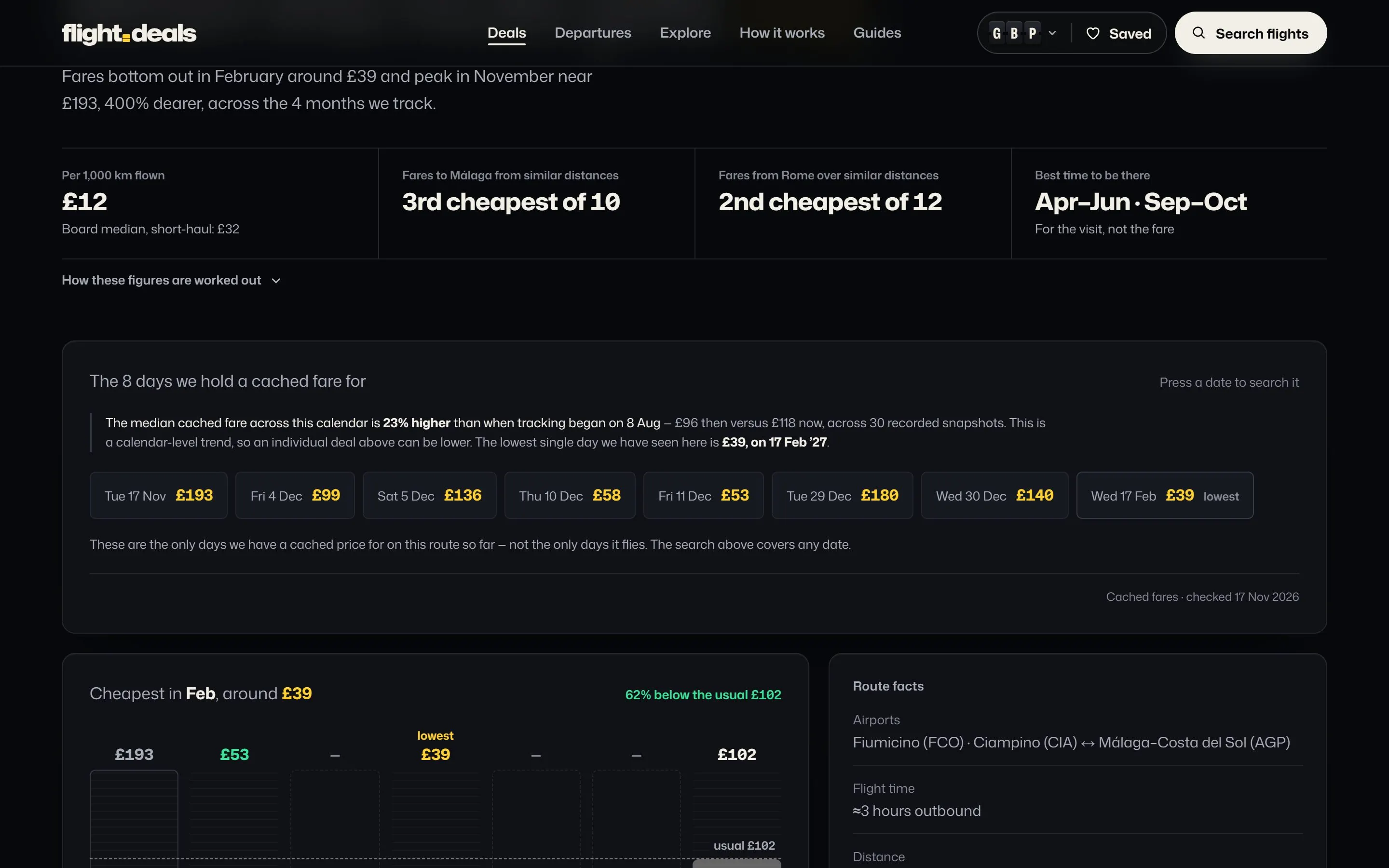
The calendar shows only what it knows. Further down, the route page lists the days it holds a cached fare for. For Rome to Málaga there were eight, from £193 on 17 November to £39 on 17 February, and the page adds: “These are the only days we have a cached price for on this route so far — not the only days it flies.” How it works explains the rule behind it: a blank date means no search has priced that day lately, not that the flight is full or expensive. Depending on how many days are priced, a route page shows a ranked grid, a list of days, a plain grid, or no calendar at all; on 18 November 2026 those counts were 672, 2,038, 733 and 532 route pages.
Around the route. Each departure city has its own board, scope and month chart; each destination has a page of the fares moving towards it. The Deals page sets six fares from every city side by side with filters for city, price, month and nonstop. Latest moves lists identical trips priced at the last two refreshes: on 17 November, 78 got cheaper and 71 dearer. Saved fares are kept in the browser, each beside the price it had when saved, with a target price the visitor can set. The Privacy page notes that there is no mailing list.
The method, in public
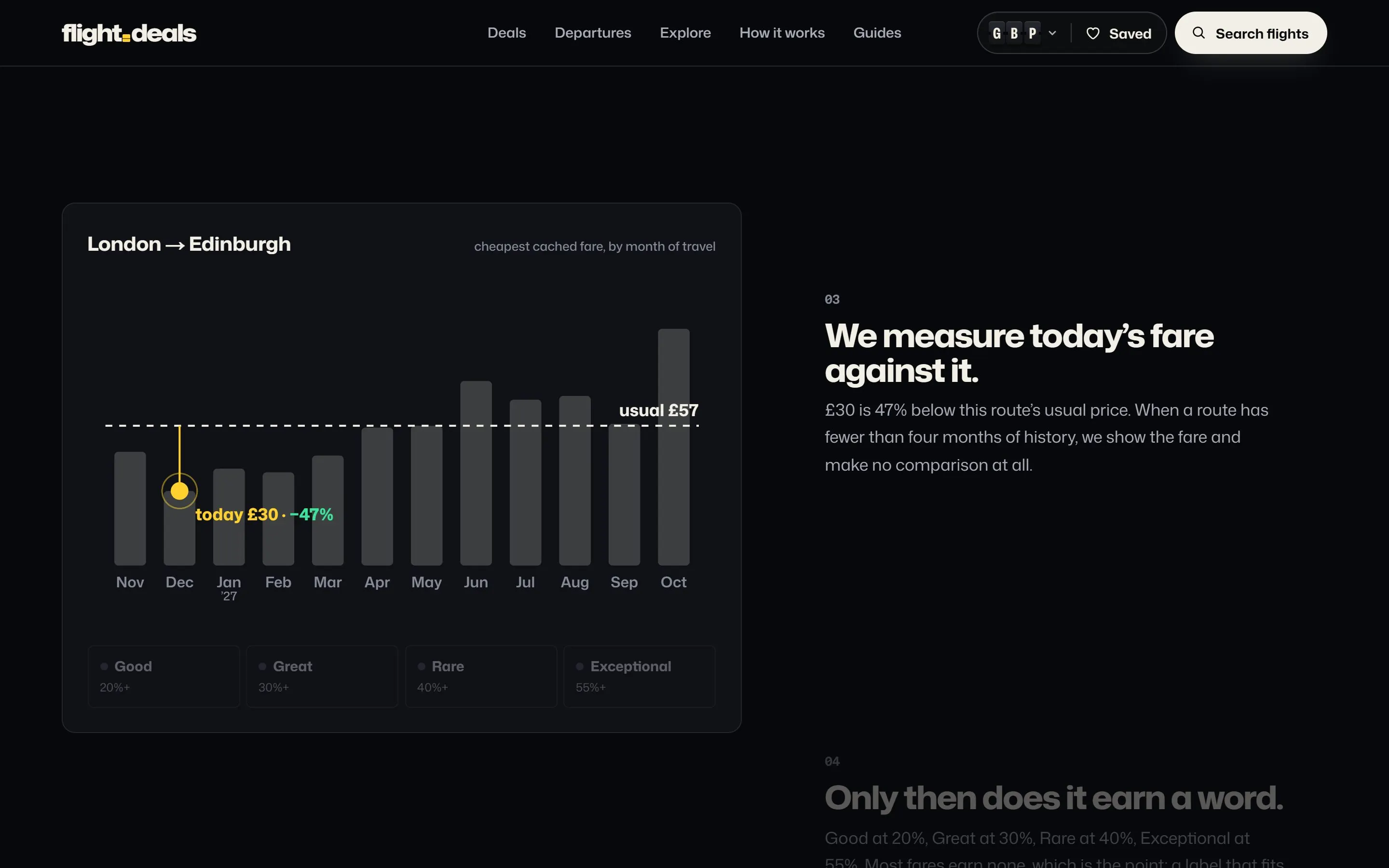
The home page and How it works both tell the method as a scroll story. A chart of one route, London to Edinburgh, sits beside four numbered steps. As the reader moves through them, the chart draws the route’s monthly lows, then the usual price as a dashed line at £57, then today’s fare at £30, 47% below it. The fourth step sets out the four label thresholds beneath the chart.
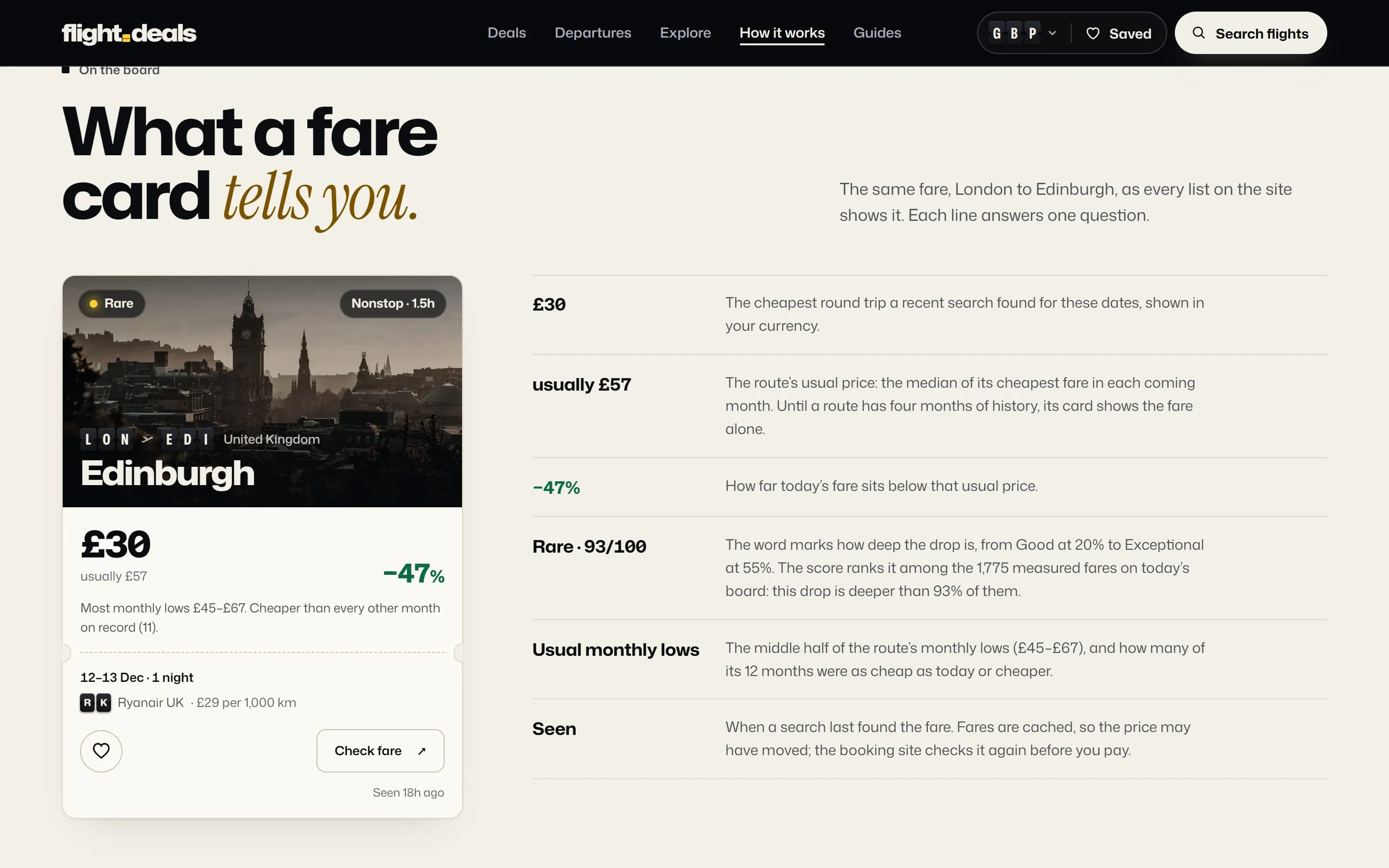
How it works then takes a single fare card apart, line by line. The figure is the cheapest round trip a recent search found; “usually £57” is the route’s median of monthly lows; the percentage is the drop; “Rare · 93/100” means the drop is deeper than 93% of the 1,775 measured fares on the day’s board. The page states that the score is a rank, not a formula, “which anyone can reproduce from the published data”.
The page is just as plain about its own numbers. It says that 1,775 of the 1,789 measurable routes sit below their usual price, and that the share is “high by construction, not by luck”, because the board keeps each route’s cheapest fare and that fare usually sits under the median of its monthly lows. What matters, it says, is how far under. It also gives the share of measured fares that clear each word: 46.5% clear Good, 11.8% Rare, 2.4% Exceptional.
How it is paid for
The business model is described in three places, and they agree. The footer of every page says that some booking links are affiliate links, that flight.deals may earn a commission at no extra cost to the visitor, and that it “never decides what a deal is”.
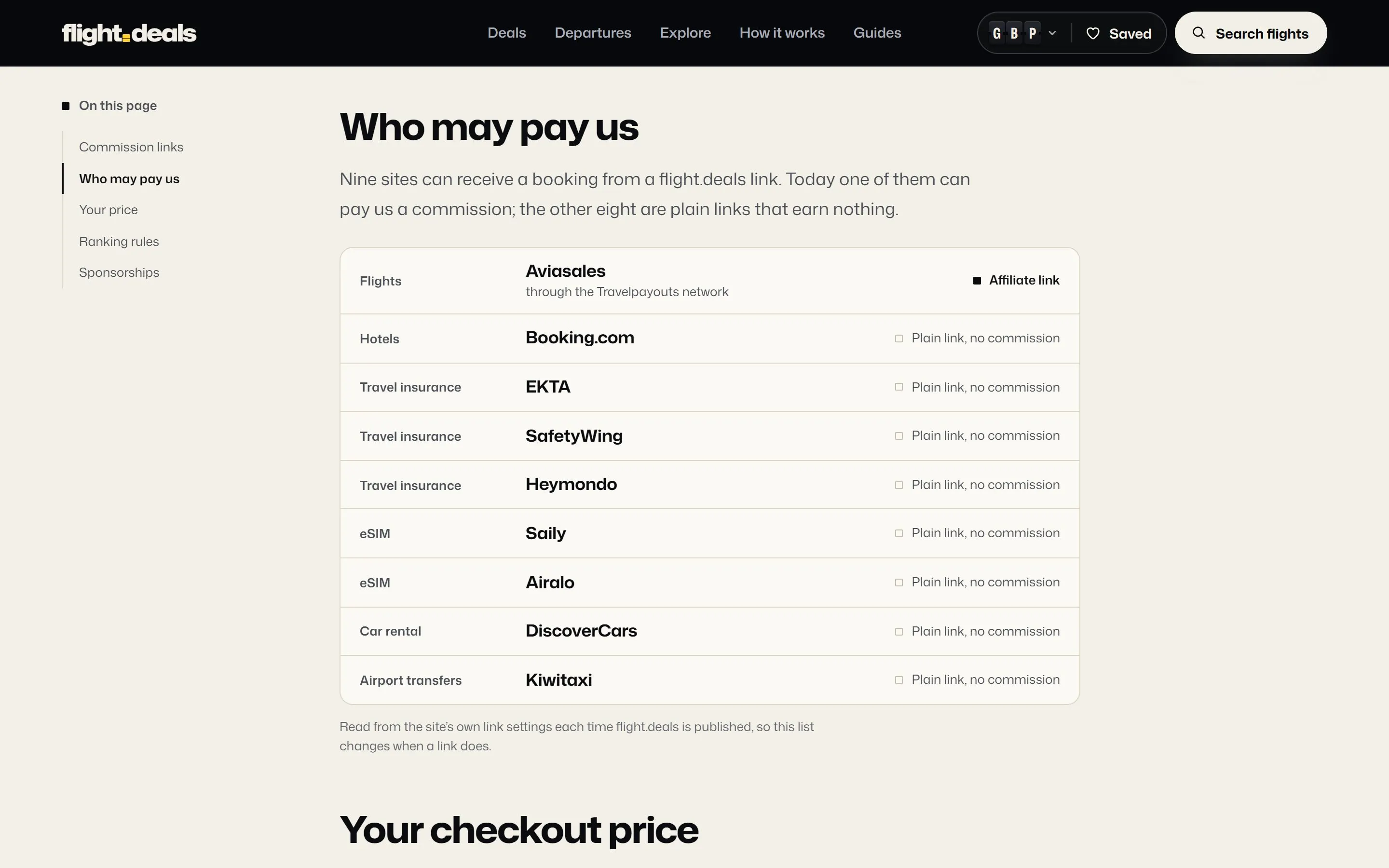
The affiliate disclosure, dated 11 November 2026, is specific. Nine sites can receive a booking from a flight.deals link. One of them, Aviasales, reached through the Travelpayouts network, is marked as an affiliate link; outbound fare links to it carry a partner marker in their address. The other eight are listed as “Plain link, no commission”: Booking.com for hotels, EKTA, SafetyWing and Heymondo for travel insurance, Saily and Airalo for eSIMs, DiscoverCars for car rental and Kiwitaxi for airport transfers. The page says the list is read from the site’s own link settings each time it is published, and that nothing on the site is sponsored today.
The Partners page draws the hand-off. The fares come from the Travelpayouts Data API, “a cache of searches made on Aviasales and its partner agencies”, and the site says it does not scrape airline or agency websites. A visitor leaves only by choosing a fare:
On the board
- 01A fare on the boardflight.dealsCached, dated, and measured against its route’s usual price where the history allows.
The choice
- 02“Check fare”VisitorThe visitor chooses to leave. The Partners page says nothing opens on its own, and booking URLs are never preloaded.
The click
- 03A new tabflight.dealsThe booking site opens in a new tab on a link marked rel="sponsored nofollow". A click through the site’s own endpoint records route, seller and offer, with no IP address, user agent or referrer, for 90 days.
The booking
- 04The partner takes overBooking siteIt prices the trip again against the seats on sale, then handles the itinerary, the final price and the payment.
The same page lists what it calls rules the board keeps, among them “No urgency”: no countdowns and no “only 2 left”. The ranking is stated in the disclosure as two things only, the measured drop and how recently the fare was seen; commission rates and paid placement “play no part”.
The search at /search/ is presented the same way. It is labelled “Flight search · preview”: where the site tracks a route, its real cached fare comes first, and the comparison of sellers below it is a preview. The Partners page states the status directly: “Live feed: not connected”.
The system
Built to be counted. The Partners page calls its coverage figures “counted, not claimed”, computed from the same data the board is drawn from. On 18 November 2026 they included 177 airlines named on the day’s fares, 3,975 route pages published (routes resting without a fare keep their page), and 254,441 dated fares on record across 3,945 routes, the oldest seen on 16 July 2026. The board refreshes every 24 hours.
Private by default. The Privacy policy says the site sets no cookies and runs no analytics script, which is why no consent banner appears. Saved fares, targets, the chosen city and currency are kept in the browser’s local storage under keys the policy lists one by one. The guess of departure city and currency is made in the browser from its time zone and language, with no location request and no IP lookup. Destination photographs and airline marks are served from flight.deals itself.
Written for machines as well. The site is in one language, English, and declares no hreflang alternates. Its robots.txt allows every crawler except the /api/ paths, and points to a sitemap index. On 18 November 2026 that index held one sitemap of 1,943 URLs, among them 1,789 route pages, 46 departure-city pages and 88 destination pages. The site also publishes an llms.txt describing the method, RSS feeds for the board, for each city and for each route, and a web app manifest so the board can be installed on a phone.
Small things, said plainly.
- A guess, labelled as one. Under the departure city the board writes “Guessed from your time zone”, until the visitor picks a city.
- Dated prices. Every fare carries “Seen” and a time; every page footer carries the time of the last board, here 17 Nov, 14:50 UTC.
- A toolkit with reasons to skip. The trip toolkit compares eight providers of insurance, eSIMs, cars, transfers and hotels, and gives each a “Skip it if” as well as a “Pick it for”. It states that none of its links pays a commission.
- Six guides, set beside the data. The guides cover when to book, nearby airports, what a good deal is, the cheapest day to fly, why prices change and error fares, each with a reading time.
Outcomes
- 3,776fares on the board, from 46 departure cities
- 1,789routes with enough history to be measured
- 4words, earned at 20%, 30%, 40% and 55% below usual
- 2.4%of measured fares deep enough to be called Exceptional
- 1 of 9outbound partners that may pay a commission
- 1,943URLs in the sitemap, 18 November 2026
Read on the live site on 18 November 2026, from the board refreshed on 17 November 2026 at 14:50 UTC: the home page, How it works, Partners, the affiliate disclosure, the Privacy policy and the sitemap. Prices are shown in pounds as the site displayed them to a UK-English browser; they change at every refresh.
This case study makes no claims about visitors, bookings or savings. flight.deals says it runs no analytics, and its Partners page describes what the board covers, “never who reads it”.
What it shows is a way to design a deal site around a comparison that can be checked. Choose a baseline that is low on purpose. Withhold the percentage when the history is thin. Make the words scarce. Put the time on every price, and the full list of who may pay on a page of its own.
Explore the project
flight.deals
A daily split-flap board of cached airfares from 46 cities, each measured against its own route’s usual price, with no invented “was” prices.
Sources for this case study
- flight.deals — Home (the fare board)
- flight.deals — How it works (the method, the business model, who runs it)
- flight.deals — Partners (coverage, method, how traffic is sent)
- flight.deals — Affiliate disclosure
- flight.deals — Privacy policy
- flight.deals — Terms of use
- flight.deals — Deals from 46 cities
- flight.deals — Rome to Málaga (a route page)
- flight.deals — Flights from Rome
- flight.deals — Exceptional fares
- flight.deals — Latest moves
- flight.deals — Flight search (preview)
- flight.deals — Saved fares
- flight.deals — Trip toolkit
- flight.deals — Guides
- flight.deals — llms.txt
- flight.deals — robots.txt
- flight.deals — Sitemap index
Everything described here can be checked on the live project. Figures were read on 21 Nov 2026; screenshots are captures of the public site.