The renewal is the price
A price board for 3,055 domain extensions at 147 registrars that ranks every offer by what it costs to keep, not to buy.
Introduction
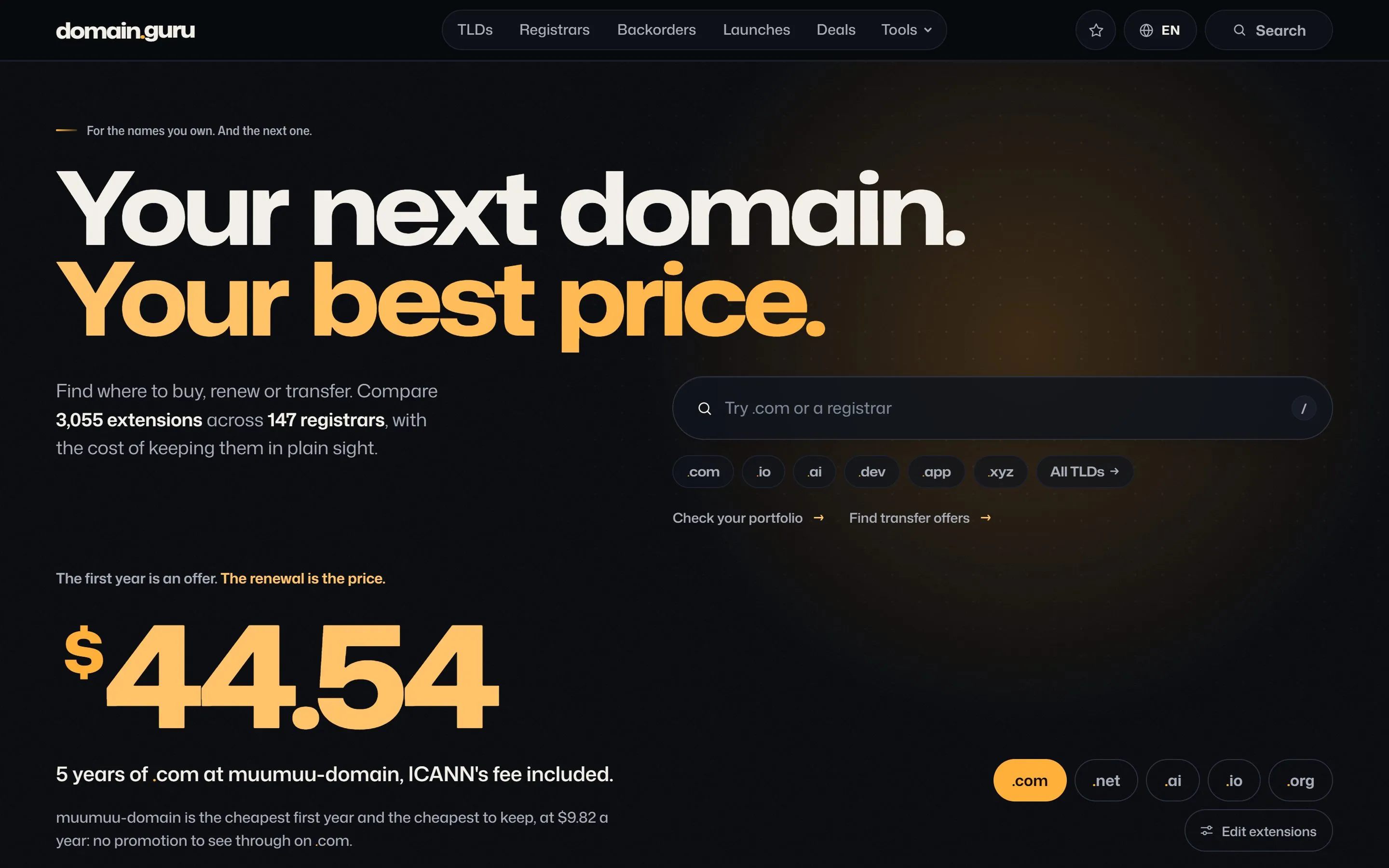
Domain.Guru compares what domain names cost. On 18 November 2026 its board covered 3,055 extensions, from .com to .рф, at 147 registrars. Each one is priced three ways: registering a name, renewing it and transferring it in. Around the board sit a set of tools: a name search, a bulk portfolio checker, price-drop alerts, registrar head-to-heads, a renewal index, and directories of backorder services, registries and new extension launches.
Plenty of sites list domain prices. This one is built around a single editorial position, which the home page states in one line: the first year is an offer, and the renewal is the price. Every ranking on the site sorts by what a name costs to keep over several years, not by the headline number a registrar puts in its banner.
This case study covers how that position became a product. It looks at a formula that every page obeys, an interface that draws cost over time, and a set of rules for evidence, privacy and money that the site writes down and keeps.
The challenge
Domain pricing is designed to be hard to compare. A registrar can sell a .org for $6.02 in the first year and renew it at $50.39. Some prices are for members only. Some need a multi-year first term, some exclude VAT and some include it, and a transfer may or may not add a year. Registrars publish in different currencies and on different tax bases, and the cheapest first year is often at one shop while the cheapest renewal is at another.
A comparison site that simply sorts by the lowest number inherits all of this. It rewards the deepest first-year discount, which is often the shop that charges most from year two. A site in this market also has a commercial pull of its own, because registrars pay for referrals.
So the brief had three parts. Rank by the real cost of owning a name. Show where every number comes from and how old it is. Then make the commercial side visible enough that a reader can check it does not bend the rankings.
The concept
Three decisions shape the rest of the site.
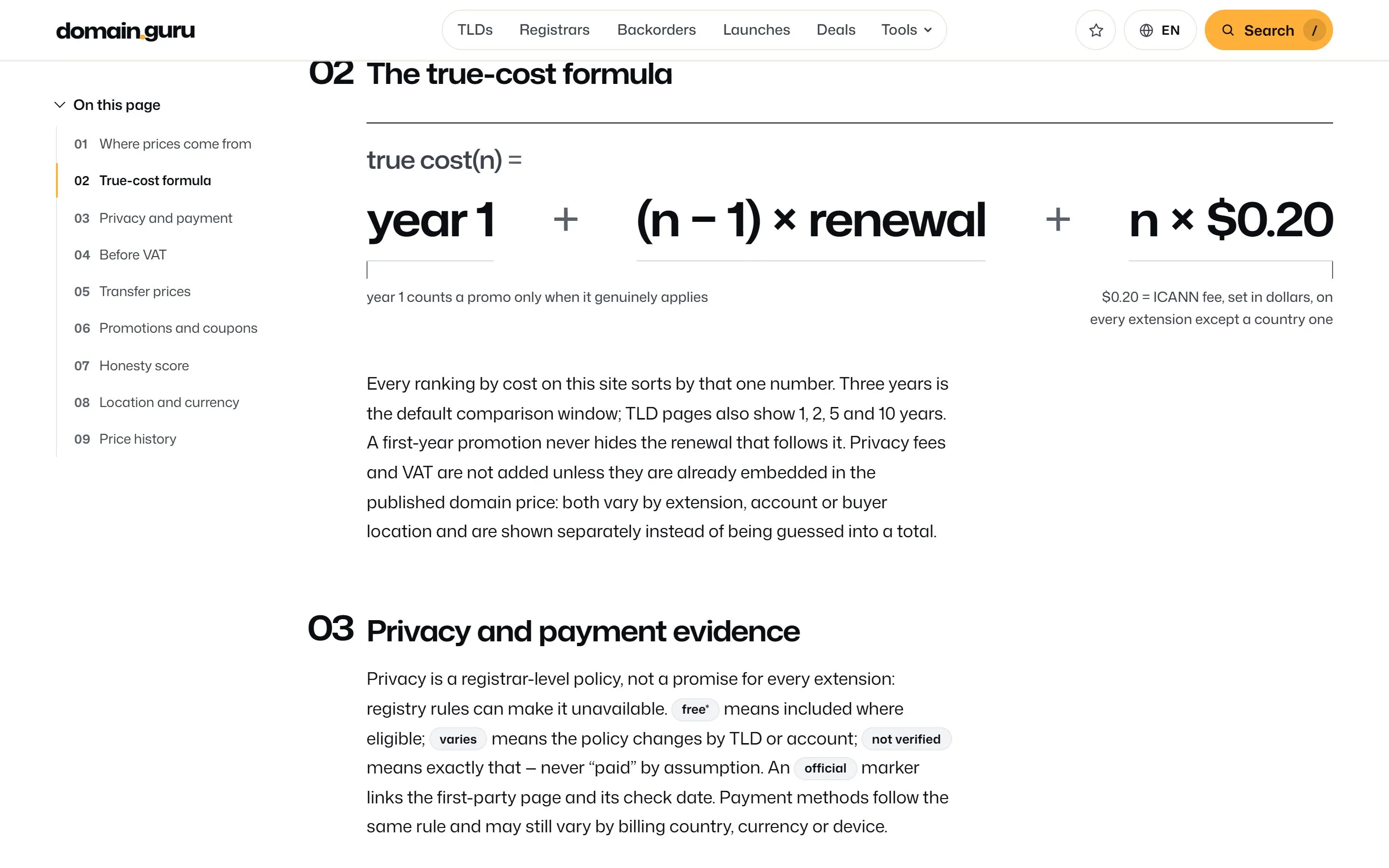
- One formula for every ranking. The Method page sets it out in large type: true cost(n) = year 1 + (n − 1) × renewal + n × $0.20, where $0.20 is the ICANN fee on every extension except country ones. Three years is the default window, and extension pages also show 1, 2, 5 and 10 years. A first-year promotion counts only “when it genuinely applies”, and it never hides the renewal that follows.
- Evidence, dated. Every price carries a status. Live means it was fetched from the registrar and dated. Held means the last good price is shown with its original date because a later fetch failed. Registrars without a reproducible source are not published at all. The footer of every page gives the time of the last read and how old it is.
- Judge the shop, not only the price. Each registrar gets an honesty score out of 100 for transparency: renewal shown upfront (30), a clean cart (30), no forced multi-year term (20) and public, stable pricing (20). Unknowns score a disclosed neutral half, so a missing piece of evidence counts as neither a bonus nor a failure.
The first year is an offer. The renewal is the price.
The design
A trading floor at night. The data pages use a dark theme: a near-black ground, warm off-white ink (#f2f0e9) and one amber accent (#f0a43a). Green marks a price that fell and red one that rose. Headlines are set in Mona Sans, a variable typeface, widened to 118% and set at weight 740 with tight tracking. On a desktop screen the home headline is about 105 pixels tall. Its second line, “Your best price.”, is filled with an amber gradient.
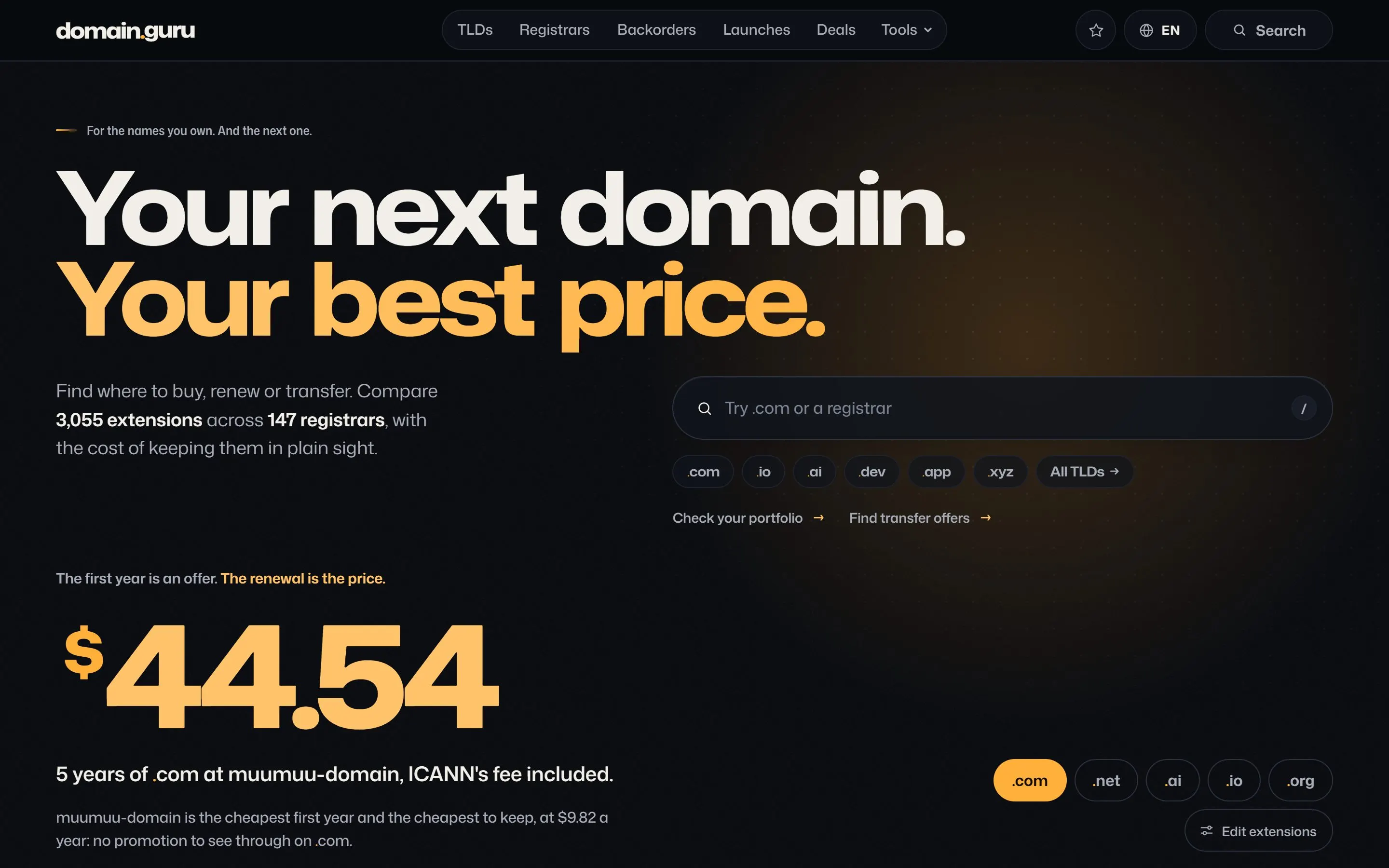

Figures of its own. The site ships a small font file of its own, named guru-glyphs. It supplies only the digits and two arrows (→ and ↗), and the stylesheet applies its figures to prices, scores and chart labels. Numbers are the product here, so they get their own drawing. The wordmark has a quieter detail. On hover or keyboard focus, the letters of “guru” run through a short sequence of other letters, like a split-flap departures board, before settling. The effect is switched off when a visitor asks for reduced motion.
Two tones. The pages meant for reading switch to a light theme marked in the code as the “reading” tone. These are Method, the guides, Privacy, Terms and Contact. They use a warm paper (#f4f1e9) and a darker amber ink (#925b06), dark enough to carry white text on buttons. The board stays dark and the explanations sit on paper.
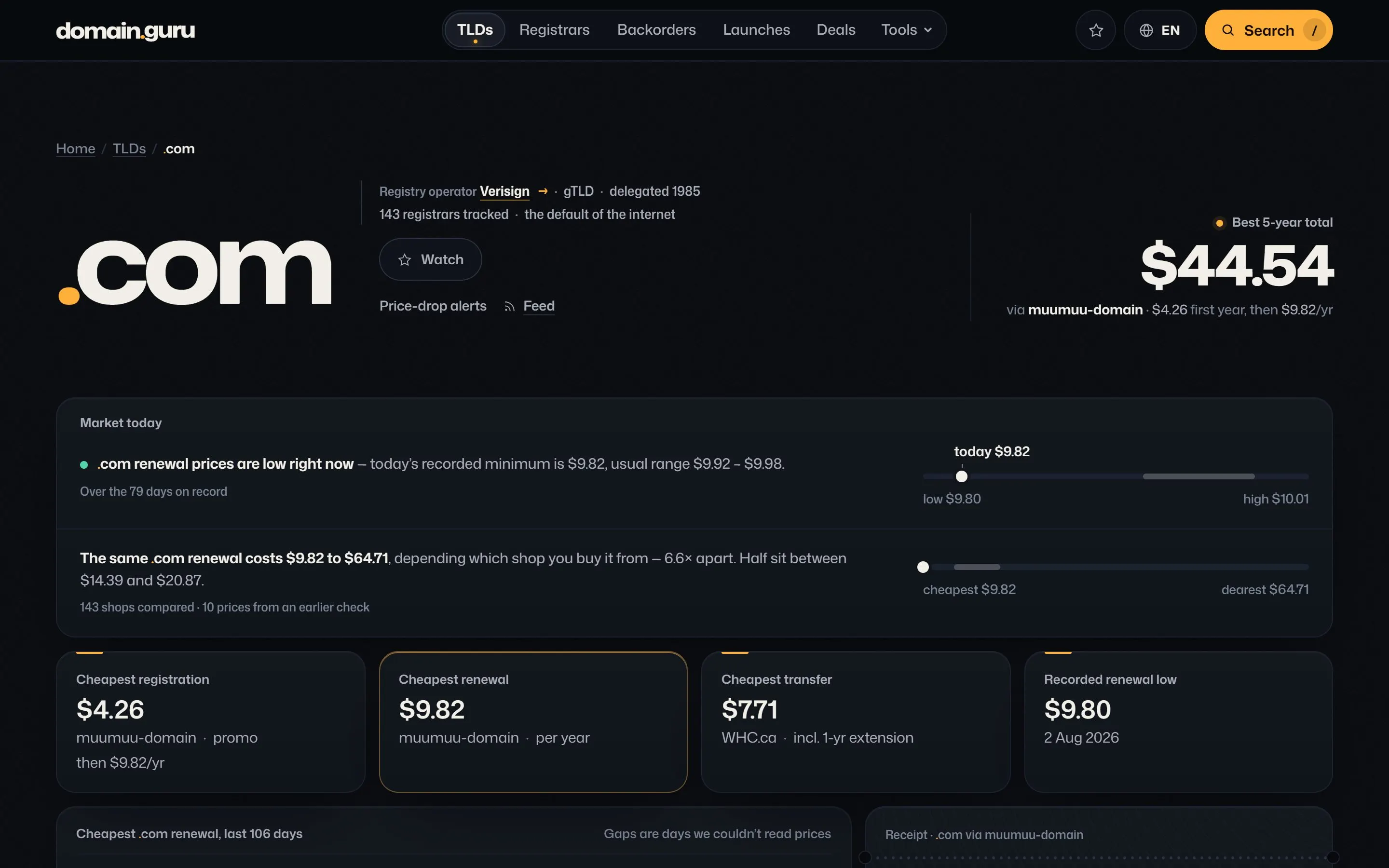
An extension as a page. Each of the 3,055 extensions has its own page. The .com page opens with the extension set large, its amber dot echoing the wordmark, beside its registry (Verisign), its type and the year it was delegated. Then comes a plain-language reading of the market. On the day of capture it said .com renewals were “low right now” and that the same renewal cost from $9.82 to $64.71 depending on the shop, “6.6× apart”.
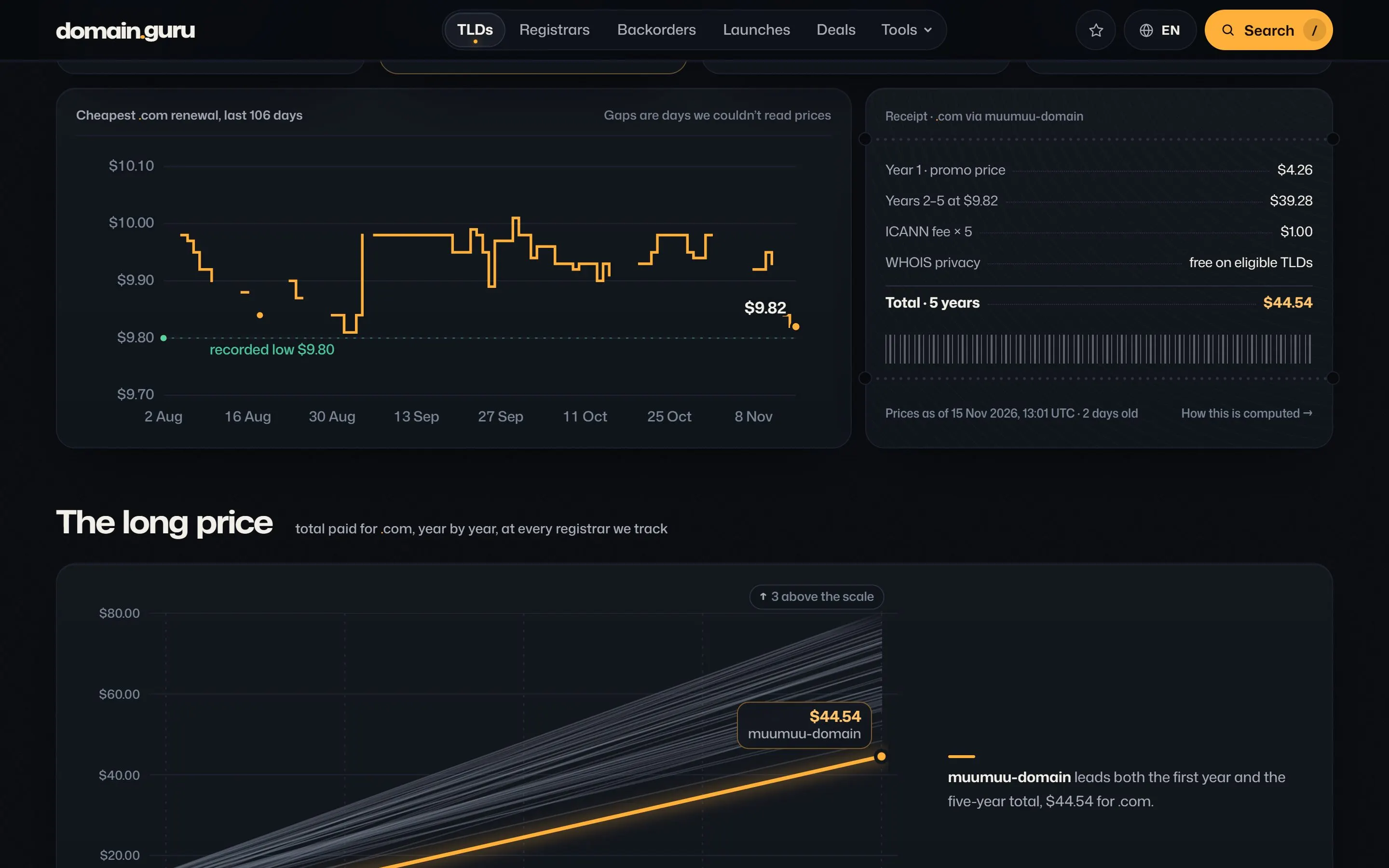
A receipt and a long price. Below the cards, the cheapest five-year path is printed as a receipt: year one at the promotional price, years two to five at the renewal, ICANN’s fee five times, WHOIS privacy, then the total. Beside it, a step chart shows the cheapest .com renewal for each day on record and leaves gaps where prices could not be read. Under both sits the chart the site calls “the long price”. It draws the total paid, year by year, at every registrar, with the cheapest highlighted in amber and every other shop as a thin grey line. On the home page the same chart has a slider for the years kept, from one to ten, and the ranking beside it reorders as the slider moves.
The board on the home page applies the same idea to the 100 most-registered extensions. Each row gives the cheapest register, renew and transfer price, each with its shop. It adds a “renewal step”, the ratio between a first-year price and its own renewal, flagged in red when it is high. The column’s note gives the rule: “×2.5 and above is a renewal trap.”
The experience
Method, in one readable page. The Method page is the site’s constitution. It covers where prices come from, the formula, privacy and payment evidence, VAT, transfers, coupons, the honesty score, currency and price history, as nine numbered sections with a side index. It explains choices that a less careful board would hide. Prices are compared before VAT, and a +VAT marker appears only where a registrar is confirmed to add it for consumers. If a registrar publishes no transfer price for an extension, its transfer cell stays empty rather than borrowing the renewal. History charts “use recorded observations only”, and missing days stay missing.
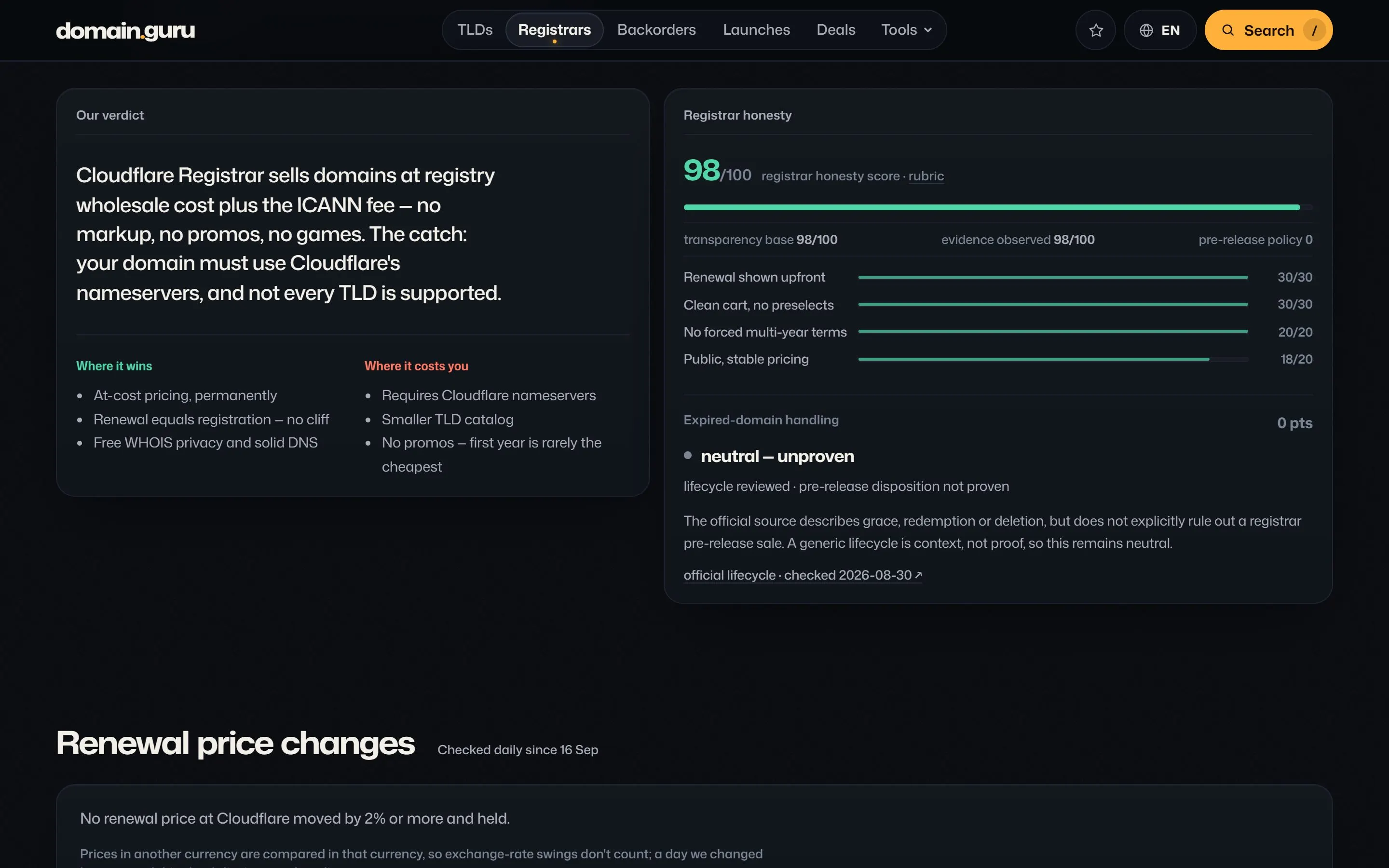
Registrars, priced and judged. Each registrar page has a title in the same form, such as “Cloudflare, priced and judged.” It counts the extensions where that registrar is the cheapest of the 147, gives its founding year, base, payment methods and privacy policy with links to first-party sources, and writes a short verdict with what it does well and where it costs you. The honesty score sits beside the verdict, with each criterion on its own bar. A separate line covers expired domains. A registrar loses five points if it can auction a lapsed name before the registry’s redemption period, and gains five if its own policy promises that period. A generic lifecycle diagram on a registrar’s site is not taken as proof either way.
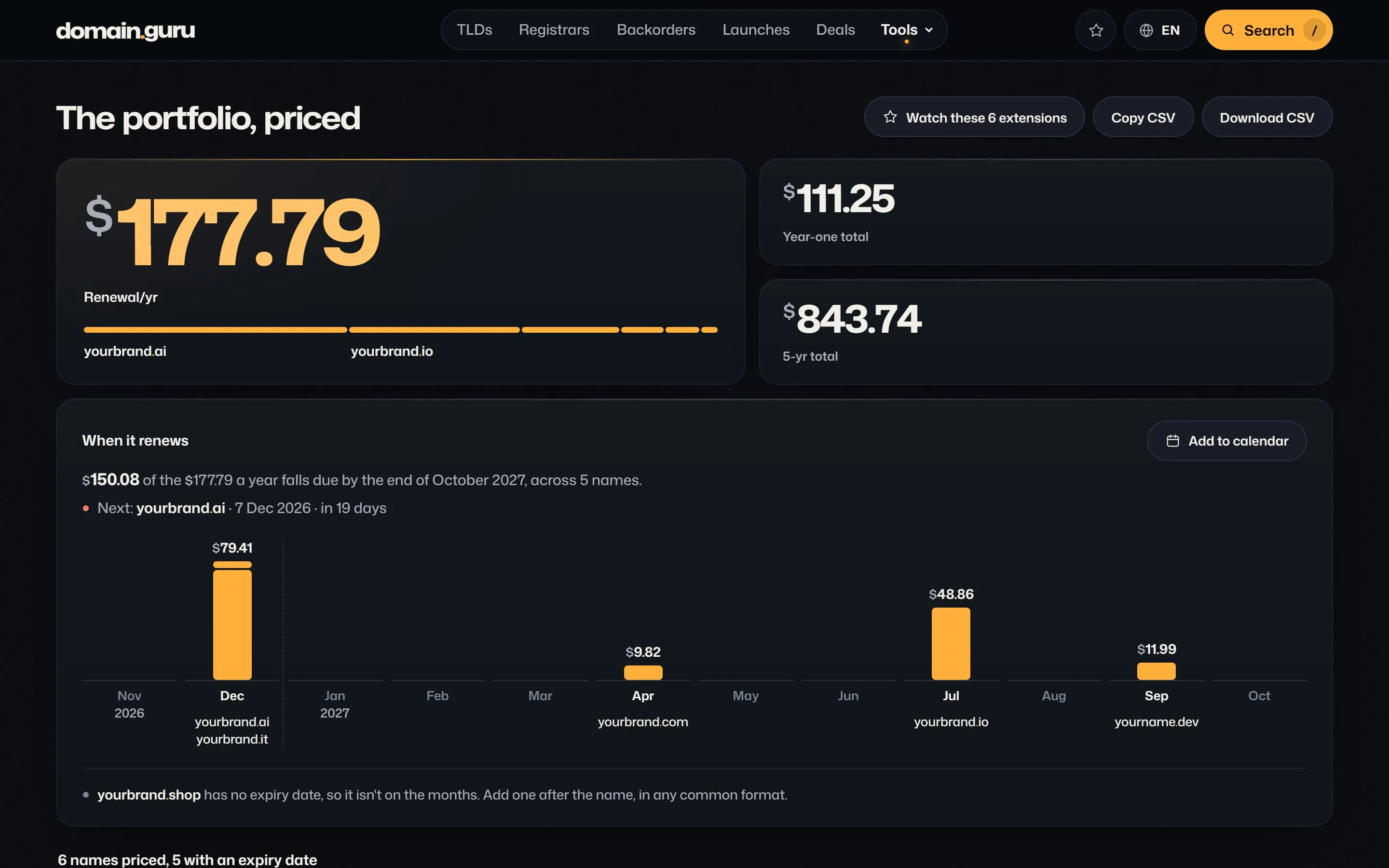
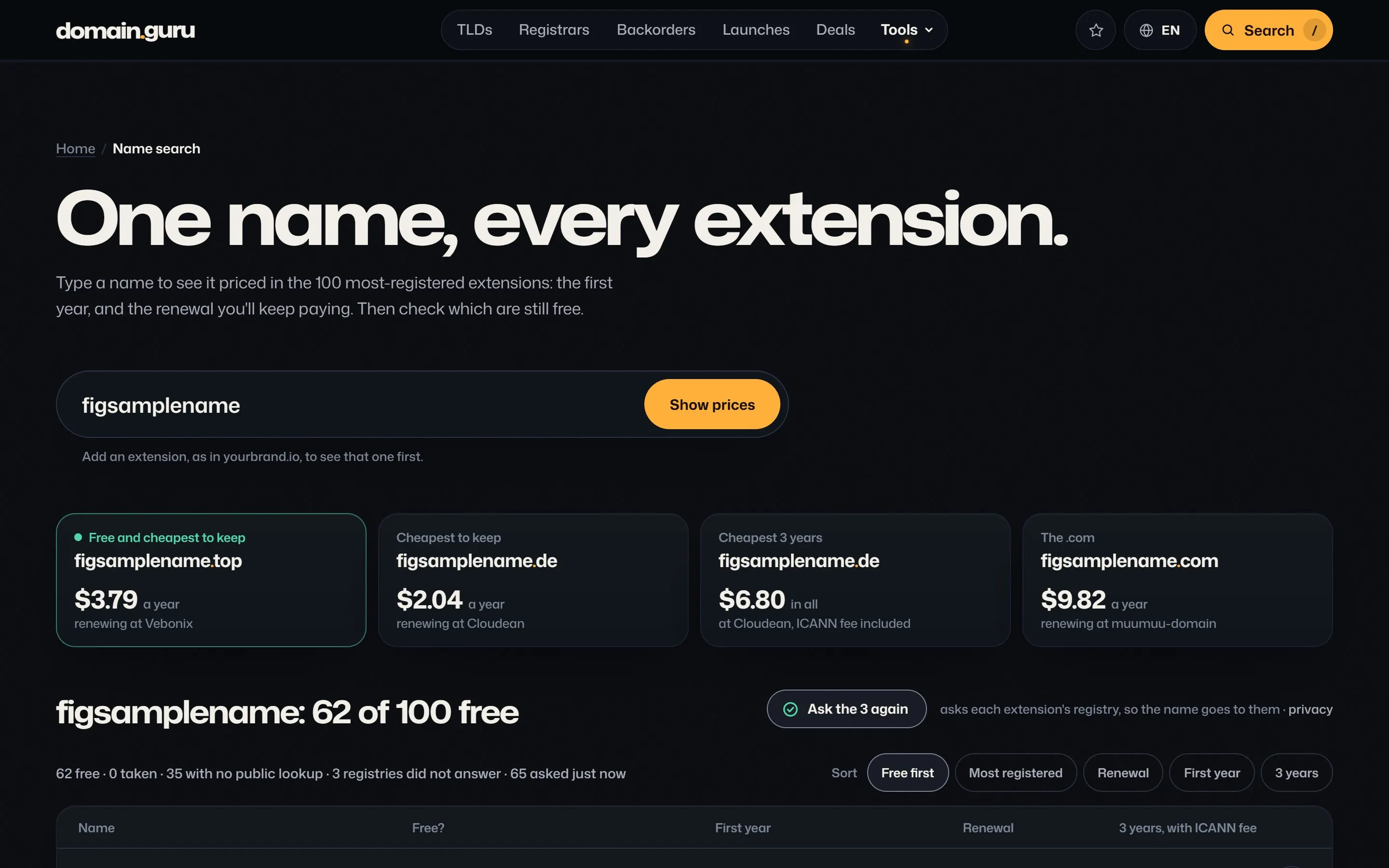
The tools. The name search prices a single name in the 100 most-registered extensions and shows the cheapest to keep, the cheapest over three years and the .com. A second button checks which of those names are free. The bulk checker takes up to 500 domains, with expiry dates “in any common format”. It returns the year-one total, the yearly renewal bill and the five-year cost, lays the renewals out by month and offers a calendar file of reminders. A “Stay or move?” table then costs each name kept at its current registrar for five years against moving it to the cheapest one that publishes a transfer price. The alerts page announces a renewal only when it reaches a new 30-day low, at least 2% under the lowest price of the previous 30 days. It gives its reason: of 36,381 falls recorded since 2 August 2026, 58% were under half a percent, mostly exchange rates moving.
What leaves the browser
The Privacy page opens with a single sentence: “We store almost nothing.” It names each of the thirteen keys the site keeps in the browser’s local storage, such as the watchlist, the currency, the text size and the last pasted bulk list. Then it lists every request that does leave the browser, in plain terms. Two of them involve a name the visitor types. The availability box on an extension page sends that name to rdap.org. The name search, when its check button is pressed, sends the name to each extension’s own registry through the public RDAP services listed by IANA, and “none of it passes through Domain.Guru”.
FIG checked both tools on 18 November 2026 with a made-up name, figsamplename, and a script that recorded every request the page made.
Opening a page
- 01The page loadsdomain.guruOn the home page, all 30 requests went to domain.guru: HTML, scripts, styles, fonts and registrar logos. None went to an analytics or advertising domain.
Pricing a name
- 02Prices appearBrowserTyping the name and pressing Show prices priced it in 100 extensions. No request carried the name; the prices were already in the page.
Checking availability
- 03Registries are askedRegistriesCheck which are free sent 65 requests to 36 registry RDAP servers, such as rdap.verisign.com for .com. Each was a plain GET. None went to domain.guru.
- 04The answerBrowserThe page reported 62 of 100 free, 0 taken, 35 with no public lookup and 3 registries that did not answer, with a button to ask those 3 again.
Pricing a list
- 05The list staysBrowserPricing the example list fetched one public file, move-plan.json, and registrar logos. Every request was a GET with an empty body.
The page is equally plain about what the site does not do. There are no accounts, no newsletter, no advertising network, no fingerprinting and no tracking cookies, and the site “works with cookies fully disabled”. Alerts follow the same rule. Instead of email, every extension has a feed, plus one for everything at /feed.xml, and the page suggests a feed-to-email service of the reader’s choosing, “so Domain.Guru never holds your address”. The contact form is the one place where a visitor hands over a name and an email address, and the Privacy page names the service that delivers it, Web3Forms.
How it is paid for
Domain.Guru takes no payment and registers no domains. Its Terms page carries a commercial disclosure. Some registrar links are affiliate links, the site may receive a commission when a reader buys after following one, at no extra cost to the reader, and paid links are identified where they appear.
On 18 November 2026 those links went to two registrars, Dynadot and DomainCostClub. Each was marked in the page code with the sponsored link relation. On the price boards, their rows carry a small “Sponsored” label. In the coupon lists, the link reads “Visit via referral” rather than “Official page”, and its tooltip begins “Referral link — never affects ranking.” Dynadot’s referral offer is listed on the Deals page with its full conditions. The new account must spend at least $9.99 on its first order, and the reward is account credit, “not an instant checkout discount”.
The rankings themselves follow the formula. On the .com board that day, the two sponsored rows stood 7th and 13th, in the order of their three-year totals. DomainCostClub’s row also carried a “Member” tag, because the price needs an annual membership. The home page’s long price leaves member-only offers out. The Contact page sets the same rule for registrars that write in. Corrections need a public link that can be opened without an account, and “a correction changes the facts on your profile, never its score or its place in a ranking.”
No sales queue.
The system
Built static, read daily. The site is generated with Astro and served as static files from Netlify, with headers that forbid framing and switch off camera, microphone and location access. The footer records the price reads. On 18 November it said the last read was on 15 November, “2 days old”, and that 79 reads had been recorded since 2 August 2026.
Twelve languages, honestly scoped. The menus and the main hub pages exist in English, Italian, Spanish, French, German, Brazilian Portuguese, Dutch, Polish, Turkish, Japanese, Korean and Simplified Chinese. The Italian home page reads “Il primo anno è un’offerta. Il rinnovo è il prezzo.” and writes its prices in the Italian way, as 44,54. The thousands of extension, registrar and registry pages are in English only, and the Preferences panel says so: their menus “follow your language”. In a browser set to British English, the site offered once to show prices in pounds, converted at the ECB’s reference rate. The same panel offers a larger text size and reduced motion.
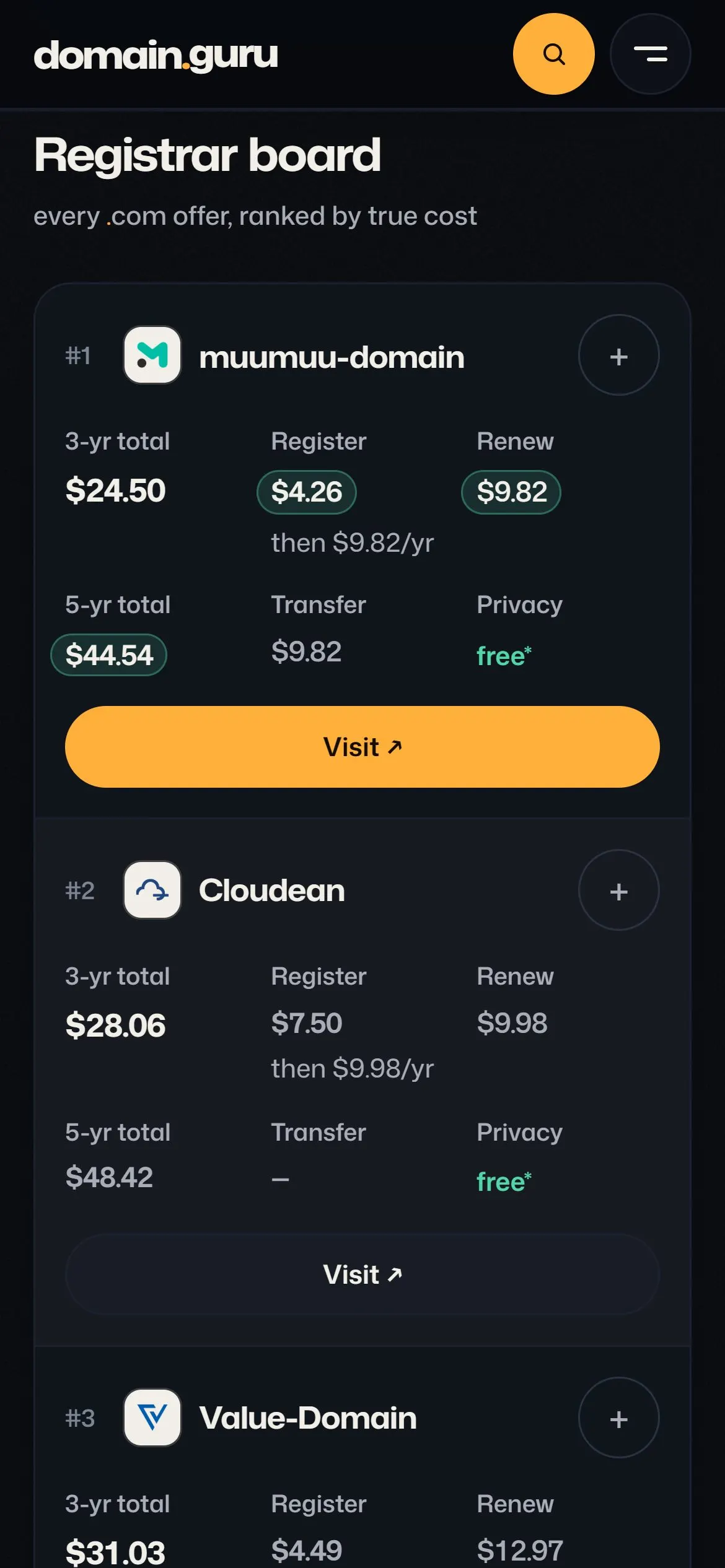
On a phone. The board becomes a stack of cards, one per registrar, each with its rank, three- and five-year totals, the three prices, the privacy policy and a single Visit button. The best figure in each column sits in a green pill.
Written for machines as well. Every hub page declares its twelve language versions and a default with hreflang. On 18 November 2026 the sitemap listed 4,567 URLs. That count includes the 3,055 extension pages, 406 registry profiles, 147 registrar pages, 190 head-to-heads and the twelve hubs in every language. The robots.txt file allows every crawler but closes two raw price files to them, and the Terms page reserves the normalised dataset: it is not licensed for bulk copying.
Outcomes
- 3,055extensions priced, each with its own page
- 147registrars compared, each with an honesty score
- 12interface languages
- 4,567URLs in the sitemap, 18 November 2026
- 0requests to domain.guru carrying the sample name
- 2registrars with sponsored links, labelled where they appear
Read and tested on the live site on 18 November 2026: the home page, Method, Privacy, Terms and Contact, the .com and Cloudflare pages, the sitemap, and the name search and bulk checker run with a sample name and the checker’s own example list.
This case study makes no claims about visitors, revenue or rankings in search engines. Domain.Guru does not publish them, and it runs no analytics that could produce them.
What it shows is a way to design a comparison when the market’s own numbers are built to mislead. Choose the number that matters and print it first. Date every figure and say when a source failed. Put the rules on a page anyone can read. Then label the money where it appears, so a reader can see for themselves whether it moved anything.
Explore the project
domain.guru
A price board for 3,055 domain extensions at 147 registrars that ranks every offer by what it costs to keep, not to buy.
Sources for this case study
- Domain.Guru — Home (the long price and the top 100 extensions)
- Domain.Guru — Method (how the numbers are compared)
- Domain.Guru — .com
- Domain.Guru — Cloudflare, priced and judged
- Domain.Guru — Registrars
- Domain.Guru — Name search
- Domain.Guru — Bulk portfolio checker
- Domain.Guru — Price-drop alerts
- Domain.Guru — Renewal Index
- Domain.Guru — Deals
- Domain.Guru — Privacy
- Domain.Guru — Terms (commercial disclosure)
- Domain.Guru — Contact
- Domain.Guru — Guide: domain transfers (bylined)
- Domain.Guru — Sitemap index
Everything described here can be checked on the live project. Figures were read on 21 Nov 2026; screenshots are captures of the public site.