One sky, nine plates
An atlas of the sky that computes any moment in the browser and draws it in four traditions — Western, Vedic, BaZi and Zi Wei — with every chart audited and no account.
Introduction
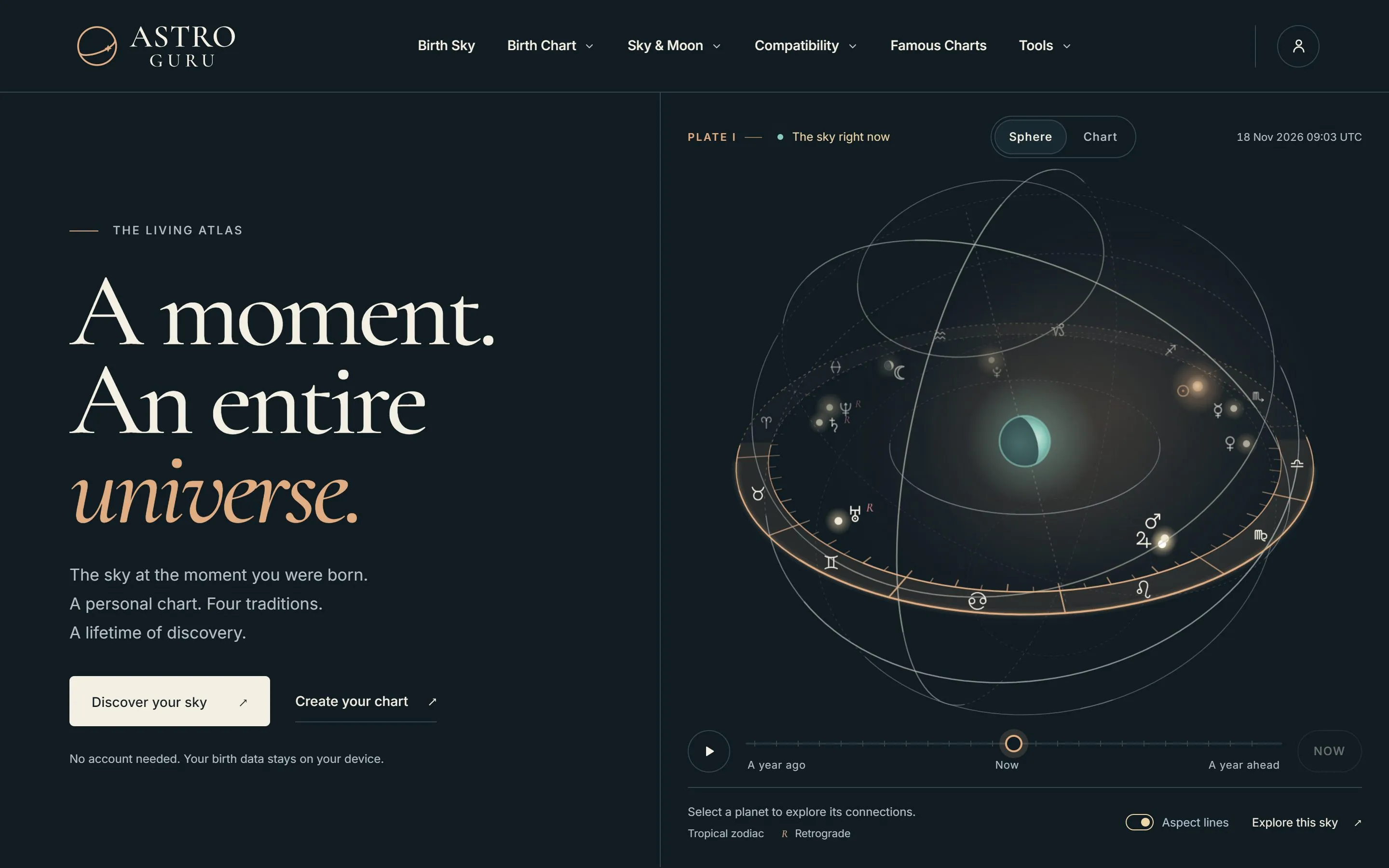
Astro.Guru calls itself “an atlas of the sky”. It computes where the Sun, the Moon and the planets stood at any moment — a birth, or this minute — and draws that one sky in the forms of four traditions: the Western zodiac, Vedic Jyotish, the Four Pillars of BaZi and the palaces of Zi Wei Dou Shu. Around it sit a live sky, a film of the sky of a birth, an archive of documented lives and a set of instruments for practitioners.
Every page ends with the same line: Drawn, written and computed in — a small Italian flag, labelled Italy — by Gabriele Masetti, FIG’s founder. The About page says it in words: an independent project, “designed, written and computed in Italy”, with no advertising and nothing for sale.
On 18 November 2026 its sitemap listed 1,585 URLs. The archive behind them held 1,556 charts of people, nations and events, and the reading library 38 notes on where the techniques come from.
This case study is about how a subject usually sold in sentences was turned into a set of drawings that show their working.
The challenge
An astrology site asks for the most personal data a stranger can hold. The privacy page opens on exactly that point: a birth date, time and place is “about the most personal thing you can give an astrology site”. The usual answer is an account, a form and a server.
The second difficulty is the material. Four traditions describe the same sky in four incompatible vocabularies — degrees and houses, sidereal lunar mansions, stems and branches, palaces counted from a lunar calendar. Each has schools that disagree, and the arithmetic behind a chart is normally invisible to the person reading it.
The third is tone. A reading can easily say more than its method allows: invent a birth hour, flatten a technique’s history, present a calendar convention as if it were astronomy.
The pages, read together, set the brief: compute the sky honestly, draw it beautifully, keep it on the reader’s device, and say at every step what was done.
The concept
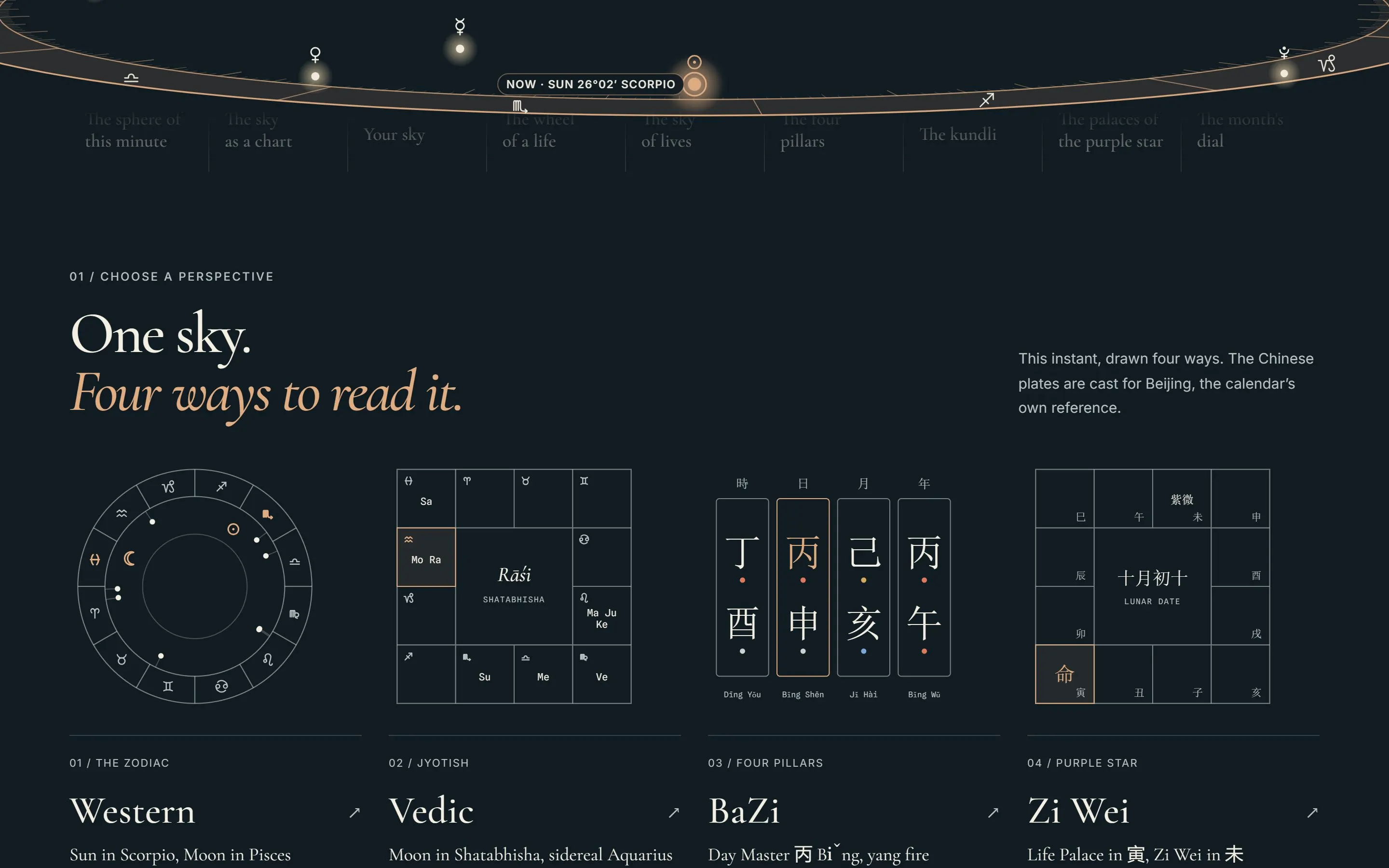
The site is organised as an atlas, and the idea runs through its whole vocabulary. The front page lists the contents — One sky, 9 plates — and every page that draws the sky is a numbered plate “framing the same computed instant another way”: the sphere of this minute, the sky as a chart, your sky, the wheel of a life, the sky of lives, the four pillars, the kundli, the palaces of the purple star and the month’s dial.
Three rules follow from the About page.
- Computed, not looked up. Positions come from an ephemeris, time zones from the IANA database, houses from their geometry, and every chart ends with an audit of what produced it.
- Unknown stays unknown. Without a birth time there is no Ascendant and no houses, so the chart leaves them out, and draws the Moon as the arc it crossed that day. The archive applies the same rule to public figures.
- Your charts stay with you. Everything computes in the browser; there is no account, no upload and no tracking of birth data.
A birth is a date, a time and a place.
The four traditions are not four products. The front page draws this instant four ways, side by side — a wheel, a South Indian chart, four pillars of characters, a square of twelve palaces — and notes that the Chinese plates are cast for Beijing, “the calendar’s own reference”.
The design
A night atlas. The ground is a deep blue-black, the ink a warm off-white, and one colour leads: the copper of the emblem — a circle crossed by a tilted ecliptic, with a four-pointed star on it. The stylesheet keeps a disciplined set of further colours, each with one meaning: harmonious, tense and neutral aspects; a red for retrograde motion; and a colour for each of the five Chinese elements, used only where an element is meant. A day theme exists for readers who choose it.
Three voices. Cormorant Garamond sets the headlines at display size, tightly tracked, with a single word turned to copper italic — universe., you, Four ways to read it. Inter carries the interface; Spline Sans Mono sets degrees, labels and plate numbers. The legal notice lists the rest of the type: Source Serif 4, Source Sans 3 and Noto Serif TC, a face for traditional Chinese, all under the SIL Open Font License.
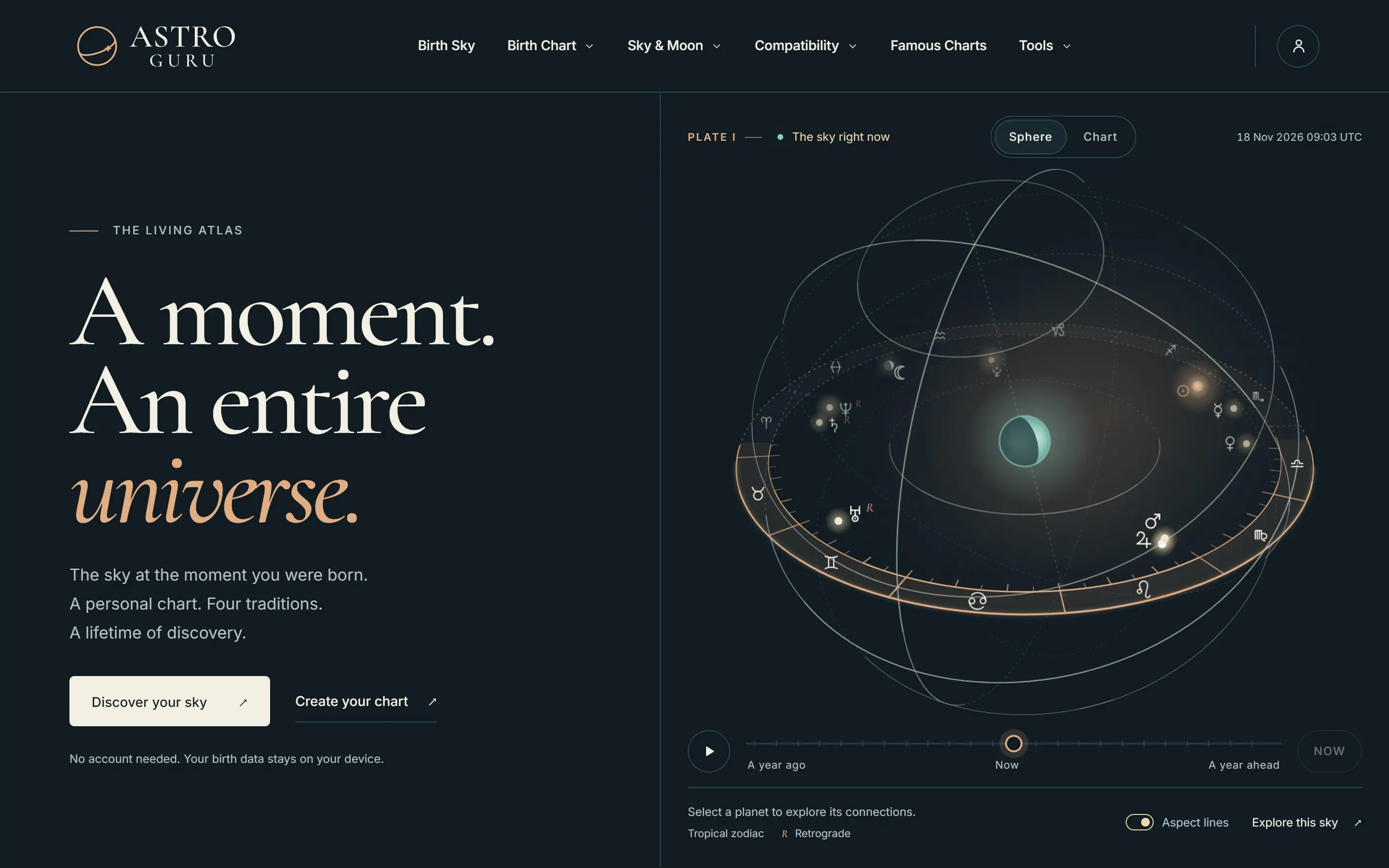
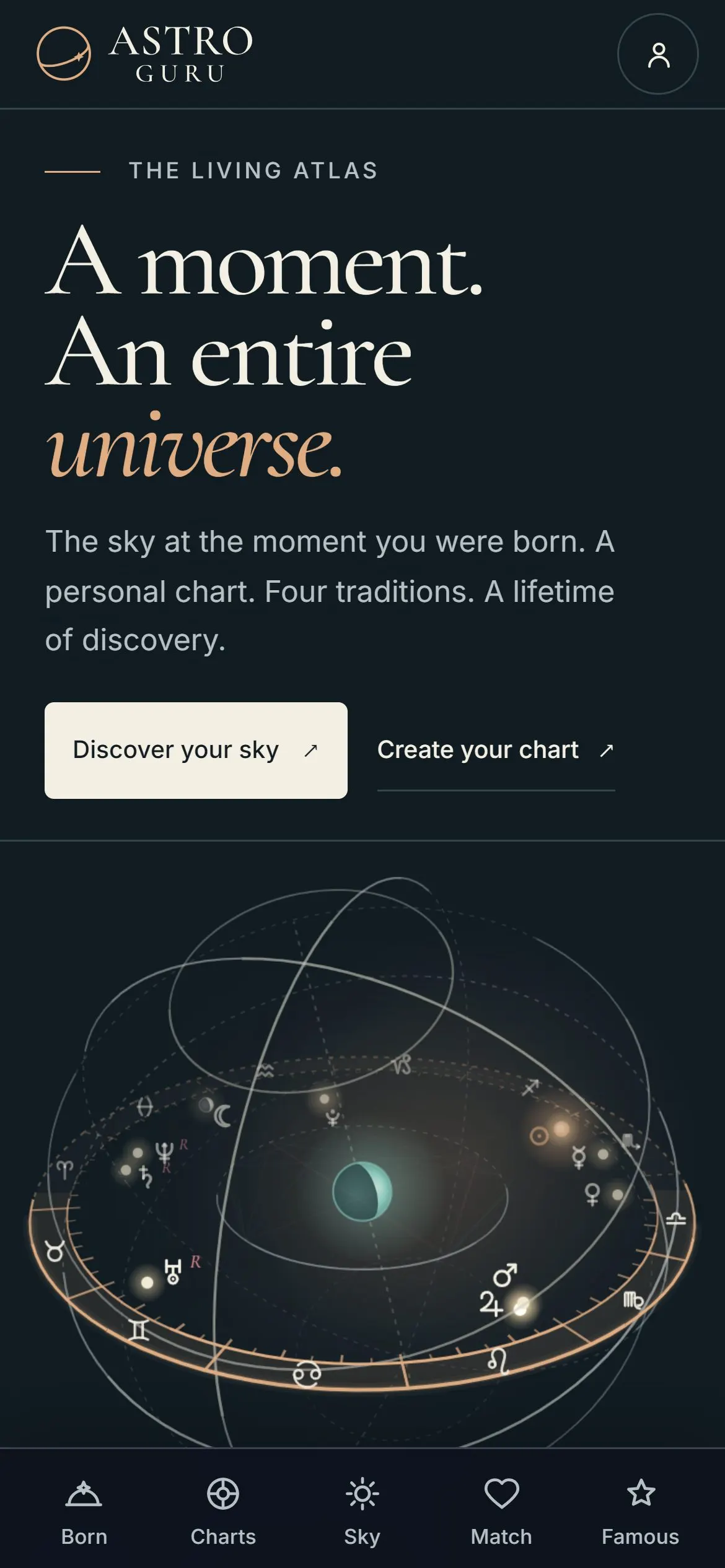
Plates, not widgets. Each drawing carries a mono label — Plate I — The sky right now, Plate IV — Natal chart — and most offer a second way to see the same data: Sphere or Chart, Wheel or Sky, Sphere, Over Rome or Chart. The front page’s sphere is translucent, the zodiac a copper ring round it, a lit globe at its centre; the time stamp in the corner is the minute it was computed.
A sky over your city. The second section draws every star an eye can see from the reader’s city at that minute, with the Milky Way, the Moon in its phase and the planets. The city is “guessed from this device’s time zone; nothing is sent anywhere”. A button turns the daylight back on, a slider moves through the hours, and the caption explains what the drawing is: the stars the Sun was hiding, “just where they were”.
The experience
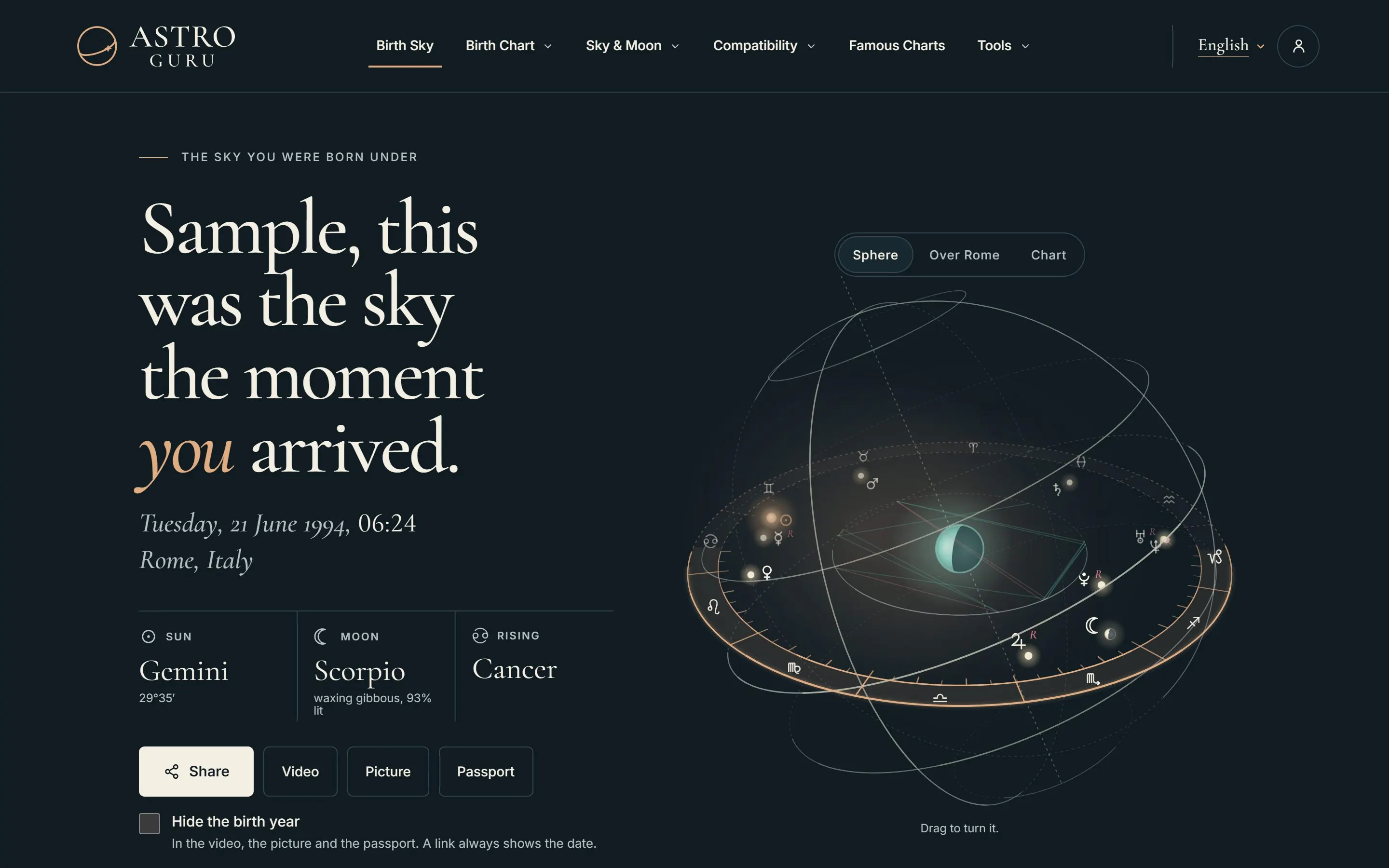
The sky you were born under. The front door for most visitors is a page of four questions — a first name, optional; a date; a place; a time, or I don’t know. Under the form: “Computed on this device. Nothing you type here is sent anywhere.” The town search runs on GeoNames places of a thousand people or more, searched in the browser.
For this study the questions were answered with the illustrative birth the site itself uses in its film: 21 June 1994, 06:24, Rome, under the name Sample. In that session every request went to astro.guru, and the only data files fetched were the atlas’s own lists of towns. The answers became the page’s own address — a link, the page notes, always shows the date — and nothing was written to the browser’s storage.
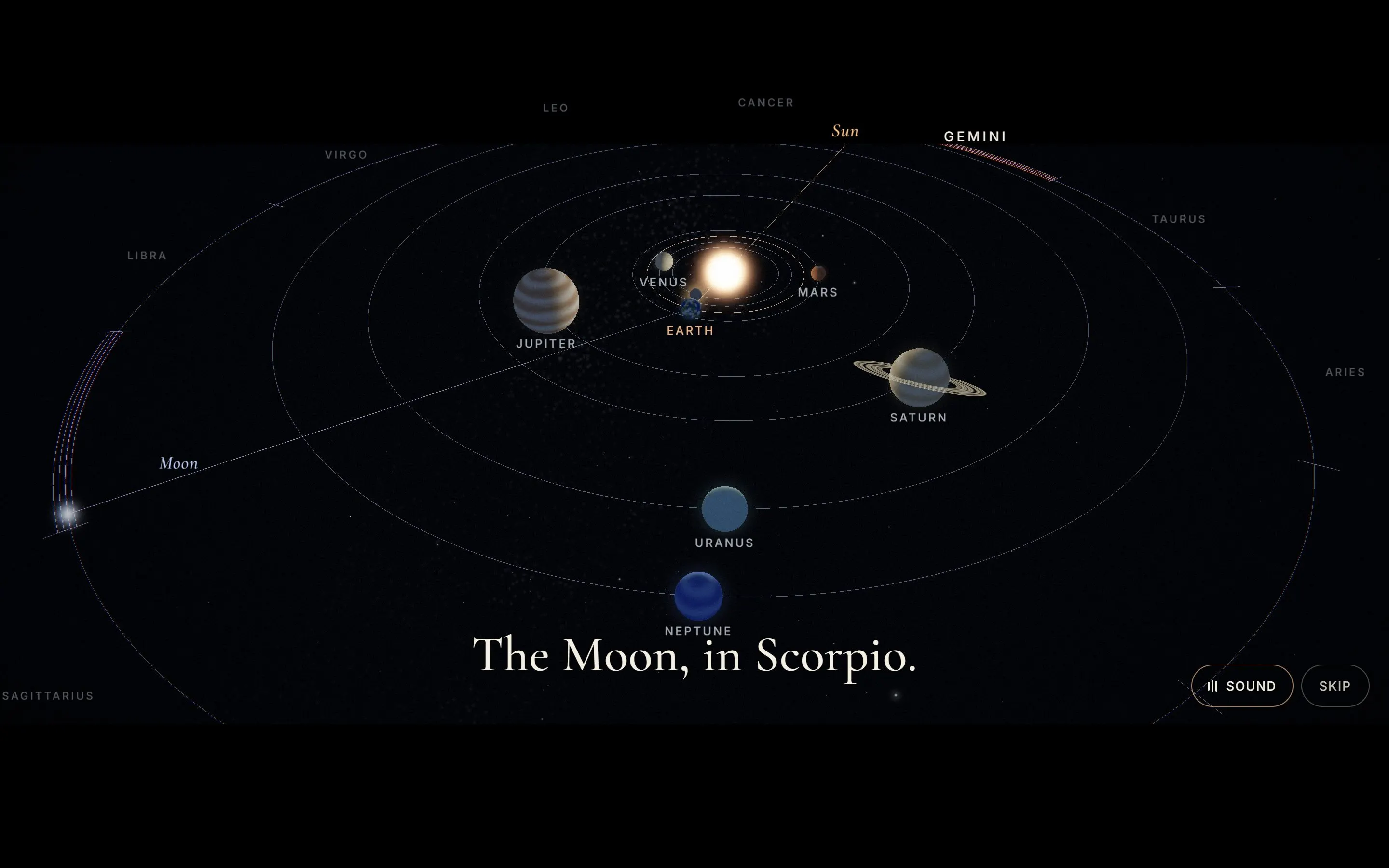
What follows is a film. It falls from the galaxies to one star, to the planets where they really were, to the Earth, the country in its outline and the city, with a title for each step.
The page that the film lands on opens with the three facts most people come for — Sun, Moon, rising sign — and with four things to make: a link, a video, a picture and a passport, with a box to hide the birth year in all but the link. Below, in numbered chapters, the birth is measured in the sky’s own units. A star whose light is as old as the reader: for the sample, Pollux, whose light “left it in February 1993”. Seconds alive and kilometres travelled round the Sun. Every full moon of a life, 401 of them, in a grid of years and decades in which the eclipses run as diagonals. Then lives in the archive born on the same day or under the same Sun, events of that date with their sources, and then and now — the world’s population, prices and the CO₂ at Mauna Loa, each figure credited.
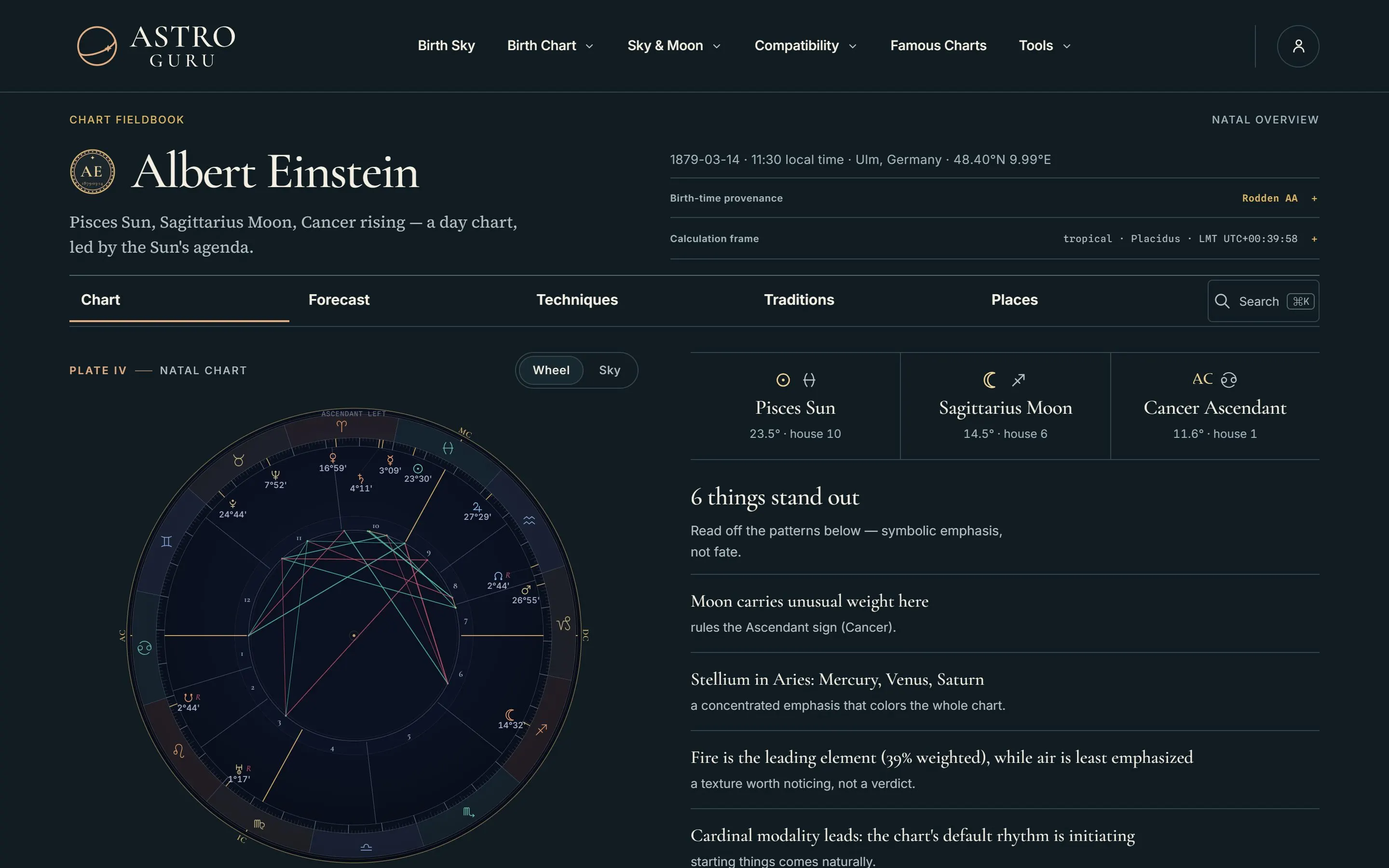
The chart as a fieldbook. A natal chart opens as a Chart fieldbook: name, date, place and coordinates, then the birth-time provenance and the calculation frame folded beneath. Tabs divide the work — Chart, Forecast, Techniques, Traditions, Places — with a search bound to ⌘K. The wheel sits beside a summary headed 6 things stand out, introduced as “symbolic emphasis, not fate”; each line has a qualifier of the same kind, such as “a texture worth noticing, not a verdict”.
Two people, three methods. The compatibility page compares two saved charts by synastry, the composite midpoint chart and the Davison chart, and asks the reader to weigh tight aspects over loose ones because “that ordering matters more than any keyword”. A documented pair is offered for anyone who has not saved two charts yet.
The system
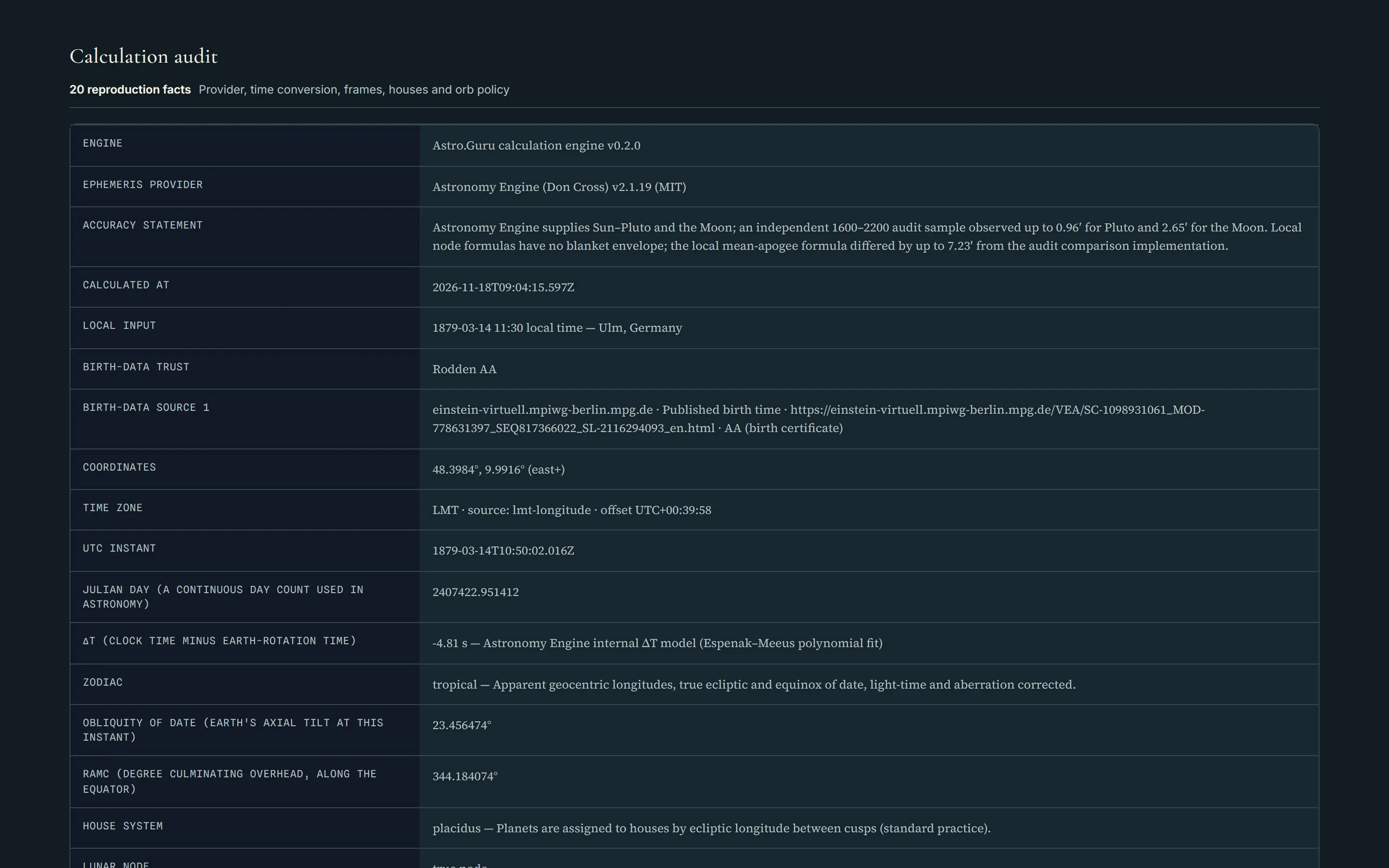
Everything is calculated in the browser. The front page, the archive and the charts are drawn by the same engine, which names itself in every audit: Astro.Guru calculation engine v0.2.0, with positions from Astronomy Engine by Don Cross, version 2.1.19, under the MIT licence.
The audit. At the foot of each chart, twenty “reproduction facts” set out how the chart could be recomputed: the local input and its source, the trust rating, coordinates, the time zone and where it came from, the UTC instant, the Julian day, ΔT and its model, the zodiac frame, the obliquity, the RAMC, the house system, the node, the lots and the orb table. The accuracy statement is specific — an independent audit sample from 1600 to 2200 “observed up to 0.96′ for Pluto and 2.65′ for the Moon” — and so are its limits. The calculation exports as JSON.
Settings that never rewrite the past. The settings page offers eight house systems, tropical or sidereal zodiac, a true or mean node, four orb profiles and optional techniques, and states its rule at the top: a saved chart keeps the settings it was computed with. Where a quadrant house system fails near the poles, the note on house division says the engine falls back to Porphyry, and says so on the chart.
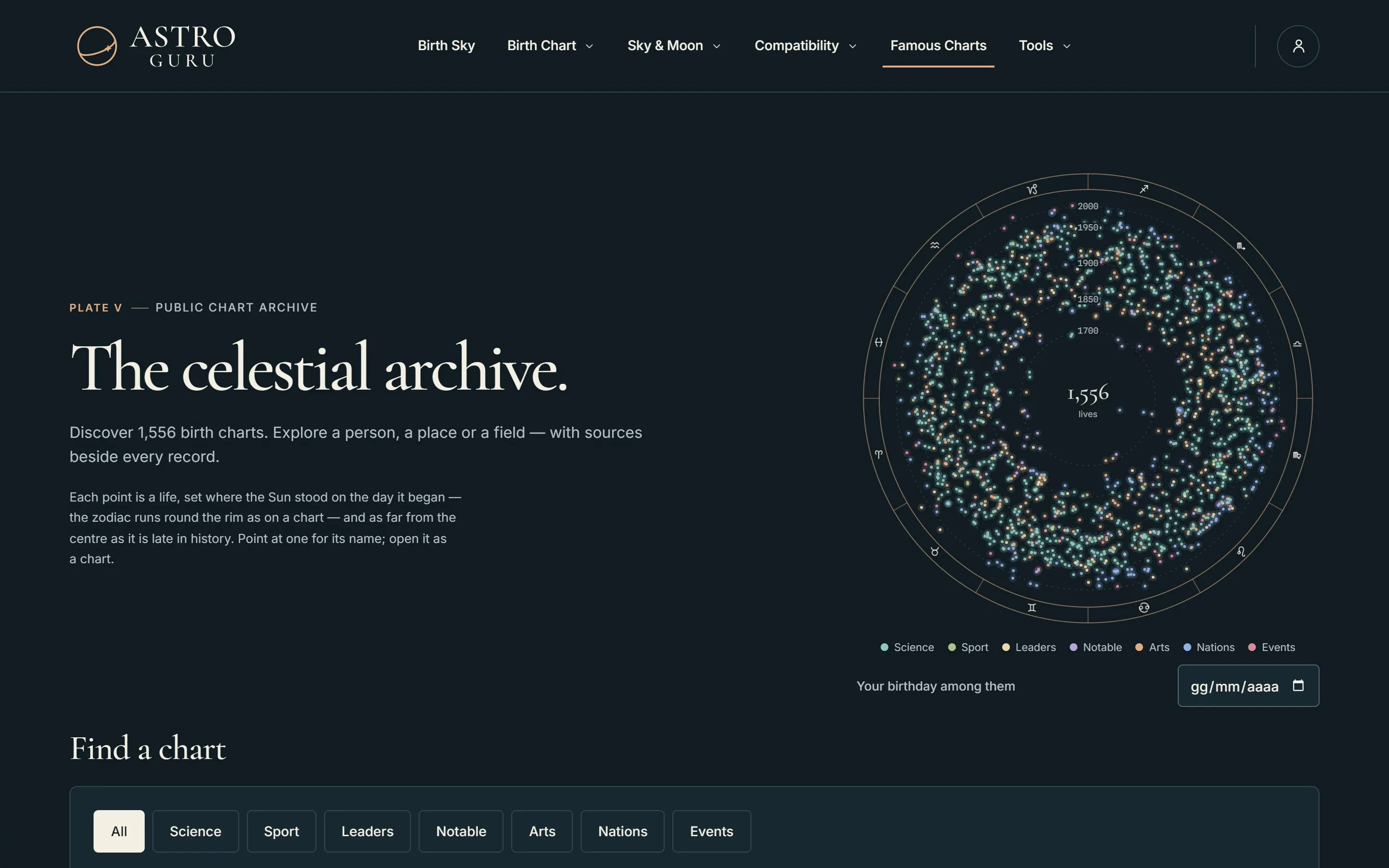
An archive with its evidence. The celestial archive draws its 1,556 records as one wheel: each life is a point set where the Sun stood on the day it began, and farther from the centre the later it is in history. Every record carries a Rodden rating and its source, and the archive can be filtered by evidence — 167 with a birth hour, 1,389 without, 53 from the Open Gauquelin Database by kind of document. Records without an hour say so in their own words: the chart “omits time-dependent angles and houses”.
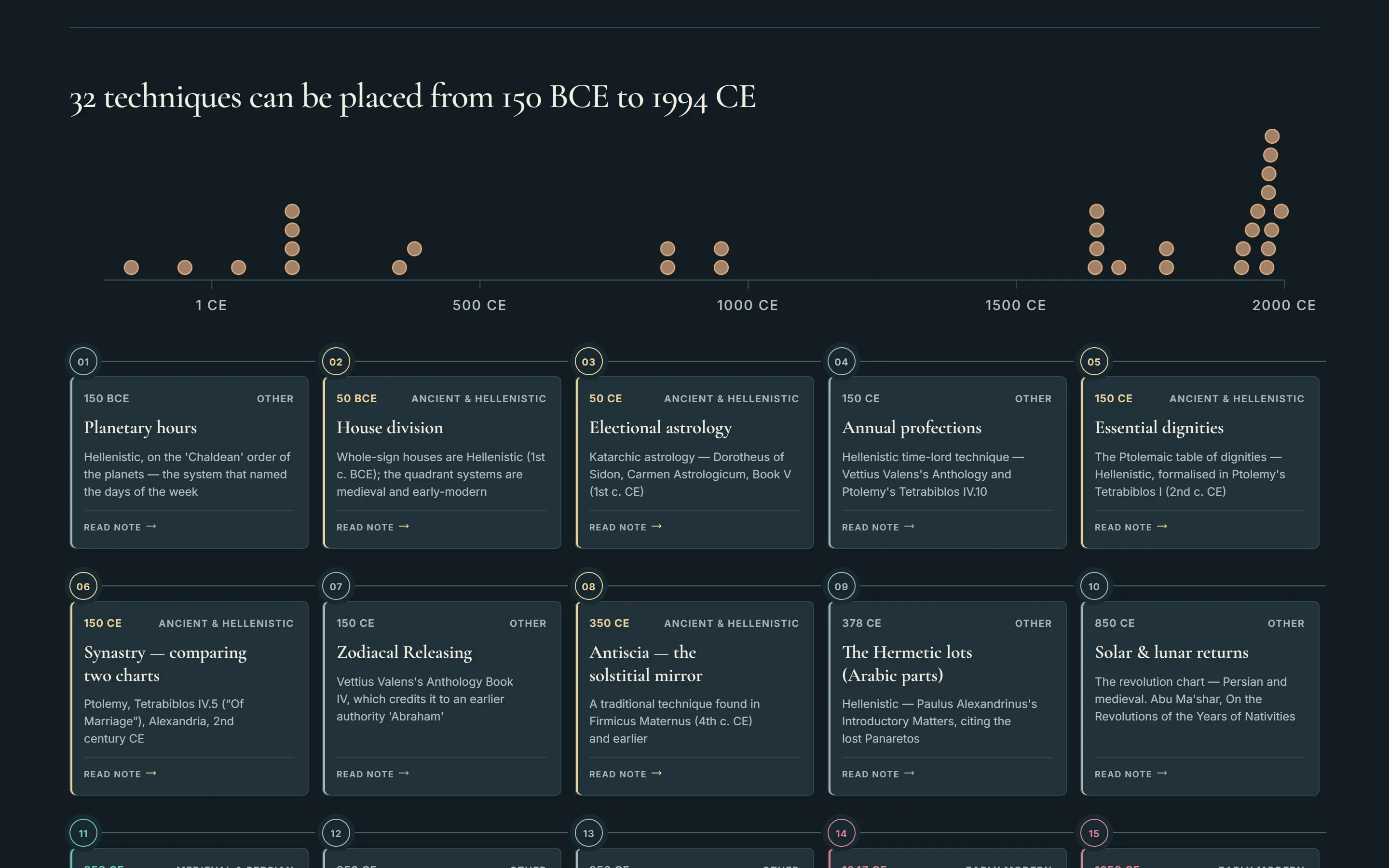
A library of methods. Where the methods begin holds 38 notes, one for each technique the engine computes. Thirty-two can be dated, from planetary hours around 150 BCE to out-of-bounds planets in 1994, and are drawn on one axis; the other six name a source without a single date and are listed only by era. Each note says who, when and what the argument is about, and “where this engine had to take a side, which side it took”. The same notes reappear under the tools that use them, as Method & provenance.
What is said, and how. The site’s readings are framed as symbolic throughout. The footer says interpretations are “symbolic and non-fatalistic” and that nothing is medical, legal or financial advice. The terms of use go further: the readings say what a tradition associates with a configuration, and “do not predict events”. The daily horoscope prints its method: every sentence is a fixed, hand-written fragment that traces to a computed fact about the day’s sky. The Zi Wei page tells the reader that none of its “stars” is an astronomical object.
Calendar mathematics wearing a sky’s name.
Private by construction. The cookies page lists every item the site keeps in the browser — twelve named keys and the cache of its own files — with what each holds and how long. A strict content-security policy tells the browser to load nothing that does not come from astro.guru. Charts can be taken away as a plain JSON backup or as a vault encrypted on the device with a passphrase. Account sync is announced but marked Coming soon, and the privacy page describes it before it exists.
Details
- The sign and the stars. The horoscope page separates the sign of Aries, a 30° slice counted from the equinox, from the constellation, and explains why a planet “in Aries” may be drawn among the stars next door.
- Names with their origin. The full moon nearest the sample birth is called the Strawberry Moon, with the note “a North American almanac name”.
- Instruments for the patient. The research lab root-finds exact aspects, stations and ingresses over a loaded span of ephemeris, and exports the results as JSON or as calendar entries.
- Calendar, not horoscope. The exact solar return and round-number days — a billion seconds, 15,000 days — can be added to the reader’s calendar.
- The maker’s mark. The flag in the footer credit is drawn in SVG and carries a label, Italy, for screen readers.
Outcomes
- 1,585URLs in the sitemap, 18 November 2026
- 1,556charts in the archive, each with its source
- 38techniques with a note on their origin
- 4traditions drawn from one calculation
- 20reproduction facts in every chart’s audit
- 0cookies set, by the site’s own account
Read on the live site on 18 November 2026: the sitemap, the archive, the reading library, the front page, a chart’s calculation audit and the Cookies & storage page.
Astro.Guru publishes no figures for visitors, and this case study claims none. It runs no analytics, so it would have none to give. Nor does this page make any claim for astrology: the site reports what each tradition associates with a configuration, says plainly that it predicts nothing, and so does this page.
What it demonstrates is a way to build on a subject that is usually told as a verdict. Compute the sky precisely, draw it the way each tradition draws it, show the arithmetic underneath, refuse to invent what is not known — and keep the most personal data a visitor owns on the visitor’s own device.
Explore the project
astro.guru
An atlas of the sky that computes any moment in the browser and draws it in four traditions — Western, Vedic, BaZi and Zi Wei — with every chart audited and no account.
Sources for this case study
- Astro.Guru — Home
- Astro.Guru — About the atlas
- Astro.Guru — The sky you were born under
- Astro.Guru — Birth chart
- Astro.Guru — Albert Einstein, chart fieldbook
- Astro.Guru — The celestial archive
- Astro.Guru — Where the methods begin (sources & traditions)
- Astro.Guru — The sky right now
- Astro.Guru — Today’s horoscope
- Astro.Guru — Kundli
- Astro.Guru — Zi Wei Dou Shu
- Astro.Guru — Research lab
- Astro.Guru — Settings
- Astro.Guru — Privacy
- Astro.Guru — Cookies & storage
- Astro.Guru — Legal notice (sources and licences)
- Astro.Guru — Sitemap
Everything described here can be checked on the live project. Figures were read on 21 Nov 2026; screenshots are captures of the public site.